
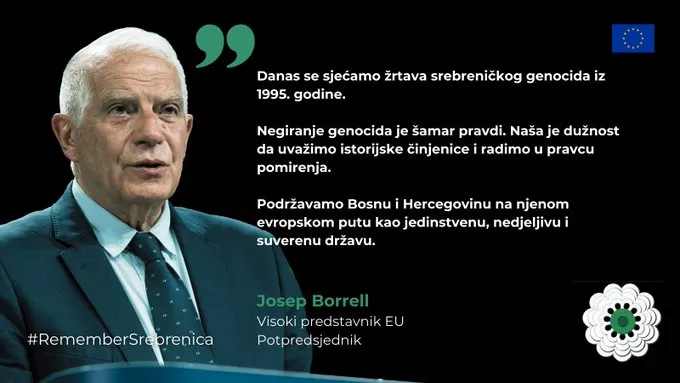
Column by the High Representative of the EU for Foreign Affairs and Security Policy and Vice-President of the European Commission Josep Borrell on the anniversary of the genocide in Srebrenica
In July 1995, one of the darkest chapters of modern European history was written. Over 8,300 boys and men were systematically killed and buried in mass graves in the hills around Srebrenica. Today, 29 years later, 14 of these victims, who were only recently identified, will find their final resting place in the Srebrenica-Potočari Memorial Center and Cemetery. For their families and loved ones, a long and painful period of uncertainty has finally come to an end.
Srebrenica remains a deep scar in Europe's history. The failure to prevent this genocide is a burden we continue to carry. Both the International Criminal Tribunal for the former Yugoslavia and the International Court of Justice have unequivocally established that this crime is genocide.
We promised never to forget – neither the victims, nor the lasting pain of their families and loved ones. Their memory compels us to work every day to ensure that history does not repeat itself, in a world where peace seems increasingly fragile.
With its decision to declare July 11th as the International Day of Reflection and Remembrance of the Genocide in Srebrenica in 1995, the United Nations General Assembly has further highlighted the significance of this tragedy beyond the European continent.
However, a worrying tendency of denial still persists in Bosnia and Herzegovina and the entire region. Any denial of genocide is a slap in the face of justice and an obstacle to reconciliation. The European Union's position is clear – there is no place for genocide denial, historical revisionism, or the glorification of war criminals in societies that value truth and justice.
Reconciliation is everyone's responsibility. Reconciliation is not an abstract goal; it must become a daily practice pervasive in politics, education, and every other sphere of everyday life. The role of political leaders in the region is, above all, to reject divisive rhetoric and actively promote reconciliation, which, in turn, requires respecting historical facts, showing respect for victims, and fostering a culture of peace and cooperation.
EU member state leaders decided in March to open accession negotiations with Bosnia and Herzegovina. The beginning of this path towards membership brings back hope for political stability, economic growth, and a better future for the citizens of BiH. It emphasizes the EU's commitment to supporting Bosnia and Herzegovina in establishing a functional democratic state and a society where pluralism, justice, and human dignity prevail.
We have shown that it is possible. Indeed, the EU itself was conceived to bring peace and reconciliation to the European continent, long divided by bloody fratricidal wars. This would not have been possible without accepting established historical facts and a commitment to building institutions that ensure lasting peace.
The genocide in Srebrenica is a painful reminder of what can happen when political elites unleash and promote hatred. It is our common duty to ensure that this memory serves as a powerful reminder of the consequences of such hatred and intolerance. It is our common duty to ensure that these atrocities never happen again. The European Union stands with Bosnia and Herzegovina in this endeavor.
Komentari (0)
Prijavite se za komentiranje
PrijavaJos nema komentara. Budite prvi!
Minuta
Sve →Iz drugih kategorija

High Representative Not Elected: Germans, French and British Sabotaged Americans, New Attempt at End of June

ČOVIĆ WITHOUT MERCY: How Those Who Brought Ademović to Office Created a Political Hell for Him



Sunny Saturday, quite warm



Tragedy in Albanian resort: Two minors drown












