
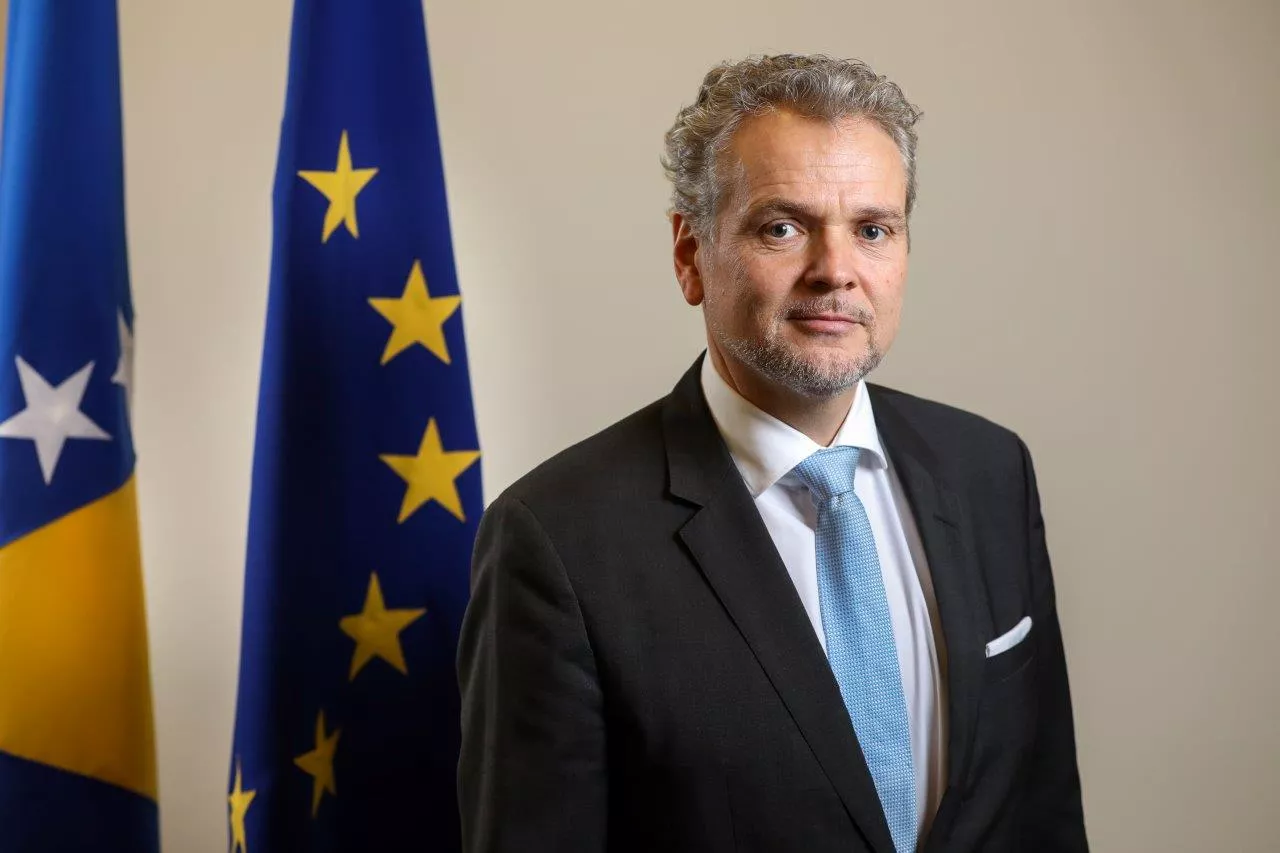
By Johann Sattler
When I took office as Head of the European Union Delegation to Bosnia and Herzegovina and EU Special Representative a year ago, I was well aware of the challenges facing this country and the region – as I had worked in or on the Western Balkans for over two decades. Yet, I believed that many difficulties could be overcome. A year later, I still hold the same conviction. Over the past year, despite the global pandemic, Bosnia and Herzegovina has made seemingly modest, yet significant strides.
Some will cynically say that many diplomats and experts who come to this country are satisfied with mere formalities, refusing to acknowledge that the political system is irreparably flawed, and that the prospect of European integration is nothing more than an illusion.
I argue the opposite. The European Union is committed to ensuring that BiH irrevocably moves forward on the path to EU membership. We are working diligently on this together with our partners in BiH – and not just political ones – to ensure concrete benefits for the citizens. The EU's commitment is reflected in millions of euros in aid annually. It is also reflected in our continuous support to the country through advice and assistance in achieving its political, economic, and structural priorities to make the necessary progress.
Yes, the political system is flawed, but it can be improved, as in any other country. We know very well that it is unlikely to be changed by those who benefit from the status quo, but even among them, there are those who are very dedicated and willing to work on changes. Citizens are very interested in changing the way problems that have profound consequences on their daily lives are currently being resolved.
And the European integration process itself is based on achieving change. This process requires strengthening and respecting the rule of law and placing citizens – not parties – at the center of political life.
We are accompanying BiH through these changes, working with engaged citizens, through the media, through institutions, and through activism inside and outside of political parties.
At the very beginning of my mandate in September 2019, more than ten months had passed since the elections in BiH were held, and the new Council of Ministers had not yet been appointed. There was general and completely understandable public skepticism regarding the parties' ability to agree on the distribution of ministries, let alone on the implementation of socio-economic reforms.
However, an agreement was reached in December on the appointment of the Council of Ministers, and the EU and other international partners immediately engaged to work with the new authorities.
In the same month, the Council of the EU welcomed the European Commission's Opinion on BiH's membership application, which outlined 14 key priorities on which the country needs to work to strengthen democracy and state functionality, improve the rule of law, respect and guarantee fundamental rights of citizens, and make public administration more efficient. Work on these key priorities must continue during the pandemic, as the progress achieved would simultaneously enable a more reliable response to COVID-19.
In April 2020, the BiH Presidency formally committed to implementing the reforms necessary to fulfill the 14 key priorities and presented an inclusive process to accelerate BiH's progress on its European integration path.
The results of that decision were immediately visible. In May 2020, Bosnia and Herzegovina was able to participate actively and constructively in the Zagreb Summit on the Western Balkans, thanks to crucial last-minute preparations.
By the end of June, the RS Government adopted the Strategic Framework for Public Administration Reform for BiH. The Strategic Framework is a necessary step towards more efficient public administration in BiH, which will be able to provide services to citizens in line with EU standards.
After numerous intensive rounds of negotiations, the BiH Election Law was amended in July, finally enabling the citizens of Mostar, after a long 12 years, to exercise their voting rights in the municipal elections, which were scheduled for December 2020. This was an important step towards fulfilling the first key priority from the Opinion related to free and democratic elections.
In the same month, we also witnessed long-awaited and crucial progress on another priority from the Opinion – the adoption of the Rules of Procedure of the Parliamentary Committee on Stabilization and Association, BiH's formal body for cooperation with the European Parliament.
It should be noted that most of the progress was achieved amidst the COVID-19 pandemic and was possible due to cooperation with the United States and other constructive international partners in the country, which prevented political actors from continuing the 'divide and conquer' game.
Meanwhile, the distribution of an EU aid package worth 80 million euros began to support Bosnia and Herzegovina in addressing the direct consequences of the pandemic and longer-term strategic challenges. The package includes 7 million euros for urgent medical needs of hospitals and healthcare institutions across the country and 73 million in aid to mitigate the economic impact and preserve jobs.
An additional 250 million euros is available through the EU's macro-financial assistance program. The lack of cooperation and coordination among the competent authorities in BiH has caused significant delays in negotiations regarding this aid program. Such delays only increase public concern regarding the capacity of the competent authorities to act effectively, especially in the midst of a pandemic.
But, as I emphasized, the EU does not cooperate only with politicians. Our partners are teachers in schools, activists, doctors, nurses, and other healthcare workers, entrepreneurs, shopkeepers, professionals, and all those who believe in the future of this country and are actively working to make that future better than its past.
Every day I meet people who are living proof that Bosnia and Herzegovina can achieve much more than what is suggested by the political situation, whether it is cultural worker Elma Hašimbegović, director of the Historical Museum in Sarajevo, which, with EU support, is currently hosting an exhibition on the theme of the country's rich European industrial heritage, and who manages to keep this museum active despite minimal public funding, or the legendary retired General Jovan Divjak, a tireless activist who engages young people in building a brighter future, or, indeed, a young artist like Rikardo Druškić, who collaborates with my team and young fellow artists in painting murals across the country in honor of solidarity and inclusion.
But the stories of the exceptional people of Bosnia and Herzegovina go far beyond media headlines. In fact, the more I get to know them, the more I am moved by the relentless strength and character of these people with whom I share the same European soil. The dignity of the struggle of Emsuda Mujagić, president of the Association “With Heart to Peace” in Prijedor, whose 48 family members were killed, and her dedication to raising awareness in the search for the remains of hundreds of civilian victims from Prijedor. The selfless sacrifice of Vanja and Kenan from “Team of Volunteers/Heroes of the Street” who joined forces with volunteers from Pomozi.ba in Sarajevo, Miroslav from “Mosaic of Friendship” in Banja Luka, Nina and her colleagues who run “Minores” in Mostar, and all those who offered a helping hand to their fellow citizens in the days following the outbreak of COVID-19. Last week I met Nurka, who takes care of her son and who, with tears and hope in her eyes, after 25 years, as an internally displaced person, finally moved into her new home in Kakanj, within the Regional Housing Program, whose main donor is the EU.
Because of them, I believe that the status quo can be changed, and for the better. I also believe that the immediate and long-term steps being taken to combat COVID-19 and its consequences, with the support of the EU, can further strengthen the progressive elements in BiH society.
However, I am still not satisfied with BiH's pace in the EU accession process. Much valuable time has been lost.
After the most incredible and challenging year for all of us, my conviction that there are more reasons for optimism than cynicism is even stronger, as is my commitment to redouble my efforts for the progress of this country and its citizens on the path to the EU.
Last year, if nothing else, showed that no global crisis can stand in the way of the European aspirations of the citizens of Bosnia and Herzegovina, as the partnership between the EU and people across the country has only deepened.
Now that Europe is embarking on a difficult path of recovery and as we jointly create a new vision for the future, the aspirations expressed by the citizens must be our guide.
Komentari (0)
Prijavite se za komentiranje
PrijavaJos nema komentara. Budite prvi!
Minuta
Sve →Iz drugih kategorija

High Representative Not Elected: Germans, French and British Sabotaged Americans, New Attempt at End of June

ČOVIĆ WITHOUT MERCY: How Those Who Brought Ademović to Office Created a Political Hell for Him



Sunny Saturday, quite warm



Tragedy in Albanian resort: Two minors drown












