
(Patria) - On the occasion of marking the Day of Sarajevo Canton 02-09.05.2025, the Assembly and Government of Sarajevo Canton are organizing wreath-laying ceremonies for three significant dates.
On the occasion of the 33rd anniversary of the Battle for the Defense of the Presidency of the Republic of Bosnia and Herzegovina, a wreath-laying ceremony will be held on Friday, 02.05.2025, at the following locations:
- 10:00 AM - Kovači Martyrs' Cemetery, commemorative address, paying tribute and laying wreaths at the Bosnian Martyr's grave and paying tribute and laying wreaths at the grave of the first President of the Republic of Bosnia and Herzegovina, Alija Izetbegović,
- 10:50 AM - Lav Cemetery, paying tribute and laying wreaths
- 11:00 AM - Stadion Martyrs' Cemetery, paying tribute and laying wreaths
- 11:30 AM - Central Memorial to the martyrs and fallen soldiers of Novi Grad (in front of the Novi Grad Municipality building), paying tribute and laying wreaths
- 12:15 PM - Vlakovo Cemetery, Veterans' Alley, paying tribute and laying wreaths
The Government of Sarajevo Canton has declared May 5 as a Day of Mourning in memory of the murdered children of Sarajevo. On that occasion, the Assembly and Government of Sarajevo Canton, together with the Association of Parents of Murdered Children of Besieged Sarajevo 1992-1995, are organizing a wreath-laying ceremony on Monday, 05.05.2025, at 10:00 AM at the Memorial to the Murdered Children of Besieged Sarajevo 1992-1995.
Battle for the Presidency
On that May 2, 1992, a key battle for the defense of Sarajevo took place at Skenderija, when units of the then Yugoslav People's Army (JNA) attempted to seize the building of the Presidency of the Republic of Bosnia and Herzegovina (RBiH).
The battle in which Sarajevo was defended, on May 2, 1992, better known as the Battle for the Presidency of the RBiH, was crucial for the defense of the capital city, as well as for the defense of the independence and integrity of the state of Bosnia and Herzegovina.
The tanks and armored personnel carriers of the then JNA were stopped by the efforts of the defenders gathered in the Territorial Defense of the RBiH and the MUP of the RBiH, at Skenderija, about a hundred meters from the Presidency building of the RBiH. The seizure of the Presidency building was prevented, but the siege of Sarajevo, in full view of the entire world, lasted more than 1,400 days, during which citizens were killed by mortar shells, sniper shots, anti-aircraft weapons, and were left without water, electricity, gas, and food, as confirmed by the verdicts of the Hague Tribunal.
On the same day, May 2, 1992, the JNA captured the then President of the Presidency of the RBiH, Alija Izetbegović, and a delegation at the Sarajevo Airport, who were returning from negotiations in Lisbon. They were then taken to Lukavica.
This event was a prelude to what would happen the next day, May 3, when the JNA began withdrawing units from the barracks in Bistrik. After negotiations, an exchange for Izetbegović was agreed upon.
On that May 2, 1992, television footage went around the world in which President Izetbegović, during a live broadcast, announced that he had been kidnapped and that he was not being allowed to come to the Presidency building of BiH.
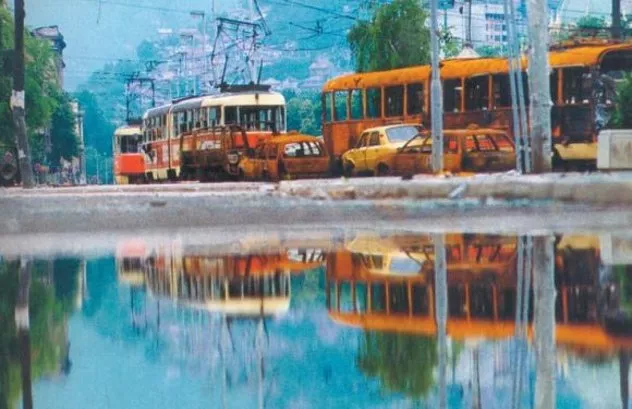
Photographs and footage of burning trams at Skenderija, in the center of Sarajevo, as well as a grenade explosion at the corner of Dalmatinska and Titova streets, across from the Central Bank of BiH building, also went around the world.
On the same day, the Main Post Office in Sarajevo was set on fire, putting 45,600 telephone connections out of service.
For one of the longest sieges in history and the terrorization of the population of the capital of Bosnia and Herzegovina, among others, the ICTY has finally sentenced former President of the Republika Srpska (RS) Radovan Karadžić, as well as the commander of the RS Army Ratko Mladić, and the former commander of the Sarajevo-Romanija Corps of the RS Army Stanislav Galić to life imprisonment, while Dragomir Milošević, who took command of the Sarajevo-Romanija Corps of the RS Army in 1994, was sentenced to 29 years.
At the Hague Tribunal, the former President of Serbia and the Federal Republic of Yugoslavia, Slobodan Milošević, was also charged for crimes committed in Sarajevo, but he died during the trial in March 2006, after which the proceedings were terminated.
Biljana Plavšić, former President of the RS, pleaded guilty to participation, among other things, in crimes in Sarajevo, after which she was sentenced to 11 years in prison.
Komentari (0)
Prijavite se za komentiranje
PrijavaJos nema komentara. Budite prvi!
Minuta
Sve →Iz drugih kategorija

High Representative Not Elected: Germans, French and British Sabotaged Americans, New Attempt at End of June

ČOVIĆ WITHOUT MERCY: How Those Who Brought Ademović to Office Created a Political Hell for Him



Sunny Saturday, quite warm



Tragedy in Albanian resort: Two minors drown












