
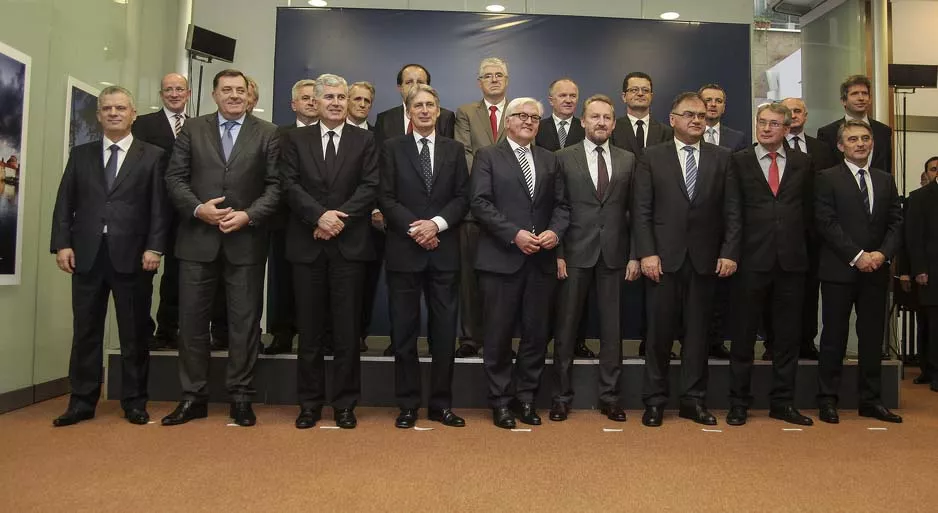
The International Institute for Middle Eastern and Balkan Studies (IFIMES) from Ljubljana, Slovenia, regularly analyzes events in the Middle East and the Balkans. IFIMES, due to the delay in the process of forming a government in Bosnia and Herzegovina (BiH) after the General Elections held on October 12, 2014, analyzes current events in that country.
The Patria News Agency fully conveys this extremely interesting analysis.
The delay in the process of forming a government in Bosnia and Herzegovina after the General Elections held on October 12, 2014, is primarily the result of obstruction by the Alliance of Independent Social Democrats - Milorad Dodik (SNSD) from Republika Srpska (RS) and the Alliance for a Better Future - Fahrudin Radončić (SBB) and the Social Democratic Party (SDP) from the Federation of Bosnia and Herzegovina (FBiH). While SNSD is feverishly trying to gain power at the state level, SBB, which has been excluded from post-election coalitions, is "hatching" plans to gain power and, through its media outlet "Avaz," is creating a negative political atmosphere in BiH daily, calling for citizen protests and "preparing" last year's February protest scenario.
It is quite clear that SNSD and SBB are currently acting together, which was publicly evident during the attempt to dismiss Šefik Džaferović (SDA) in the BiH Parliament, when deputies/representatives from the aforementioned parties jointly attempted to initiate Džaferović's dismissal. Furthermore, the activities of Mirsad Kebo, the outgoing Vice-President of the FBiH, are linked by analysts to attempts to obstruct and slow down the formation of a government between SDA–HDZ–DF–Alliance for Changes, or to form another parliamentary majority that would include SNSD, SBB, and even SDP.
INTELLIGENCE-DESIGNED ACTIVITIES
Analysts warn that the activities of FBiH Vice-President Mirsad Kebo are intelligence-designed, not only to slow down the establishment of government in BiH but also to make another attempt to link SDA, now through Šefik Džaferović, who was considered an example of a so-called honest politician, with war crimes and terrorism, thereby portraying SDA as a party of "dangerous intentions" and provoking a reaction from the international community, primarily the USA. Such a scenario has already been seen, and the arrest of FBiH President Živko Budimir (SPP) was intended as a prelude to simultaneously criminalize or potentially prosecute Bakir Izetbegović and Šefik Džaferović for alleged crimes of the mujahedin and war actions of the "Ševe" unit of the MUP BiH. Current global trends, especially after the attacks in Paris, favor precisely such individuals who appear in public "as needed and on demand."
Analysts assess that Mirsad Kebo is very sophisticated in intelligence activities, although he publicly denied any connection with intelligence services during his guest appearance on the TV show "Face TV." It was precisely Mirsad Kebo who conducted interviews in 1992, received and assigned experienced intelligence officers within the then civilian and military security-intelligence services of the Republic of BiH. Thus, on August 20, 1992, among other things, he assigned a Yugoslav civilian intelligence officer to the military security service, who later became the head of the Analytical Department at the General Staff of the Army of BiH and was directly involved in monitoring the activities of individuals from Afro-Asian (A-A) countries and the "El Mudžahid" detachment. Analysts warn that Kebo, by all accounts, was the person who knew about and directed actions related to individuals of A-A origin. There is also a series of evidence of Kebo's activities in the "Patriotic League," an organization formed in 1991, about which numerous witnesses have testified before international courts. Furthermore, Mirsad Kebo's activities can be linked to our previously published analyses.
The second reason for the slow formation of government is the fundamental political struggle between parties over key positions at the state level, and for parties and political organizations from the FBiH, at the federal level. Although there are no indications that the SDA-DF-HDZ-Alliance for Changes coalition might collapse, it is a very important fact that Dragan Čović (HDZ) would very much like to have Milorad Dodik (SNSD) and Fahrudin Radončić (SBB) as partners. Although most political analysts believe that the relationships between the three mentioned politicians are tied to a future reorganization of BiH, their connections are private, and it is precisely private relationships and connections that form the basis for their continuous pacts. Of course, one should not forget the continuous direct interference of neighboring countries in the events in BiH. Serbia's "swearing" of loyalty to Republika Srpska, as well as the announcements by the newly elected President of the Republic of Croatia, Kolinda Grabar Kitarović (HDZ), who, like Slobodan Milošević, hypocritically "supports every agreement of the peoples in BiH," while at the same time encouraging and supporting HDZ BiH in creating a third entity in BiH, require additional caution.
The fourth factor is the international community, which has designated Germany and Great Britain as the drivers of future changes in BiH. BiH needs changes that would ensure the economic recovery and prosperity of the country. Only a clear commitment of political elites to change and the establishment of not only professional but top experts in key positions can bring about the much-needed changes.
ECONOMIC DEVELOPMENT AND SECURITY ARE MOST IMPORTANT FOR BIH
If the international community truly desires fundamental changes, it must also have a clear and defined stance, especially the representatives of states in diplomatic missions in BiH and the Peace Implementation Council (PIC). It is expected that this time there will be no "concessions" for the obstructers of change in BiH. Generally speaking, the political elites on all three sides in BiH do not welcome the "interference" of the international community in this very firm and clear manner. Only pressure from the international community can show who truly desires progress and improvement, and who is the real obstructer of positive processes in BiH. The international community must be very subtle and should provide absolute support to those forming the government, while in return demanding respect for and fulfillment of undertaken obligations. Economy and security are the most important issues for BiH in the next four years. Only the best experts in governments and intelligence-security agencies can help the German and British initiative to be successfully implemented in BiH. It is not an encouraging fact that the leading parties in BiH have proposed individuals with modest capabilities and insufficient experience to lead the Council of Ministers, as well as the FBiH Government and the Government of Republika Srpska, in order to successfully move BiH towards NATO membership and EU integration. Only economic progress and a stable security situation in the country can ensure and accelerate the much-needed path towards EU and NATO membership.
YEAR OF PARTY CONGRESSES
Internal party realignments, power struggles, and maneuvering in the upcoming period may play a key role in the establishment and efficiency of the future government and the future economic recovery of BiH. In 2015, four electoral assemblies/congresses of the strongest political parties in BiH are expected, where presidents and new leaderships of the parties will be elected. Two assemblies are planned for April 2015: the electoral assembly of HDZ BiH and the SNSD assembly, where the presidents and leaderships of these parties will be elected. Dragan Čović is the absolute master of the situation in HDZ and will be re-elected, while Milorad Dodik will face fierce competition from his former associates and will likely not succeed in renewing his mandate as SNSD president. Bakir Izetbegović expects the position of SDA president at the (likely) May congress, although there are indications that some high-ranking representatives of the strongest countries will interfere in the election of the SDA president. The SDP congress is planned for the end of 2015, and Nermin Nikšić, if he wishes to revive the SDP, will have to work on reaffirming the idea of social democracy and try to unite the divided idea of social democracy in BiH. However, the focus is on the elections in SNSD and SDA.
DESTRUCTIVENESS OF PARTY PERSONNEL POLICY
The foundation of any good and successful policy is personnel policy. In BiH, as well as in the region, personnel policy is tied to mutual interests. Personnel policy is actually a policy of negative personnel selection, i.e., rewarding loyal and faithful party cadres who are generally unskilled and incapable. The best example is the proposed party cadres to lead the Government of RS and the Government of FBiH, as well as the BiH Council of Ministers. The proposed cadres lack the potential to successfully implement the German-British initiative for the economic recovery of BiH and establish a high level of security. Such personnel combinations represent yet another lost opportunity for BiH and all its citizens. The current and previous personnel policies have not been aimed at the betterment of society, people, or the state, but have been reduced to personal and party interests. Unfortunately, the upcoming political assemblies/congresses largely position most of the personnel solutions in new governments to ensure party support and financial backing in the upcoming internal party elections.
STRENGTHENING OF RUSSIAN INFLUENCE IN BIH
BiH has its last chance to improve its long-standing weak economic situation and, in recent years, its seriously deteriorated security situation. Any defeat for BiH is a defeat for everyone in BiH. Obstruction or non-implementation of reforms will boomerang back to all political actors in BiH.
Serb representatives in the BiH government are under the shadow of connections with Vladimir Putin and Russia, which has become a disruptive factor in the world. If the "West" managed to economically shake Russia in a matter of weeks, there is no need to doubt what will happen to any Serb representative in the BiH or RS government if they obstruct the current German-British initiative for BiH.
Similarly, but in a diametrically opposite way, standards apply to Bosniak political representatives. Any obstruction of the country's economic recovery, corruption, and/or crime will not be tolerated, and at the same time, the focus will be on the relationship with events in the Middle East and security challenges related to events in Syria and Iraq.
Croat political representatives in BiH have secured a more favorable position with the victory of Dragan Čović and HDZ than they had in the last eight years. The victory of Kolinda Grabar Kitarović in the Republic of Croatia could be a "millstone around the neck" for HDZ BiH and especially Dragan Čović in certain upcoming political maneuvers in BiH.
The message from the international community to Bosnian-Herzegovinian politicians is very clear: "Commit to changes effectively, and you can have our support." If the German-British initiative is not realized, BiH faces a difficult and uncertain period, not only economically.
Komentari (0)
Prijavite se za komentiranje
PrijavaJos nema komentara. Budite prvi!
Minuta
Sve →Iz drugih kategorija

High Representative Not Elected: Germans, French and British Sabotaged Americans, New Attempt at End of June

ČOVIĆ WITHOUT MERCY: How Those Who Brought Ademović to Office Created a Political Hell for Him



Sunny Saturday, quite warm



Tragedy in Albanian resort: Two minors drown












