
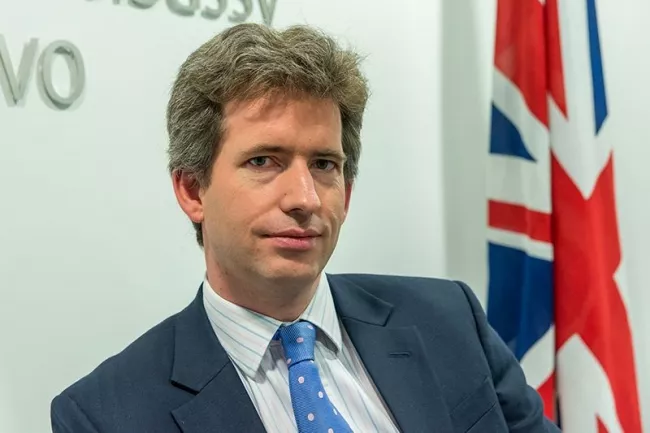
British Ambassador to BiH Edward Ferguson today published another blog about BiH titled "Jobs, more jobs and only jobs", which is reproduced in full by the BiH news agency Patria.
- When Peter Sorensen was asked at his farewell press conference, in his capacity as EU Special Representative, what the priorities for the future should be, his answer was simple: “Jobs, more jobs and only jobs.” It is hard to disagree with that. Unemployment in Bosnia and Herzegovina is the highest in Europe at around 30% youth unemployment, and according to the International Labour Organisation, the highest in the world at 59%. Job creation was the main topic of the recent elections and President Bakir Izetbegović set a goal of creating 100,000 jobs during his term. Where to start?
I recently visited a local company, Posao.ba. The company was founded during the siege of Sarajevo when its inspiring CEO Edin Mehić gained access to a number of donated computers. Today, Edin has expanded his business to the point where it largely dominates the online recruitment process, with a market share of 97%, and has ambitious plans to expand into other parts of Europe. He directly employs 80 people, and is also passionate about teaching others to gain the skills and confidence needed to succeed.
Edin Mehić represents what Bosnia and Herzegovina could become if its leaders empowered the country's greatest strength – its citizens. As a country, you have a large number of brilliant and talented people, but too often they have to go abroad to get opportunities they do not have here. If the newly elected leaders are serious about creating jobs, they must stop the brain drain and start working hard to transform this country into one with a modern and dynamic economy.
I must say it is depressing to hear politicians, trade union representatives or ordinary citizens constantly talk about the need to attract investment from large companies. Of course, Bosnia and Herzegovina needs to work on attracting foreign investment whenever the opportunity arises. But the era of car factories is over and will not return. Nostalgia for the industrial past is not a strategy for the future. For this country to succeed, and I passionately believe it can, it must do so through innovation and entrepreneurship. And by creating conditions in which small and medium-sized enterprises can start up, succeed and grow.
I know this is not a popular statement and people do not want to hear it. Politicians, as well as workers, want the return of heavy industry that will employ thousands of people. That is understandable. The scale of the unemployment problem is measured in hundreds of thousands of unemployed, and big business would enrich the corrupt. But the global economy has moved on. Look at what is happening in Russia due to the lack of modernisation and changes in the economy. The most successful economies are those that change quickly, that are flexible and creative. One of those is the British economy.
Britain's economic recovery has been built on job creation in the private sector, while reducing the cost of government. From a civil servant's perspective, I can tell you that process was not easy, but citizens in the United Kingdom understood that tough times require tough measures. That is why Britain today is one of the fastest-growing economies in Europe, with an unemployment rate of just 6%.
How did we achieve this? Among other things, through systematic reforms to improve the business environment, attract foreign investment and support new companies. We simplified procedures for starting new companies and reduced taxes on employment. We invested in infrastructure and innovation – such as investing in 4G wi-fi networks to support hi-tech industries. Reforms of this type and investment are the reasons why the United Kingdom is the leading European destination for foreign direct investment and why more foreign companies have their European headquarters in the United Kingdom than in France and Germany combined.
Yes, of course, Britain is a different country, with a different economy from Bosnia and Herzegovina. But you have advantages that we do not, especially in terms of a well-educated and relatively cheap workforce. With reduced bureaucracy, lower taxes and less corruption, and with a clear strategy for attracting small and medium-sized investors, I believe there would be a dramatic increase in investment from international companies, and a greater number of local entrepreneurs like Edin Mehić would emerge.
The good news is that we already know what needs to be done. The EU-led Agreement on Growth and Employment in BiH provides a roadmap towards a more stable economy that would be in a better position to create new jobs and attract foreign investors. We have placed socio-economic reforms at the heart of the new EU strategy, because without economic stability, there can be no political stability.
The challenge is cultural and requires a change in mindset. Research conducted by Posao.ba shows that most people in this country still want to work for the government. The legacy of disastrous privatisations of many state-owned industries has created aversion and distrust towards the private sector. Those who want to work in business often try to go abroad and work there. This must change. This country's bureaucracy already takes about 60% of GDP just for its own maintenance, and that is a huge burden on the economy. The private sector is what creates value. The private sector is what will enable Bosnia and Herzegovina to repay its debts, rather than taking on more debt.
I do not mean to say that economic reforms will be easy. They will not. According to World Bank data, Bosnia and Herzegovina is one of the most difficult countries in Europe to do business in, and one of the worst in the world when it comes to encouraging entrepreneurship. The problems are deeply rooted. Serious structural reforms are needed that require strong leadership from your new government. Of course, the work of previous governments is not encouraging, but the new EU strategy provides the best possible framework for encouraging and supporting such reforms. It is time to take the first step towards a new and brighter future for Bosnia and Herzegovina as a modern and vibrant economy that offers real opportunities to its citizens.
Komentari (0)
Prijavite se za komentiranje
PrijavaJos nema komentara. Budite prvi!
Minuta
Sve →Iz drugih kategorija

High Representative Not Elected: Germans, French and British Sabotaged Americans, New Attempt at End of June

ČOVIĆ WITHOUT MERCY: How Those Who Brought Ademović to Office Created a Political Hell for Him



Sunny Saturday, quite warm



Tragedy in Albanian resort: Two minors drown












