
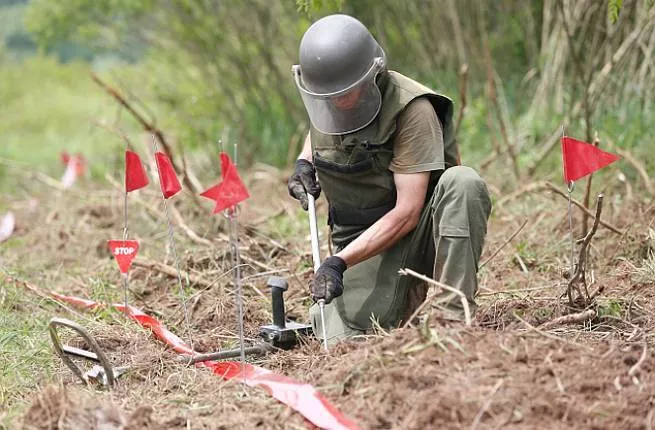
On the occasion of marking April 4, the International Day of Mine Awareness and the entry into force of the Convention on the Prohibition of Anti-Personnel Mines on March 1, 1999, the Mine Action Centre in BiH (BHMAC) once again draws attention to the long-term problem of mine contamination in our country, and points to the need to intensify the search for additional funds for its resolution, it was announced by BHMAC, as reported by the Bosnian news agency Patria.
The general assessment of the mine situation in BiH conducted in 2012 identified 1,417 threatened communities under the influence of mines/UXO.
Locations contaminated with mines/UXO directly affect the safety of about 540,000 citizens, or about 15% of the total population of BiH.
A new General Assessment of the mine situation in BiH will be carried out by the end of 2015, within the II revision of the Mine Action Strategy, which should indicate the new factual situation and provide indicators for future activities in this area, BHMAC states.
The current size of the mine-suspected area is 1,176.5 km2, or 2.3% of the total area of BiH. A further 9,185 mine-suspected micro-locations have been defined, where it is estimated that about 120,000 mines/UXO remain.
Currently, BHMAC has 4,500 projects for mine action operations awaiting implementation.
The most contaminated areas in the Federation are the Central Bosnia Canton, Una-Sana Canton, Zenica-Doboj Canton and Herzegovina-Neretva Canton, i.e., the areas of Maglaj, Kladuša, Posavina, and Tuzla. In the RS, the most contaminated area is the Doboj region, the areas of Brod, Šamac and Lopare.
Since the beginning of mine action in BiH in 1996, when the suspected area was 4,500 km2, combined methods of mine action (non-technical and technical methods) have so far freed an area of 3,324 km2, of which 169 km2 has been cleared.
59,789 anti-personnel mines, 8,252 anti-tank mines and 54,270 UXO have been found.
In the period 2009 - 2013, an average of 45 million KM per year was allocated for mine action in BiH. Of that, an average of 25 million KM was provided from donor funds, and 20 million KM from all domestic sources. Unfortunately, this is only about 50% of the plan, which is the main reason for the slowness of the process.
We remind you that Bosnia and Herzegovina, as a signatory country to the Convention on the Prohibition of Anti-Personnel Mines/Ottawa Convention, at the third Review Conference held last year in Maputo, committed to increase budget allocations in order to fulfill the remaining obligations in implementing mine action, because the prerequisite for achieving the goals set by the Mine Action Strategy is for local authorities to assume greater or full responsibility for this area.
We remind you that since 1996, mines hidden in the ground have been taking lives, and to date, 1,732 people have been affected by these devices, of which 603 have died.
Statistics have shown that most accidents occur at the beginning of spring, BHMAC states, as reported by NAP.
Komentari (0)
Prijavite se za komentiranje
PrijavaJos nema komentara. Budite prvi!
Minuta
Sve →Iz drugih kategorija

High Representative Not Elected: Germans, French and British Sabotaged Americans, New Attempt at End of June

ČOVIĆ WITHOUT MERCY: How Those Who Brought Ademović to Office Created a Political Hell for Him



Sunny Saturday, quite warm



Tragedy in Albanian resort: Two minors drown












