
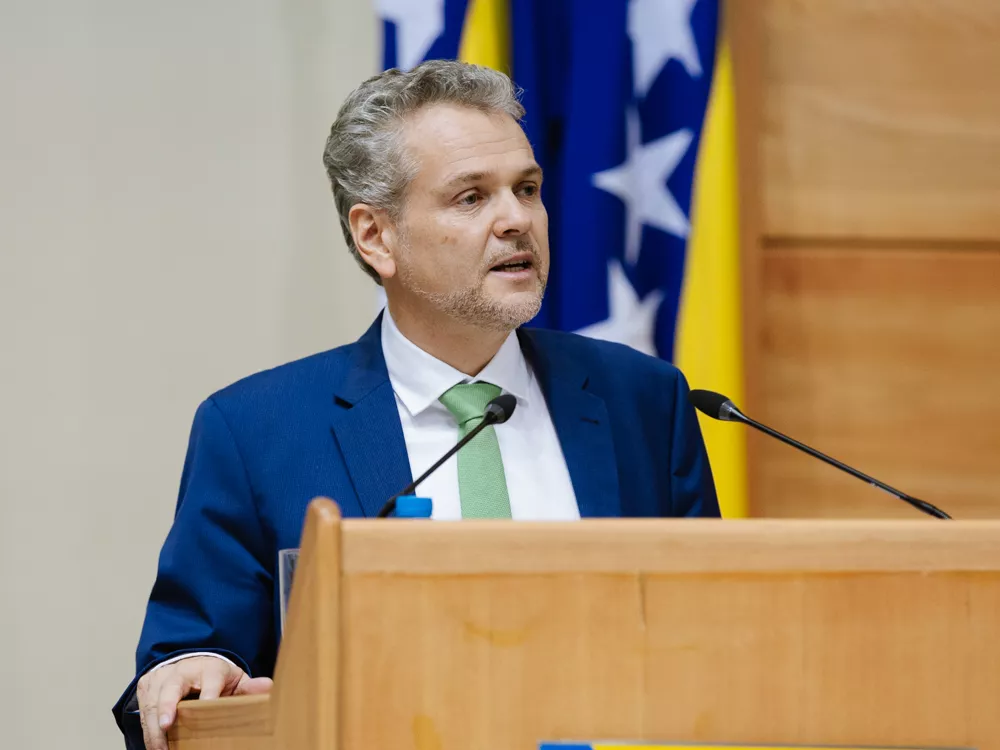
“Good morning, Sarajevo,” I posted enthusiastically on Twitter, enjoying the beautiful Saturday morning. Fresh air and sunshine. Sarajevo in full resolution.
“Ambassador, it is not good at all. Citizens are scared; I feel it in the air,” a Twitter user replied.
Although Bosnia and Herzegovina has come a long way from war to peace, this is not the first time I have heard such concerns.
This country has enormous potential, and what it lacks is serious and comprehensive political commitment to solving the everyday problems of its citizens. Just like the citizens of EU member states, people here want to enjoy the opportunities offered by good jobs, quality education and healthcare, good pensions, and a functional rule of law system.
In search of these basic things, too many people have already left Bosnia and Herzegovina. Too many are considering leaving. They are motivated not only by the lack of employment opportunities but perhaps even more by the constant economic and political insecurity that makes life difficult. Governance deficits have outweighed opportunities in people's awareness and lives. Domestic politicians cannot afford to ignore the fact that the population of BiH is rapidly declining.
It doesn't have to be this way!
A couple of weeks ago, I hosted a joint meeting in Bijeljina with representatives of the Council of Ministers of BiH and the entity governments. Several ambassadors and colleagues from international financial institutions joined us to help domestic representatives lead socio-economic reforms in BiH.
These activities come at a time when the European Commission has proposed a new enlargement methodology with a strong focus on the economy, along with plans to increase funding for those countries that achieve progress and improve the quality of life of their citizens along the way.
The domestic authorities of BiH have committed to improving the implementation of socio-economic reforms, while the EU and other international institutions have committed to supporting this process. A list of activities in the areas of economic governance, education, energy, environment, and other areas has been agreed upon.
My excitement about such a positive outcome was short-lived. As we discussed reforms and the future, another political crisis in a series of crises erupted in the country. In light of these developments, the overall tone of our discussions was, as expected, much gloomier.
I couldn't help but wonder:
Will the reforms be postponed again?
Whenever I talk about reforms in this country, I keep in mind the conditions in which citizens live. Things must change. And quickly. Time is measured in months, not years.
There are numerous priorities, but the list of initial 66 short-term priorities arising from the European Commission's Opinion is a good starting point.
Each of these priorities is feasible. They are expected to have a positive impact on the lives of ordinary people across Bosnia and Herzegovina who have little or no power or privilege, as well as on businesses that are the drivers of the economy in this country.
For example, one of the priorities states: “introduce a uniform minimum rate of parental benefits throughout the country, starting with harmonizing the definitions of parental leave for both parents.” No woman in this country should ever have to choose between employment and pregnancy for fear of not being able to earn to care for her family. No man should be prevented from taking parental leave to care for his child.
We also discussed improving the management of public enterprises, which is essential for potential growth and to stop the practice of further burdening the already limited financial resources of governments. Restructuring these companies and introducing open competition with the private sector would result in lower prices and better quality services provided to citizens. Sarajevo International Airport is one such example; BiH citizens expect more connections, better service, and more competitive ticket prices.
It sounds like I am stating the obvious, but these 66 measures, combined with the socio-economic reforms adopted by the entity governments last year and approved by the Council of Ministers in January 2020, represent a list of things that clearly need to be addressed urgently. No one here is reinventing the wheel. What is needed now is the willingness to translate commitments into concrete action.
Why should the citizens of BiH have to wait?
After the meeting in Bijeljina, I had an interview for BN TV.
“Do you think BiH will need 100 years to join the EU?” the journalist asked me seriously, expressing a frustration that many might share with her.
No, I really don't think so.
This country is not a black hole in Europe. It is not a lost cause. People may be tired of hearing about all the necessary reforms or feel overwhelmed by so many problems. Yes, there are many, but there are also many solutions.
The EU accession process involves transforming society so that it becomes stable, just, and safe for everyone. That is what matters and why I will continue to advocate and return to reforms until we collectively succeed in changing things for the better for everyone in the country. Until Bosnia and Herzegovina is ready for the EU.
It is definitely worth the effort.
Komentari (0)
Prijavite se za komentiranje
PrijavaJos nema komentara. Budite prvi!
Minuta
Sve →Iz drugih kategorija

High Representative Not Elected: Germans, French and British Sabotaged Americans, New Attempt at End of June

ČOVIĆ WITHOUT MERCY: How Those Who Brought Ademović to Office Created a Political Hell for Him



Sunny Saturday, quite warm



Tragedy in Albanian resort: Two minors drown












