
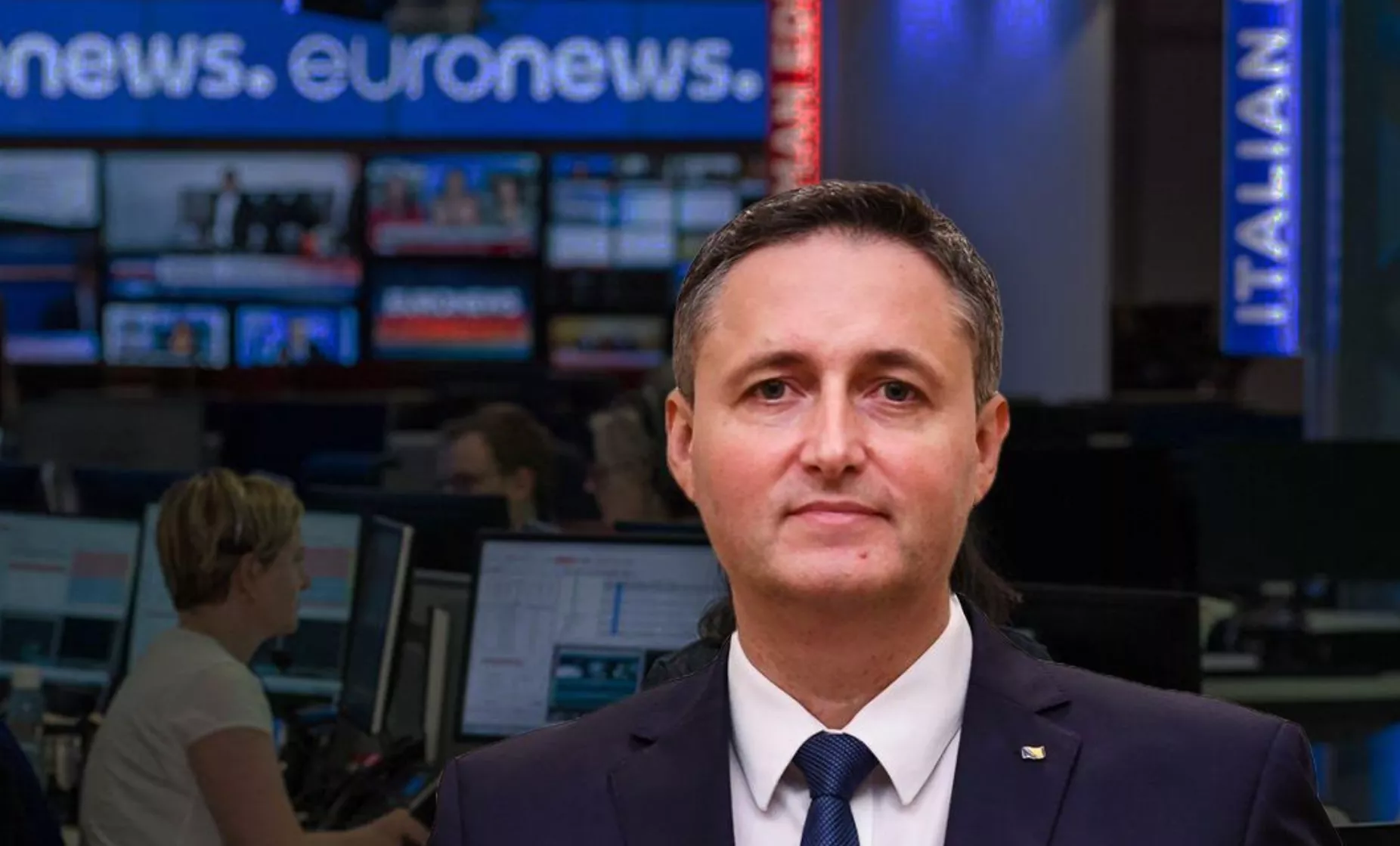
(Patria) - Our commitment and destiny are in the EU, and the speed of our journey towards this union will directly affect the democracy and living standards of our citizens, writes member of the BiH Presidency Denis Bećirović.
Denis Bećirović's op-ed was published by Euronews, a multilingual European 24-hour media channel that reports on events from Europe and the world.
Euronews, a European media channel available in 17 languages, reaches over 400 million homes in 160 countries.
Bećirović discusses Bosnia and Herzegovina's membership prospects in the European Union, talks with leading European officials, as well as the unconstitutional actions of officials of the BiH entity of Republika Srpska.
You can read Bećirović's op-ed for Euronews below.
Lack of Progress
Bosnians and Herzegovinians have been waiting for good news from Brussels for decades. My compatriots, no strangers to difficult fates, have always known that the path to EU membership is not without significant obstacles.
Bosnia and Herzegovina's path has so far been an echo of its own domestic political problems, and years of lack of progress in EU accession have caused many to lose hope, despite their personal sense of belonging to the great European family.
All that has changed, and my country is currently on the verge of opening accession negotiations with Brussels – the final step that ultimately leads to full membership.
Neither side should allow this opportunity to be united under the same flag to slip away, especially while the bloodiest conflict in Europe since World War II is ongoing. Almost thirty years after the horrific war on its soil, the citizens of Bosnia and Herzegovina know very well what is at stake.
Several EU member states strongly advocated for a decision to open negotiations with Bosnia and Herzegovina in December 2023, aligning its path with Ukraine and Moldova.
The European Council ultimately followed the conditional recommendation of the European Commission.
In this way, Bosnia and Herzegovina was sent a message that the decision to open negotiations is imminent as soon as appropriate progress is made in the coming months.
However, despite numerous internal obstructions, significant progress has been made in BiH in the European integration process.
A set of important laws has been adopted by the BiH Council of Ministers and the BiH Parliament. The BiH Presidency has adopted a series of important decisions and ratified numerous agreements that strengthen regional cooperation and Bosnia and Herzegovina's European path.
Opening membership negotiations would be an important political message about the EU's readiness to initiate a process with Bosnia and Herzegovina that would produce substantive and visible reforms.
It is a process that would certainly have positive effects on Bosnian society as a whole and would signify recognition and valorization of the progress achieved on the European path.
On the other hand, further delays and long waits lead to a loss of enthusiasm, as well as citizens' trust in the credibility of the European integration process.
Domestic "Anti-Europeans"
According to a survey from May and June 2023, 73.3% of citizens support Bosnia and Herzegovina's entry into the EU. This represents a strong fundamental consensus for implementing reforms on the European path, something Brussels should not hesitate to leverage.
I expect the European Council in March to give Bosnia and Herzegovina an opportunity to demonstrate its commitment to European values – an opportunity to strengthen our interconnection and cooperation.
The initial culprits for the current blockade on Bosnia and Herzegovina's European path are domestic "anti-Europeans." They show disinterest in EU membership because they know that joining the EU means aligning with EU laws and standards.
The European legal framework would mean the loss of existing privileges for many of them, and for some, it would mean the loss of freedom, as they are linked to criminal activities and corruption.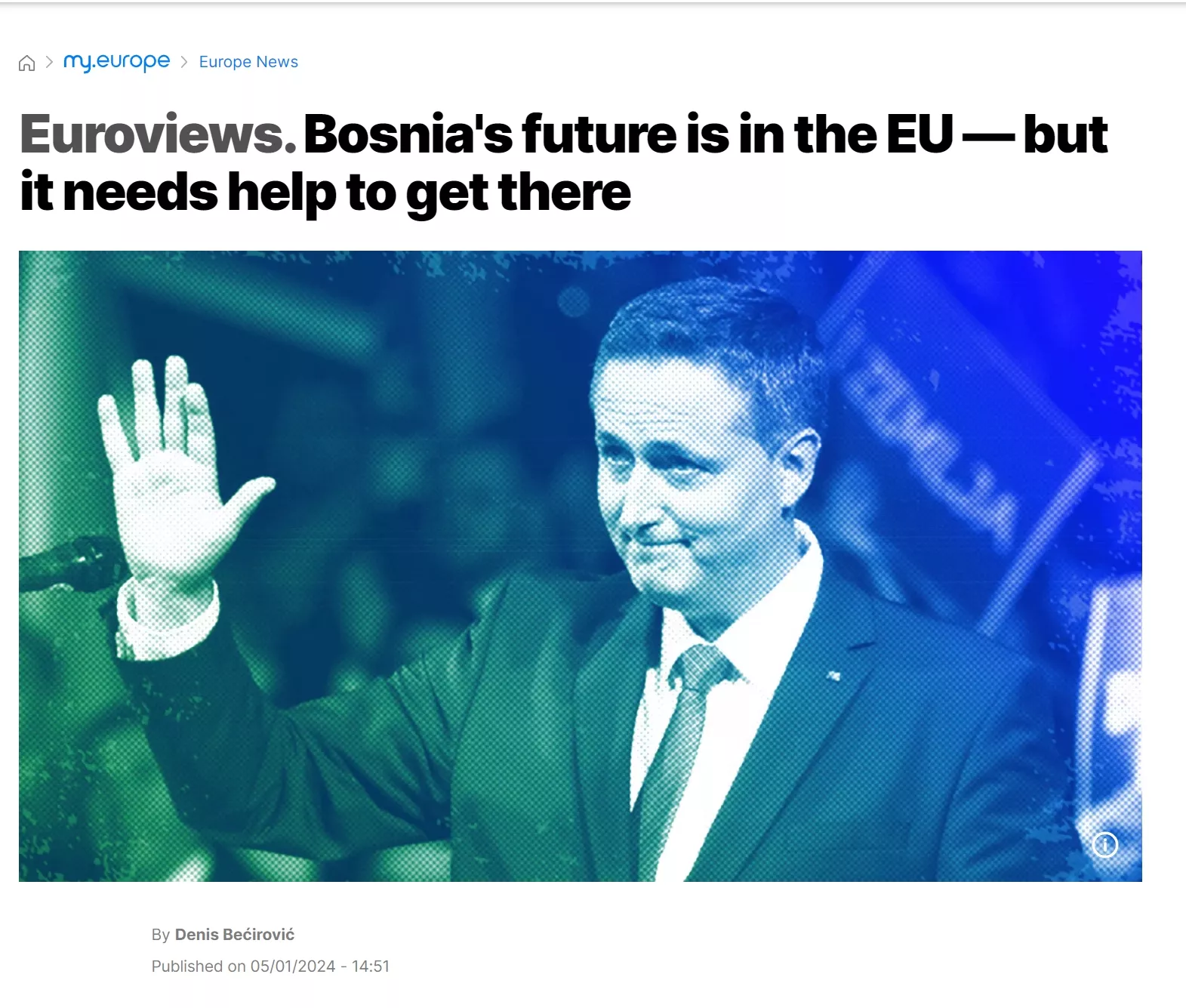
It is equally important that the EU avoids further miscalculations regarding Bosnia and Herzegovina.
Some of the biggest mistakes the EU has made include its unwillingness to consistently implement European principles and standards in BiH; a lenient policy towards destructive politicians who openly threaten the Dayton Peace Agreement and the BiH Constitution, and a reluctance to sanction extremist politicians who threaten peace in BiH and the wider Western Balkan region.
Had Brussels taken a more decisive stance over the past decade, Bosnia and Herzegovina would have been spared many crises, and this part of Europe would be much more stable.
However, there are indications that a change is coming. Following my visits in 2023 to NATO and EU headquarters in Brussels, with subsequent visits to Paris, Berlin, Washington, and London, I am convinced that Western support for Bosnia and Herzegovina is strengthening.
During my visit to the Federal Republic of Germany, I spoke with Chancellor Olaf Scholz and received clear and unambiguous messages that Germany supports Bosnia and Herzegovina.
I also received encouraging messages from the President of the French Republic, Emmanuel Macron, during my visit to France. During our conversation at the Élysée Palace, President Macron offered firm support for preserving the independence, sovereignty, and territorial integrity of Bosnia and Herzegovina.
Bosnia and Herzegovina needs more of this kind of support. In the coming period, the EU should more strongly and concretely support the pro-European and democratic forces of the country.
It is extremely important not to forget the fact that pro-Russian and separatist forces within the Republika Srpska entity are deliberately blocking both the European and Euro-Atlantic path of Bosnia and Herzegovina.
For six months now, there has been an open attack in Bosnia and Herzegovina on the fundamental provisions of the 1995 Dayton Peace Agreement – parts of which de facto constitute the Constitution of Bosnia and Herzegovina – and the country's constitutional order.
The situation is extremely serious. This is not just my personal assessment, but also the stance expressed by almost all key leaders in the West.
Destabilization of the Region
Accordingly, the West should stop all anti-Dayton and unconstitutional actions, the first of which is the upcoming celebration of January 9th, "Republika Srpska Day," a holiday that the BiH Constitutional Court has ruled to be discriminatory and unconstitutional.
Despite final and binding court decisions, entity leaders are persistent in illegally celebrating this event, maintaining a continuous, dangerous, and systematic attack on the Dayton Peace Agreement and the future of Bosnia and Herzegovina.
If attempts to undermine the Dayton Peace Agreement are not stopped, inaction could be interpreted as encouragement to move to the next phase of escalating tensions, which could lead to the destabilization of the entire region.
Knowing what it knows now, after almost two years of Russia's aggressive war against Ukraine, the West can and must prevent the escalation of that war from causing conflicts in the Western Balkans and further across Europe.
Ever since gaining independence in 1992, the future of Bosnia and Herzegovina has been firmly linked to the future of Europe.
If the EU shows readiness to positively leverage Bosnia and Herzegovina's geopolitical, geo-economic, and geocultural advantages, both the EU and our country will benefit.
Given the evolving geopolitical dynamics, there is an urgent need for the EU to strategically consider an accelerated and more adaptable approach to its enlargement policy concerning Bosnia and Herzegovina and other countries in the region.
Furthermore, accelerating Bosnia and Herzegovina's path to full EU membership would not only strengthen economic and political ties but also establish a new form of solidarity and shared values essential for the European identity as a whole.
Our commitment and destiny are in the EU, and the speed of our journey towards this union will directly affect the democracy and living standards of our citizens.
Bosnia and Herzegovina is at the heart of Europe, and its rightful place is within the EU.
Komentari (0)
Prijavite se za komentiranje
PrijavaJos nema komentara. Budite prvi!
Minuta
Sve →Iz drugih kategorija

High Representative Not Elected: Germans, French and British Sabotaged Americans, New Attempt at End of June

ČOVIĆ WITHOUT MERCY: How Those Who Brought Ademović to Office Created a Political Hell for Him



Sunny Saturday, quite warm



Tragedy in Albanian resort: Two minors drown












