
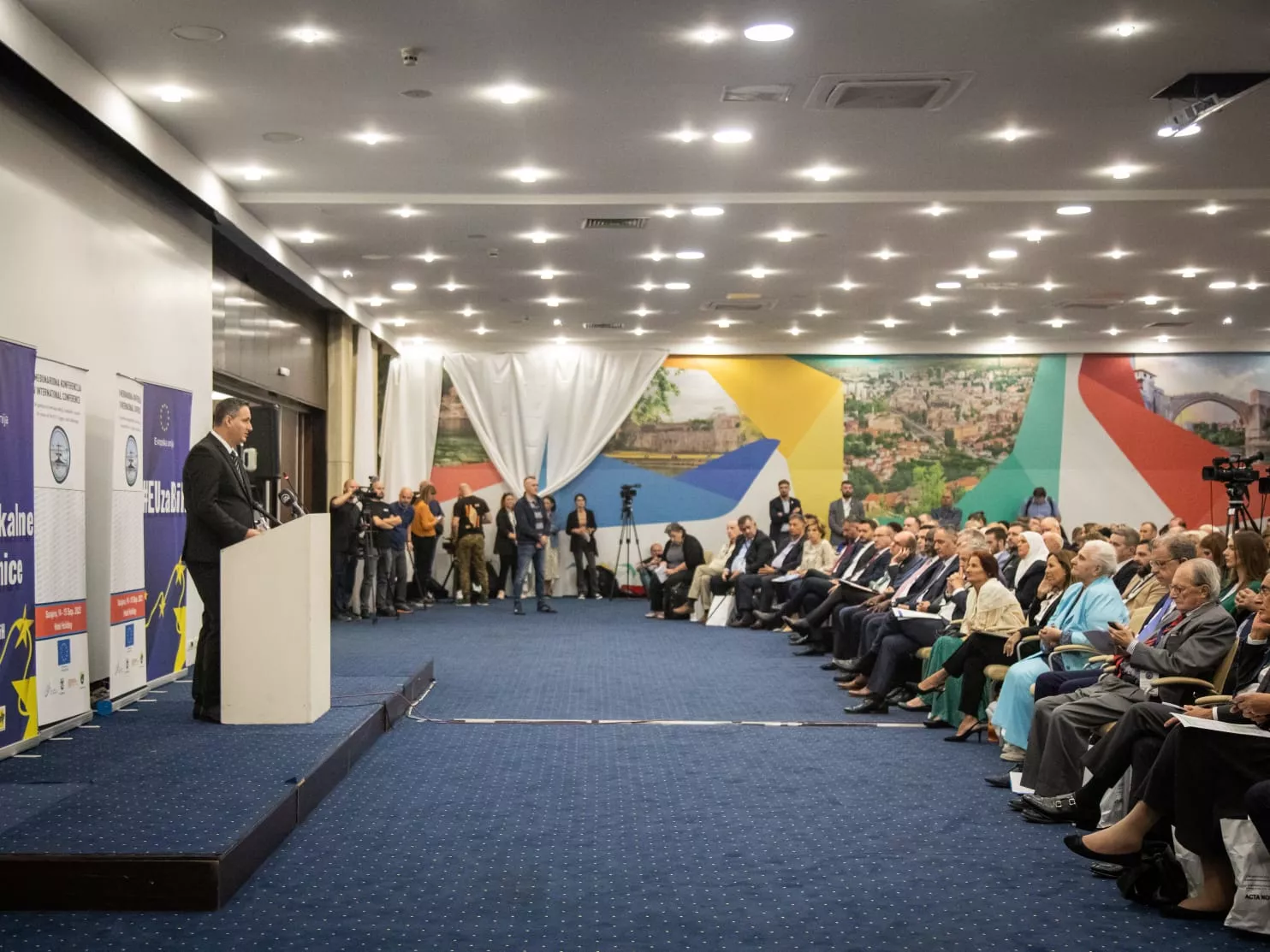
(Patria) - BiH Presidency member Denis Bećirović at the V International
Conference on the topic "30 Years Since the Establishment of the International Criminal Tribunal for the Former Yugoslavia, Legacy and Challenges" paid special respect to the brave and dignified women from the Association "Mothers of the Enclaves of Srebrenica and Žepa", and other associations of victims and witnesses of genocide.
"Today's conference is of great significance because it points to the importance and results of the Hague Tribunal's work, but also raises awareness in national and international frameworks about the importance of opposing ideologies and policies that lead to genocide, crimes against humanity, and other crimes.
The United Nations (UN) Security Council established the International Criminal Tribunal for the Former Yugoslavia (ICTY) on May 25, 1993, with the aim of stopping violations of international humanitarian law, as well as violations of the laws and customs of war.
The UN Security Council decided to establish an international court with the exclusive task of prosecuting persons responsible for grave breaches of international humanitarian law committed in the territory of the former Yugoslavia from January 1, 1991, until a date determined by the Security Council after the re-establishment of peace, and by the adopted Resolution, it also ordered the adoption of the Statute of the International Court.
The UN Security Council, by the adopted Resolution, determined that the situation in the former Yugoslavia, and primarily in the territory of the Republic of Bosnia and Herzegovina, constitutes a threat to international peace and security.
By the Resolution, the UN Security Council expressed its firm intention to stop such crimes and to take effective measures to bring those responsible to justice. Namely, the UN Security Council was convinced that, as an ad hoc measure, the establishment of an international court and the prosecution of persons responsible for grave breaches of international humanitarian law would contribute to the establishment and maintenance of peace," Bećirović stated.
He further said that by establishing the Hague Tribunal, a clear stance was taken – the prosecution of individuals responsible for committing war crimes is of fundamental importance for the entire international community, as well as for each state individually.
"We are witnessing that international armed conflicts, unfortunately, still occur, therefore all those who threaten or use force, contrary to the UN Charter, should be aware that they will be held accountable for the committed criminal offenses, and that the objective facts about the legal nature of the given conflicts will be determined before the competent judicial bodies.
By establishing the Tribunal, the international community has stimulated the development of international criminal law and given impetus to the idea of abolishing impunity for grave breaches of the Geneva Conventions, the laws and customs of war, genocide, and crimes against humanity.
Through its work, the Tribunal, as well as the Mechanism, has enabled victims to have their voices heard, thereby actualizing the issue of the victim's position in contemporary criminal proceedings.
The establishment of the ICTY had legal, historical, civilizational, and moral significance. The Tribunal was the first international criminal court established after the Nuremberg and Tokyo Courts, which prosecuted criminals after World War II.
The Hague Tribunal has left a huge archive of committed genocide against Bosniaks, crimes against humanity, and other crimes. Among other things, the Hague legacy includes: 2.5 million transcripts of court proceedings, 422,000 documents, and 30,000 video recordings. 10,800 days of trials were held at the Hague Tribunal, and over 4,600 witnesses testified.
A total of almost 1,500 years of imprisonment and 7 life sentences were imposed. The Tribunal did not try peoples but determined individual responsibility.
From the ICTY's verdicts, politicians from neighboring countries, as well as some from Bosnia and Herzegovina, must draw lessons. They must understand that the policy of force, aggression, and crime does not pay off and that there are always mechanisms that sanction such policies.
The truth about the committed genocide and the legacy of the Hague Tribunal remain a permanent warning to humanity. The civilizational achievement of the ICTY is that some of the highest officials responsible for genocide, crimes against humanity, and other crimes have been brought to justice. The bringing of presidents, generals, camp commanders, and other responsible persons before the Hague Tribunal surpassed even the initial expectations at the beginning of this international ad hoc court's work.
With decisions concerning the genocide committed against Bosniaks, crimes against humanity, and other war crimes, the ICTY has shown that an individual's high position cannot be a protection from criminal prosecution.
The Tribunal also confirmed the legal nature of the war waged against the internationally recognized state of the Republic of Bosnia and Herzegovina.
Through final verdicts of the Hague Tribunal, including verdicts on joint criminal enterprises, it has been proven that it was an international armed conflict. Neighboring countries waged a war for territories with the aim of creating a Greater Serbia, and for a period of the war, a Greater Croatia.
Unfortunately, despite the verdicts of the ICTY and the International Court of Justice, we still witness anti-civilizational actions by some politicians who deny genocide and glorify war criminals.
We must not underestimate the danger posed by politicians who follow the ideology and policies of criminals. Neither we in Bosnia and Herzegovina, nor the international community," Bećirović emphasizes.
He further stated that new tasks lie ahead of us, which are telling the truth and nurturing a culture of remembrance.
"To accomplish this task, it is necessary to start from the objective facts established in the proceedings before the Tribunal. However painful and difficult they may be, we must start from them, because only they can form the basis for establishing a stable and prosperous society. Lies, manipulations, and glorification of criminal policies and ideologies do not lead in the right direction.
On the occasion of the 30th anniversary of the establishment of the Hague Tribunal, I remind you that I have requested the UN to make a just decision and to store the complete original archive of the Hague Tribunal in Sarajevo, the capital of Bosnia and Herzegovina.
Namely, as a member of the BiH Presidency, at the beginning of this year, I requested the UN Secretary-General, the President of the UN General Assembly, and the President of the Residual Mechanism for Criminal Courts to store the archival material of the Hague Tribunal in the capital of Bosnia and Herzegovina. Millions of printed pages, audio recordings, video recordings, photographs, political agreements, and secret data, which clearly confirm what happened during the aggression against the Republic of Bosnia and Herzegovina from 1992 to 1995, should be stored in Sarajevo. This is the only just solution.
Considering the verdicts of the highest UN courts, I believe it is important to state the following:
- The Hague Tribunal's verdicts are of capital importance for international law and order as a whole. Among other things, the verdicts of the highest UN courts have established that genocide against Bosniaks and joint criminal enterprises against the state of Bosnia and Herzegovina were committed.
- The highest UN courts have permanently condemned Greater-state ideologies and policies that attempted to divide and destroy Bosnia and Herzegovina as an independent, sovereign, indivisible, and internationally recognized state.
- The international community and the state of Bosnia and Herzegovina have a legal, political, moral, and historical obligation to victims and future generations to seek a revision of criminal legislation in the countries of the region for the adequate prosecution and punishment of all those who deny court verdicts and glorify convicted war criminals.
- The international community should not allow the final verdicts of UN courts to be merely archived and then forgotten.
- Bosnia and Herzegovina has the right to request that the international community, in the interest of all of humanity, send a message that the results of committed genocide, crimes against humanity, and other crimes must not be permanently recognized.
- There is no justice without a serious and responsible approach to solving past problems, and there is no serious approach without applying transitional justice mechanisms.
Finally, I wish to conclude today's address with a message:
Behind us are 30 years of the history of the Hague Tribunal (International Criminal Tribunal for the Former Yugoslavia - ICTY and its legal successor, the International Residual Mechanism for Criminal Courts - IRMCT). On the foundations of this Tribunal's verdicts, we must continue our common journey towards justice and truth. We have no other way," Bećirović said in his speech.
Komentari (0)
Prijavite se za komentiranje
PrijavaJos nema komentara. Budite prvi!
Minuta
Sve →Iz drugih kategorija

High Representative Not Elected: Germans, French and British Sabotaged Americans, New Attempt at End of June

ČOVIĆ WITHOUT MERCY: How Those Who Brought Ademović to Office Created a Political Hell for Him



Sunny Saturday, quite warm



Tragedy in Albanian resort: Two minors drown












