
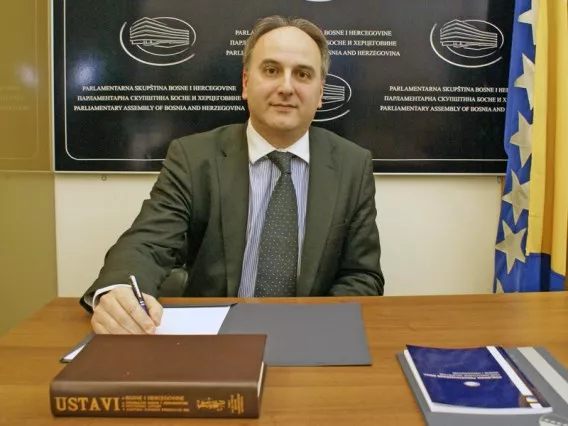
(Patria) - Damir Arnaut, a Member of the House of Representatives of the Parliamentary Assembly of Bosnia and Herzegovina, commented on the events in Australia related to Novak Djokovic.
"The saga surrounding Novak Djokovic's (non)entry into Australia reminded me of the standards I witnessed as the Ambassador of Bosnia and Herzegovina. Truth, justice, the rule of law, and equality before the law are values that Australians unite through 'Fair dinkum' – a term that cannot be translated, but which in one of its contexts signifies fairness and equal opportunity. Therefore, I am equally horrified by the suggestions that Australians are 'too strict' because they are not making an exception for 'someone like Novak Djokovic,' as well as by the idea that they banned him from entering because of his origin.
The first thing I did upon arriving in Australia was to ask our citizens what their priorities were. They were, in this order, the opening of negotiations on a social security agreement, the recognition of BiH driver's licenses, and the resolution on the genocide in Srebrenica in the Australian Parliament.
Then I created a huge map of the federal electoral districts – 151 of them – and entered the number of Bosnians and Herzegovinians living in each, using the detailed census data that the country conducts every five years.
The third thing was to visit every Member of Parliament in whose district more than 50 of our citizens lived.
The fact that I was an ambassador was enough to get a courtesy meeting. The information that more than 50 potential voters had an opinion on a certain issue was enough to get their attention and a second meeting. But for their vote or intervention with ministers, it was necessary to present solid evidence and arguments.
I secured the opening of negotiations on a social security agreement by presenting Prime Minister Gillard with exact data on the savings Australia would achieve if our people using free housing and health insurance returned to Bosnia and Herzegovina and stopped using them, which they would only do if they could continue to receive their pensions after leaving Australia. I proved the latter through their numerous letters.
I secured the recognition of BiH driver's licenses by proving – with hundreds of documents – that the standards of the driving license exams and integrity in Bosnia and Herzegovina were at the same or even higher level than in Australia. How arduous this process was is shown by the fact that ten years later, our country is one of only 25 sovereign states whose driver's licenses Australia recognizes. Moreover, of those 25, only BiH and three others are not members of the EU and/or NATO. Those three are New Zealand, Japan, and Singapore. However, the only question throughout the entire process was whether we met the conditions and satisfied their high standards.
The Resolution on the Genocide in Srebrenica, however, is the best example of Australia's fair approach. I did not write that resolution; I rewrote it. I deliberately used verbatim quotes from the judgments of the International Court of Justice and the International Criminal Tribunal for the former Yugoslavia. The Serbian ambassador followed me closely through the halls of Parliament, claiming that parts like 'The Army and Police of Republika Srpska separated men aged 16 to 60 or 70 from their families' or 'these were acts of genocide, committed by members of the Army of Republika Srpska in and around Srebrenica...' were not true.
The official sponsor of the Resolution, Michael Danby, whose grandparents were killed in Auschwitz, directed the ambassador each time to the courts that had written those sentences, which was also pointed out to Tony Abbott, then the leader of the opposition and later prime minister, who requested a postponement of the vote due to letters he received from opponents of the resolution. The fact that the Serbian diaspora is five times larger than the Bosnian-Herzegovinian diaspora could not outweigh the court judgments.
Danby only begged me to 'take the Turkish ambassador off his back,' who was also lobbying against the resolution because he feared it would 'set a precedent for Armenian claims.' I am proud that it will soon be a decade since the adoption of my resolution in the Australian Parliament, but also that the genocide against Armenians was finally recognized in that body two months ago.
Australia enjoys unlimited resources, a pleasant climate, an unburdened history, distance from the problems of the rest of the world, and all other forms of prosperity. Therefore, it has the luxury of taking a fair approach to most issues. Djokovic's entry into Australia was challenged solely due to doubts about the integrity of his medical documentation. If these doubts are confirmed in court on Monday, he will be deported, and if they are refuted by evidence, he will be allowed to enter. The decision will not be guided in any way by arguments like 'do you know who I am,' nor by Djokovic's origin. Only by facts. And as such, it will be fair. That is Australia," Arnaut wrote.
Komentari (0)
Prijavite se za komentiranje
PrijavaJos nema komentara. Budite prvi!
Minuta
Sve →Iz drugih kategorija

High Representative Not Elected: Germans, French and British Sabotaged Americans, New Attempt at End of June

ČOVIĆ WITHOUT MERCY: How Those Who Brought Ademović to Office Created a Political Hell for Him



Sunny Saturday, quite warm



Tragedy in Albanian resort: Two minors drown












