
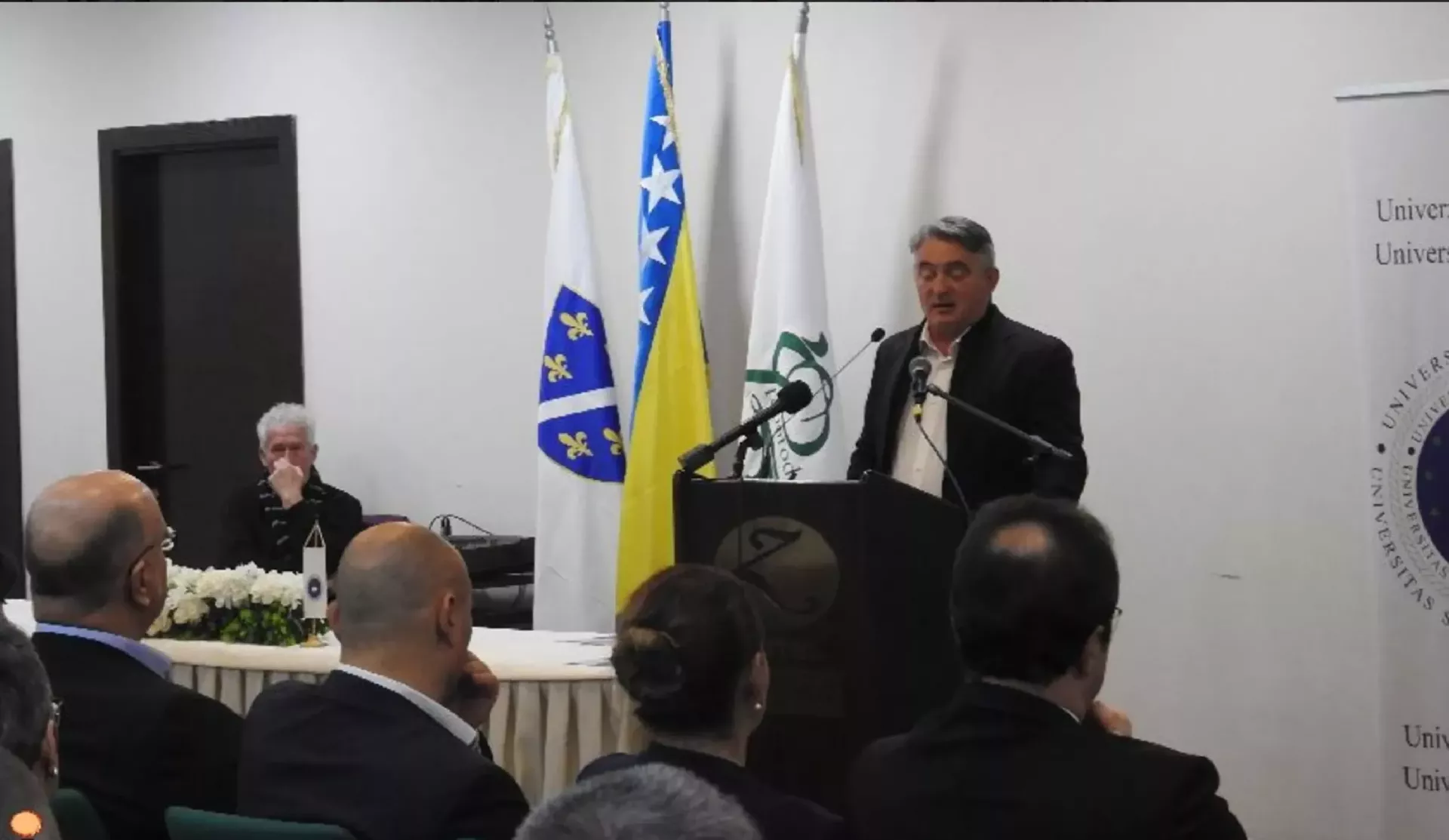
(Patria) - BiH Presidency member Željko Komšić was a guest at this evening's formal academy in Zenica, on the occasion of marking November 25, Statehood Day of BiH, organized by the University of Zenica and BZK "Preporod" - City Society Zenica, writes Preporod.info.
Komšić stated that it would be a big question whether March 1, 1992, and BiH Independence Day would have existed if it hadn't been for November 25, 1943, and the restoration of BiH's statehood at the session of the State Anti-fascist Council of National Liberation of Bosnia and Herzegovina (ZAVNOBiH) in Mrkonjić Grad.
- Of course, at that time within one state - the former Yugoslavia. On that day, BiH's statehood was actually restored after several hundred years. Because BiH, as a kingdom, was definitely one of the oldest states on the European continent.
If not in the world. Of course, with the arrival of the Ottomans and later the annexation by Austria-Hungary, the Austro-Hungarian occupation, BiH lost that element - Komšić said.
He emphasized that in the National Liberation Movement during World War II, there was resistance when discussing BiH's status - people had enough wisdom to say that BiH is a Republic, just like Serbia, Croatia, and all other republics in Yugoslavia at the time.
- Without that element, without November 25, it is questionable what the finding of the Badinter Commission would have been, based on which the referendum on independence, BiH's independence, and international recognition of BiH as a sovereign and independent state came about. So, figuratively speaking, perhaps November 25 is the birthplace of March 1, and you cannot separate them - Komšić points out.
He adds that anti-fascism also connects these two dates, because both November 25, 1992, and March 1, 1992, were born in the fight against fascism.
- Anti-fascism is the common denominator of these two dates, which are two historical dates for BiH. The earlier attempts to achieve autonomy within the Ottoman Empire, such as the attempt by Husein-kapetan Gradaščević, should not be overlooked.
But, until November 25, 1943, there was no concrete result. That is why these are two dates we must never forget.
We must not overlook them, because they are the foundation of everything we have today when we talk about the state, statehood, and independence. Whether BiH is truly in line with all of this is a completely different question - Komšić said.
He emphasized that the Constitution of BiH was not written by "us, nor is it a product of any political or broader consensus in BiH," but rather it is an integral part of the Dayton Peace Agreement.
- In fact, others drafted it, as they thought it was possible at the time. I don't want to sound ungrateful and say that it's nothing. Thanks to all those who contributed to the signing of the Dayton Peace Agreement and, of course, the Constitution of BiH as an annex to that agreement, thereby bringing peace to BiH.
However, what we should start thinking seriously about is whether this Dayton constitution, which many swear by today, provides us with any basis for further progress when we talk about what is expected from the authorities in BiH.
I think it will be difficult - with this constitutional structure and this constitution - for us to be not only a NATO member state but, especially, we will not be able to be a member state of the European Union - Komšić believes.
Whoever claims otherwise, he said, let them try to prove it - but he thinks they are not telling the truth.
- In my daily contact with European officials, I encounter precisely this question. And they all whisper that - it's not possible. With this constitution, it's not possible! BiH, especially, cannot be a member of the EU.
But, no one will say it out loud, as we do in Bosnia, driven not by the desire to deceive someone or achieve some political goal - but driven by the reality in which we live and the need for things to move forward - Komšić concluded.
Komentari (0)
Prijavite se za komentiranje
PrijavaJos nema komentara. Budite prvi!
Minuta
Sve →Iz drugih kategorija

High Representative Not Elected: Germans, French and British Sabotaged Americans, New Attempt at End of June

ČOVIĆ WITHOUT MERCY: How Those Who Brought Ademović to Office Created a Political Hell for Him



Sunny Saturday, quite warm



Tragedy in Albanian resort: Two minors drown












