
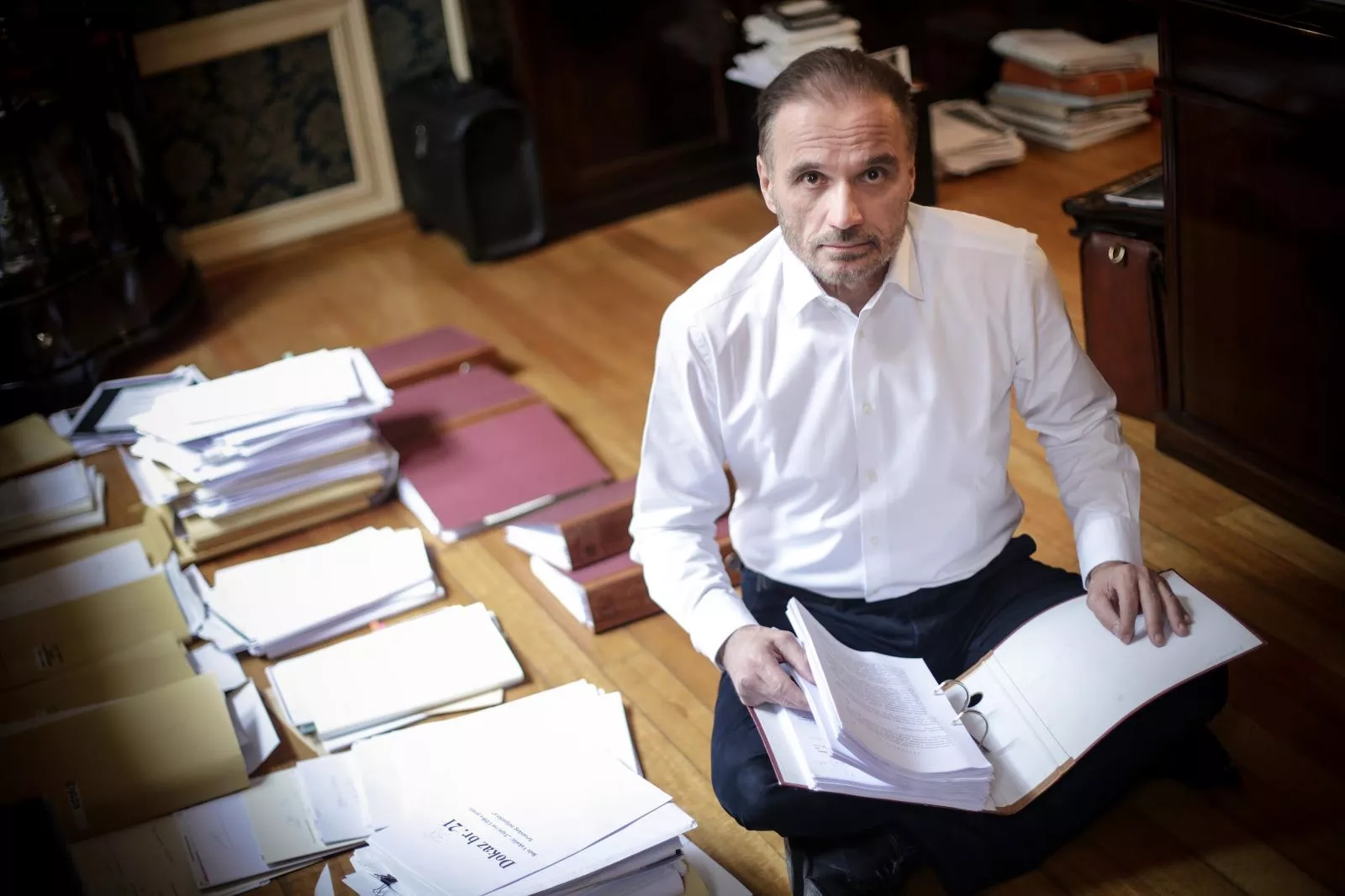
Interviewer: Armin Aljović
The promotion of the book "Defense of Croatian Counterintelligence Officer Josip Perković in the German Court" by Croatian lawyer Ante Nobilo will be held tonight in the amphitheater of the UNITIC Business Center in Sarajevo.
The book will be discussed in Sarajevo by former President of the Republic of Croatia and last President of the SFRY, Stjepan Mesić, historian and professor at the Faculty of Philosophy in Sarajevo, Prof. Dr. Husnija Kamberović, journalist and editor from Sarajevo Faruk Vele, BiH lawyers Vladimir Adamović and Duško Tomić, journalist from Zagreb, Drago Pilsel, and the author Nobilo.
Josip Perković is a Croatian counterintelligence officer convicted for the murder of emigrant Stjepan Đureković. The Zagreb County Court last December commuted the life sentence imposed by a German court for him and Zdravko Mustač to a 30-year sentence, which they will serve in a Croatian prison. They are, namely, charged with responsibility for the murder of Đureković, who was killed in 1983 in Wolfratshausen near Munich by as yet unknown perpetrators.
The court delivered a guilty verdict in the Perković case just over three months ago. What are your next steps?
- In Germany, there is no appeal on facts, only an appeal on possible procedural violations. However, I have filed a lawsuit before the European Court of Human Rights, because I believe that he and /Zdravko/ Mustač did not have the right to an impartial court and a fair trial...
Your book discusses the very relationship and role of intelligence services in the Perković case. It is known that intelligence services are an eternal enigma for ordinary people. In this context, the great interest in your book can also be observed, which is a kind of precedent in Croatian publishing and beyond.
- That is the beauty of the legal profession. We deal with criminal acts, but each criminal act occurs under different circumstances. So, this criminal act occurred within the framework of the secret services war, the Cold War, and so on... For instance, when I defended Blaškić, I had to “enter” the war in Bosnia and Herzegovina and study the balance of power in BiH during that period. For that reason, I also had to ‘enter’ the secret services, to see what was happening there.
And what happened; Stjepan Đureković was killed in 1983 in Germany. After 30 years, we established that he was an agent of the German intelligence service BND, and a highly paid agent. So, in that case, we have elements of BND activity against Yugoslavia. And that knowledge alone is interesting. The second case is the conflict between the German and Yugoslav services from that period. On the third hand, we have the phenomenon of liquidations, which have been mythologized until now. Namely, the BND launched the idea that Đureković was killed because of his political activity, while we established in this proceeding that not a single emigrant was killed for political reasons, but exclusively for terrorist activities. And then we established that the German secret service stood behind the terrorist activities of Croats who were in exile in Germany.
The book also presents the entire decision-making model on who would be liquidated. So, there was a very precise decision-making mechanism for such matters, to avoid abuses of the secret services. Decisions on liquidation were made at the highest political levels.
Are you saying that the theories that you could have been “swallowed by the dark” in Yugoslavia because you said something wrong are invalid?
- Whatever we think about Yugoslavia, the secret service of Yugoslavia was a serious secret service. The republic could not decide who would be liquidated. Nor could the Service itself decide who to kill. It was done in a way that a proposal was submitted for the neutralization of a terrorist who does not stop terrorist activities against Yugoslavia, and the host country where he is located does not want to prosecute him... It was examined whether all efforts to pacify him and make him abandon that work had been exhausted. When all that was fulfilled, the State Security Service of Yugoslavia submitted a proposal /for liquidation/ to the Federal Council for the Protection of the Constitutional Order. And in that Council in 1983 sat a member of the Presidency of the SFRY, the secretary or minister of the Interior, the minister of Foreign Affairs, and the minister of National Defense. And they made such a decision, but again after an analysis of the multi-year activity of that terrorist.
Services do this even today, only, for example, the right to liquidations has been taken away from the CIA and transferred to the US military... After Osama bin Laden was killed, President Obama said they would kill any terrorist wherever they were. Chancellor Merkel congratulated him on that. So, we have the same phenomena today, and we see that liquidations were not a specificity of Yugoslavia alone.
Of course, Yugoslavia had a one-party system, of course, if you go to overthrow that system you would suffer, but if today you go to overthrow the system by unconstitutional methods, you will suffer.
So, all states behave according to certain patterns, regardless of whether they are communist, or capitalist, and so on. The system protects the state when the state is threatened.
Are today's intelligence services, at least in the countries of the former Yugoslavia, out of control?
- That is the problem. In Yugoslavia, that happened at one point in the 1960s, and then the crackdown on Ranković began, because he used the services for his political option. But, after Tito removed Ranković from all functions and pensioned him off, the service was under absolute control... It is wrongly considered that UDBA was some special force. UDBA was a tool of politics, like the police and the judiciary, and so on. So, UDBA did not have its own ideas; they were just expert bodies.
Do you get the impression that today's intelligence services in the region are not even under the influence of politics, but under the influence of certain individuals in those political parties?
- Yes, and that is the problem, because secret services are used to achieve political goals, everything goes outside the system, and that is then a problem for society.
Recently, data emerged that BiH is an area where a large number of foreign intelligence officers are concentrated. How much truth is there in that?
- That is primarily due to the geographical position of Bosnia and Herzegovina, because the large /political/ blocs that exist today collide in BiH. The second reason is the unpredictability of the political situation in BiH... Great powers still have their interests today as before. For example, Germany, as a large European country, wants to expand and go east. That path, among other things, leads through the Balkans and Bosnia and Herzegovina. Furthermore, we have Russia, which also wants access to warm seas and influence in the Balkans... Turkey also has an interest. All these countries influence and create certain processes in Bosnia and Herzegovina. On top of all that, we have additional influence from neighboring countries on BiH, because part of the citizens of Bosnia and Herzegovina consider their capitals to be Zagreb and Belgrade. Bosnia and Herzegovina is very fertile ground for foreign intelligence services.
You worked on the Hague trials for a long time. Do you expect that a catharsis and rejection of war criminals can occur in BiH?
- Unfortunately, the Hague verdicts have not influenced Bosnia and Herzegovina in a way that lessons were drawn from those verdicts. Croats did not draw a single lesson from the Prlić et al. case, nor will Serbs draw a lesson from the verdict against Karadžić and others if the verdicts are guilty. So, with guilty verdicts, the victims did receive some satisfaction, but there was no impact on society in terms of rejecting war crimes. If you have a neighbor who has been convicted of pedophilia or rape, the entire neighborhood will create a sanitary cordon around them; they simply will not socialize with them instinctively. But, when you have someone convicted of war crimes, someone who killed 100 or 200 people, they will be a hero to their neighbors. And that is an enigma to which I have no answer. And there is no progress until society undergoes a catharsis and recognizes the delusions of the past. It is completely normal to renounce criminals and camps. Germany could not move forward until it carried out denazification.
Komentari (0)
Prijavite se za komentiranje
PrijavaJos nema komentara. Budite prvi!
Minuta
Sve →Iz drugih kategorija

High Representative Not Elected: Germans, French and British Sabotaged Americans, New Attempt at End of June

ČOVIĆ WITHOUT MERCY: How Those Who Brought Ademović to Office Created a Political Hell for Him



Sunny Saturday, quite warm



Tragedy in Albanian resort: Two minors drown












