
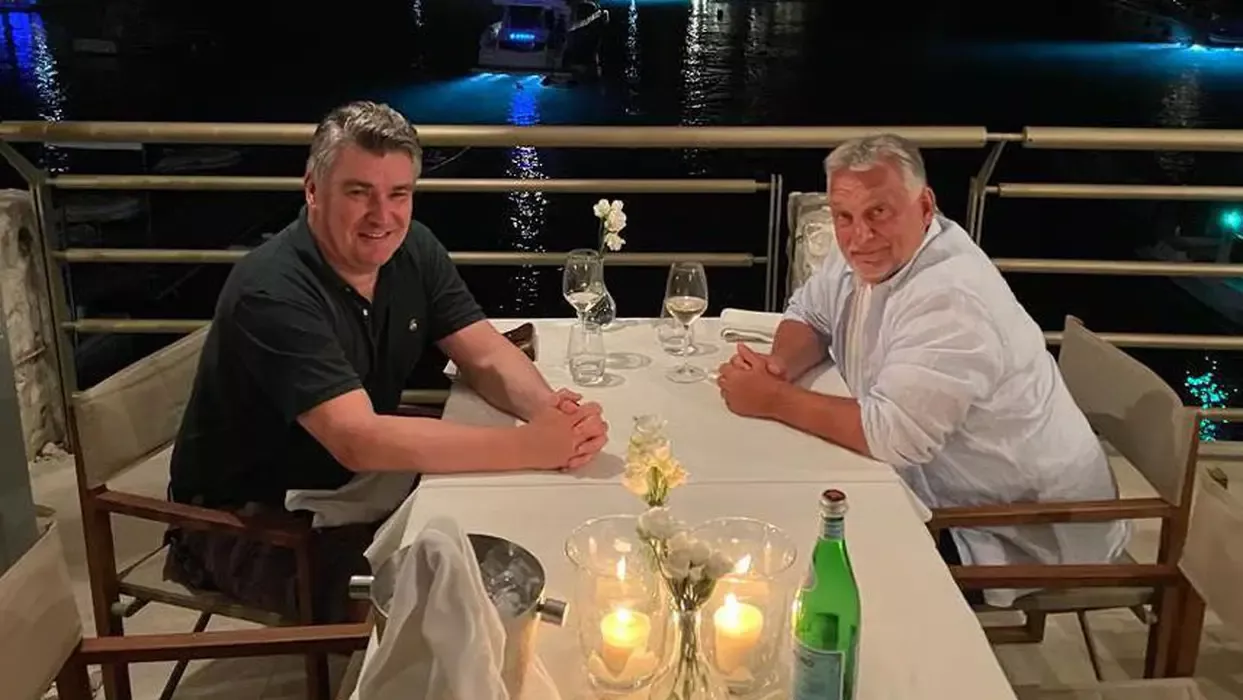
(Patria) - In recent years, much has been said about the renewal of the “great power competition” in the Western Balkans, with Russia, China, Turkey, and even the Gulf Arab states being portrayed as threats to the primacy that the US and EU have established in the region since the end of the Yugoslav wars. However, political analyst Jasmin Mujanović believes that the Quint countries should primarily focus on those within their own alliance who contribute to the destabilization of the region, specifically Croatia and Hungary.
In an analysis for the newly established “Western Balkans Observatory” at the American New Lines Institute, Mujanović states that Russia and China have developed a strong political and economic footprint across the region over the past decade, and that in recent months, regional analysts largely perceive the adaptation of the US and EU to the almost autocratic regime of Aleksandar Vučić in Serbia as a reflection of “the US and Europe’s desire to prevent Belgrade from sinking deeper into the Kremlin’s orbit”.
However, he notes that Washington and Brussels have paid little attention in such policies to those within the Euro-Atlantic community itself who potentially undermine their policies in the Western Balkans. In this context, he specifically mentions EU and NATO member states Croatia and Hungary, which “show a tendency to explicitly or subtly undermine the strategic interests” of NATO and the EU in the Western Balkans, and for which BiH is “the primary target of malicious activities”.
“Croatia’s Colonial Aspirations”
Mujanović states that, during the period of so-called “de-Tuđmanization” prior to Croatia’s accession to the EU in 2013, officials in Zagreb took modest steps towards accepting responsibility for the Croatian government’s policy of cooperation with Serbia in repeated attempts to partition BiH. However, he notes that when Andrej Plenković took over the leadership of the long-dominant HDZ in the country, and subsequently became Prime Minister in 2016, Croatia “radically reversed course”.
“Today, the country has almost no foreign policy interests other than continuous and systematic interference in the internal affairs of BiH, exclusively in the name of the hardline sectarian HDZ BiH, the sister party of Plenković’s HDZ, and the primary driver of aggression from the time of Franjo Tuđman against BiH from Croatia,” he points out.
He believes that the goal of Plenković’s government since 2016 has been to gain international support for the introduction of “further sectarian provisions within the electoral and constitutional regime in BiH” and for “cementing the grip” of the sister party HDZ BiH at all possible levels of government in BiH. He states that HDZ BiH represents “nothing more than a proxy for the political and ideological machinations of Plenković and the right-wing nationalist group that makes up his cabinet”.
The most visible example of this, according to Mujanović, is the case of Željana Zovko, who resigned from her ambassadorial post in the Bosnian diplomatic corps and “overnight” became a Croatian MEP.
To Mujanović, it appears that Zovko has no other political interests in Brussels “other than concerns for BiH’s election laws and other related internal affairs in the country”.
Commenting on Plenković himself, Mujanović states that he often praised Tuđman as a great statesman and also characterized Tuđman’s well-documented cooperation with the regime in Belgrade on the partition of BiH as a struggle for the equality of Croats in BiH.
He points out that Croatian President Zoran Milanović, a supposedly fierce critic of Plenković, is “even more committed to supporting” the sister party HDZ in BiH. Mujanović reminds that Milanović has repeatedly glorified Croatian nationalist military formations in BiH that were involved in large-scale crimes, and that he has also established close ties with the “secessionist strongman” Milorad Dodik, the president of the BiH entity Republika Srpska (RS), even calling him a Croatian partner in BiH.
He also recalls Milanović’s “thinly veiled racist comments about the Bosniak community,” and that he has repeatedly questioned the facts of the Srebrenica genocide. He also reminds that in April 2022, Milanović made international headlines when he insisted that Croatia should not allow Finland and Sweden to join NATO until BiH, which is not an EU and NATO member, is forced to amend its election laws in accordance with Zagreb’s demands.
Mujanović then turned to the actions of the High Representative of the international community in BiH, Christian Schmidt, who received state honors from the Croatian government just a few months before taking office. He reminds that on election day, October 2, 2022, Schmidt unilaterally amended the election law and the constitution of the Federation entity.
Mujanović writes that the specifics of what Schmidt did are extremely complex, but the conclusion is simple: “The Croatian government orchestrated a major perversion of a significant part of BiH’s electoral regime, using the executive Bonn powers of the Office of the High Representative” to ensure the HDZ BiH’s power in the entity and thus indirectly at the state level.
He points out that in any other context, Schmidt’s actions, specifically “changing parts of a country’s election laws a few minutes after the polls closed to secure the position of a political party whose party loyalty was clearly loyal to a foreign government and with which he had disturbingly close ties,” would be considered a “coup d’état”.
“In BiH, however, this has become just the latest episode in a decades-long effort by neighboring Croatia to dismantle the country’s sovereign institutions, through the (in)direct complicity of key Western officials, all under the guise of 'electoral reform',” he states.
Hungary’s Role
Mujanović writes that, while Zagreb has largely focused its efforts on HDZ BiH, “Budapest, along with Belgrade and Moscow, has become one of the leading patrons of Dodik’s secessionist authorities in the RS entity”.
He reminds that during a press conference in December 2021, at the height of another political crisis in BiH “orchestrated by Dodik,” Hungarian Prime Minister Viktor Orbán raised the question of how to integrate a country with two million Muslims into Europe.
“Orbán not only considered the very existence of a predominantly Muslim nation in Europe an inherent security threat; at the same time, he materially supported the secessionist efforts of Dodik’s regime in Banja Luka, even promising €100 million to compensate for any financial losses the RS entity government might suffer as a result of EU sanctions, which Budapest also pledged to explicitly block,” Mujanović states.
In service of its support for Dodik’s regime, as Mujanović states, Hungary has also worked within EU institutions, and in 2019, Oliver Varhelyi, Budapest’s former ambassador to the EU, was appointed Commissioner for Enlargement of the Union.
“In fact, Orbán has taken control of the entire EU policy towards the Western Balkans,” he points out.
He then quotes reporting from BiH media from December 2021, regarding documents that allegedly imply that Varhelyi and local EU staff in Sarajevo “coordinated with Dodik’s secessionist authorities regarding the conduct and timing of a session of the RS entity assembly, during which Dodik’s ruling bloc sought to unilaterally transfer a series of state competencies to its own entity government”.
Varhelyi denied any wrongdoing at the time, but the leaked documents and his activities in BiH resulted in a call from the European Parliament for a formal investigation into his activities.
Mujanović states that nothing has come of that appeal to date, and that Hungary’s activities for Dodik have “categorically succeeded”.
“Dodik remains free from any meaningful EU reprimands, and EU sanctions are not even on the table. In March 2023, the Hungarian Minister of Foreign Affairs openly stated that ‘as long as we are in power in Hungary, … Dodik will not be on any sanctions list’,” he states.
Mujanović points out that Dodik’s regime “continues to (in)directly use a number of EU funds for the development and economic modernization of the entity; although most of them are framed as being for the whole of BiH”.
“In practice, however, Dodik continues to systematically obstruct both BiH’s Dayton Peace Agreement—within which the country’s constitution is embedded—and its aspirations for EU and NATO integration, while still receiving billions in aid from Brussels, and now direct cash transfers from Budapest,” he adds.
As examples of this, he cites that in December 2022, Dodik’s regime received a ten-year loan of $117 million from the Hungarian state Export-Import Bank, and in May 2023, Hungary provided another €17 million to the RS entity, as part of a separate tranche of a €35 million loan. According to Mujanović, in return, the RS government appears to be selling “large segments of its energy infrastructure” to Hungary with little public oversight.
Hungary’s Financial Ties with Croatia and Their “Russian Dimension”
“The Hungarians also have strong financial ties with Croatia, which aligns with their common interest in BiH, and also includes a significant Russian dimension,” Mujanović states. He explains that Hungarian companies are “directly involved in two of the largest financial scandals in Croatia’s post-war history”.
The first such case, Mujanović states, is related to Hungary’s stake in the Croatian state oil conglomerate INA, which last year was involved in a scandal of embezzlement of a huge sum of money, in addition to the 2019 verdict which found Zsolt Hernadi, CEO and chairman of MOL, the energy group that owns 49% of INA, guilty of bribing former Croatian Prime Minister Ivo Sanader to allow MOL to become the key decision-maker in the Croatian energy company INA.
He then states that on the eve of the Russian invasion of Ukraine in February 2022, Croatia was “desperately trying to deal with” the Kremlin’s stake in the Croatian giant Fortenova.
“In a short period, the Russians struck a deal to sell their stake to a group close to Orbán, which the Croatian authorities were also prepared to approve. The deal, however, collapsed when Moscow formally (re)invaded Ukraine,” he states. He adds that Zagreb’s attempts to transfer the Russian ownership stake to more reputable owners have been unsuccessful.
US and EU Have Become “Accomplices”
While Western officials continue to express concern about the deteriorating political and security conditions in the Western Balkans, Mujanović states that the extent of their real desire or capacity for “a comprehensive reset of their regional stance is still limited,” clearly visible in the example of the “rogue machinations” of Croatia and Hungary in BiH.
He states that, not only have the US and EU not opposed their activities, but they have even become “accomplices in the increasingly malicious interference of Zagreb and Budapest in a country where 100,000 people were killed in a war less than three decades ago”.
He points out that if the leading countries of the Atlantic community, the Quint, ever truly decide to re-examine their mistakes in the region, “they should not start by assessing Russian or Chinese machinations in the Western Balkans”.
“They should start from within, from within their own alliance, and consider the dangerous and selfish adventurism in which their allies are involved. If the US and EU cannot curb Croatia and Hungary in BiH, they have no hope of ever confronting the Russian or Chinese challenge in the next decade,” he concluded.
Komentari (0)
Prijavite se za komentiranje
PrijavaJos nema komentara. Budite prvi!
Minuta
Sve →Iz drugih kategorija

High Representative Not Elected: Germans, French and British Sabotaged Americans, New Attempt at End of June

ČOVIĆ WITHOUT MERCY: How Those Who Brought Ademović to Office Created a Political Hell for Him



Sunny Saturday, quite warm



Tragedy in Albanian resort: Two minors drown












