
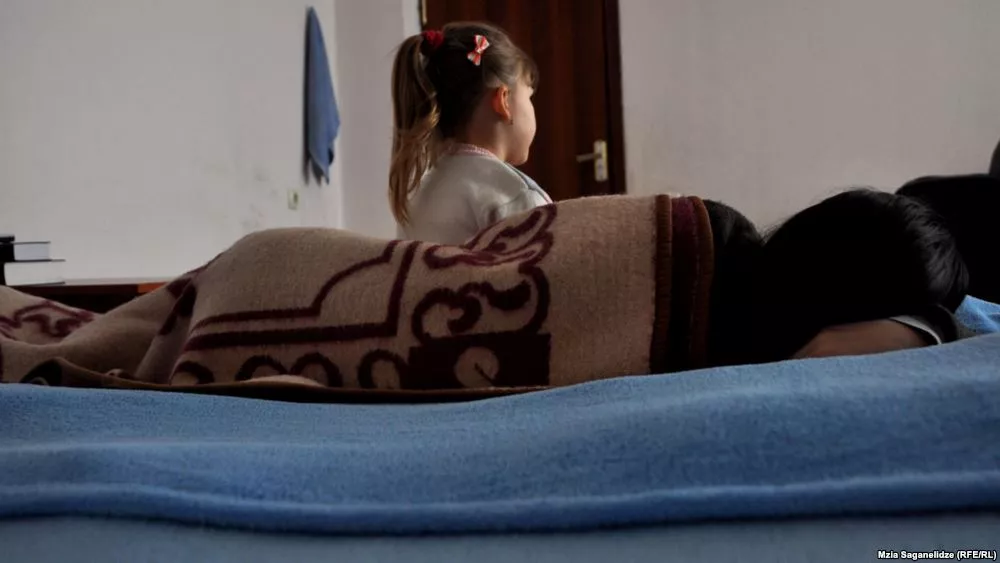
Every fourth woman in the Federation of Bosnia and Herzegovina is a victim of violence, and the only place where they can take shelter and save themselves are safe houses run by non-governmental organizations in this BiH entity, reports the Patria news agency.
The new law in the Federation of BiH on protection from domestic violence, which should soon be before the Parliament of the Federation of Bosnia and Herzegovina, could jeopardize the work of safe houses. The new law stipulates that safe houses become institutions. These institutions, according to the new law, do not favor victims, nor will they provide them with better protection.
One of the victims who suffered violence in her family for more than 20 years agreed to speak to RSE about how - thanks to the only safe house at the association "Vive žene" - she managed to escape from a family hell.
"Through their treatments, I realized what condition I was in. I was in a severe psychological state. I never asked anyone for help, because that's how it is here in the Balkans. We women just suffer and suffer. A sweater I was beating didn't help me express all the horror inside me. I had psychologically hit rock bottom," says our interlocutor.
And her husband admits the mistakes he made. But he realized those mistakes only when he sought help together with his wife.
"I had big problems at work. And then I would come home and just a small trifle was enough for me to explode. I would bang my head against the wall. Then the psychologists at 'Vive žene' explained some things to me. I didn't know that until now, and I'm not young. I had never heard of those things, psychiatrists and such. If I had heard earlier, I would have been a different man. I could have caused all sorts of problems, but thank God I didn't, all thanks to that house at 'Vive žene'," emphasizes the husband.
The survival of safe houses, which are mostly run by non-governmental organizations in the Federation of BiH, could now be called into question. Although governments at all levels in the Federation finance them very little or not at all, due to which one safe house in Mostar has been unable to provide protection to women for several months, the Federation Government is now, nevertheless, setting conditions on how their organization must look in the future.
"Three members of the working group - the Ministry of Health, the Gender Center, and non-governmental organizations - were against such a conclusion. However, on December 1st, a proposal was suddenly made that safe houses be established in accordance with the Law on Institutions. This poses a problem for us in the sense that we will no longer be non-governmental organizations, that the existing safe houses need to be closed, i.e., they will no longer be able to function. It should be emphasized that this is not just about non-governmental organizations but, above all, about victims of violence, because the only protective measure that currently works is accommodation and shelters. And it's not just a shelter, to hide a woman from the abuser. It's a matter of recovery and rehabilitation of victims," said Jasna Zečević, director of "Vive žene" Tuzla.
And the fact that safe houses, often the only refuge for abused women, become institutions would not bring victims any better protection, nor would it prevent abusers from accessing victims. These institutions would only mean a much larger management structure: a director, management and supervisory boards, additional administration, and enormous paperwork.
Fatima Bečirović, coordinator at the Association "Vive žene" Tuzla, has been working with victims of violence for years. She states that she now fears that women and children would be left without the only protection from abusers.
"Safe houses in BiH receive requests for the admission of victims every day. We know that the situation on the ground is very serious and that we even have murders. There will be significantly more complex issues and significantly more severe consequences if the existing safe houses have to be shut down. Also, if the existing safe houses are shut down, we are not sure that the state is ready to take responsibility and open new safe houses in accordance with the proposed law. Many serious consequences will follow, which, in the end, will again only harm the victims," states Bečirović.
The safe house at the association "Vive žene" is the only one in the Tuzla Canton area. It is financed mainly thanks to foreign donors.
Although the law stipulates that the Government of the Federation of Bosnia and Herzegovina is obliged to finance safe houses with 70 percent, over the last eight years the Government has covered only 10 to 15 percent of the costs.
Safe houses have so far provided complete protection to women from societal condemnation. Many of them told us that when seeking help at health centers, they encountered prejudice, disapproving looks, and psychological help was also lacking.
Also, they would return under the same roof as their abusers. Our interlocutor from the beginning of the story now tells everyone how important it is to seek professional help, because her own life has completely changed.
"Now, when he comes home from work, he looks at me so nicely. I cannot describe it to you in words. It's happiness. He doesn't bring me material things, because what did that gold mean to me when he looked at me sideways, it was worthless to me. But when he says a kind word to me and when he casually caresses me, that means a lot to me. A person certainly needs to be apart sometimes to know the meaning of their partner, how much we mean to each other. I would recommend everyone to turn to professionals. They will help them better than their closest family members," our interlocutor will say sincerely.
In Bosnia and Herzegovina, safe houses have never been institutionally resolved. Victims are mostly cared for by non-governmental organizations. When it comes to domestic violence, the entire system is, in fact, skewed, and the new law, if Parliament adopts it in this form, will not correct it much, writes RSE.
Komentari (0)
Prijavite se za komentiranje
PrijavaJos nema komentara. Budite prvi!
Minuta
Sve →Iz drugih kategorija

High Representative Not Elected: Germans, French and British Against Americans, New Attempt at End of June

ČOVIĆ WITHOUT MERCY: How Those Who Brought Ademović to Office Created a Political Hell for Him



Sunny Saturday, quite warm



Tragedy in Albanian resort: Two minors drown












