
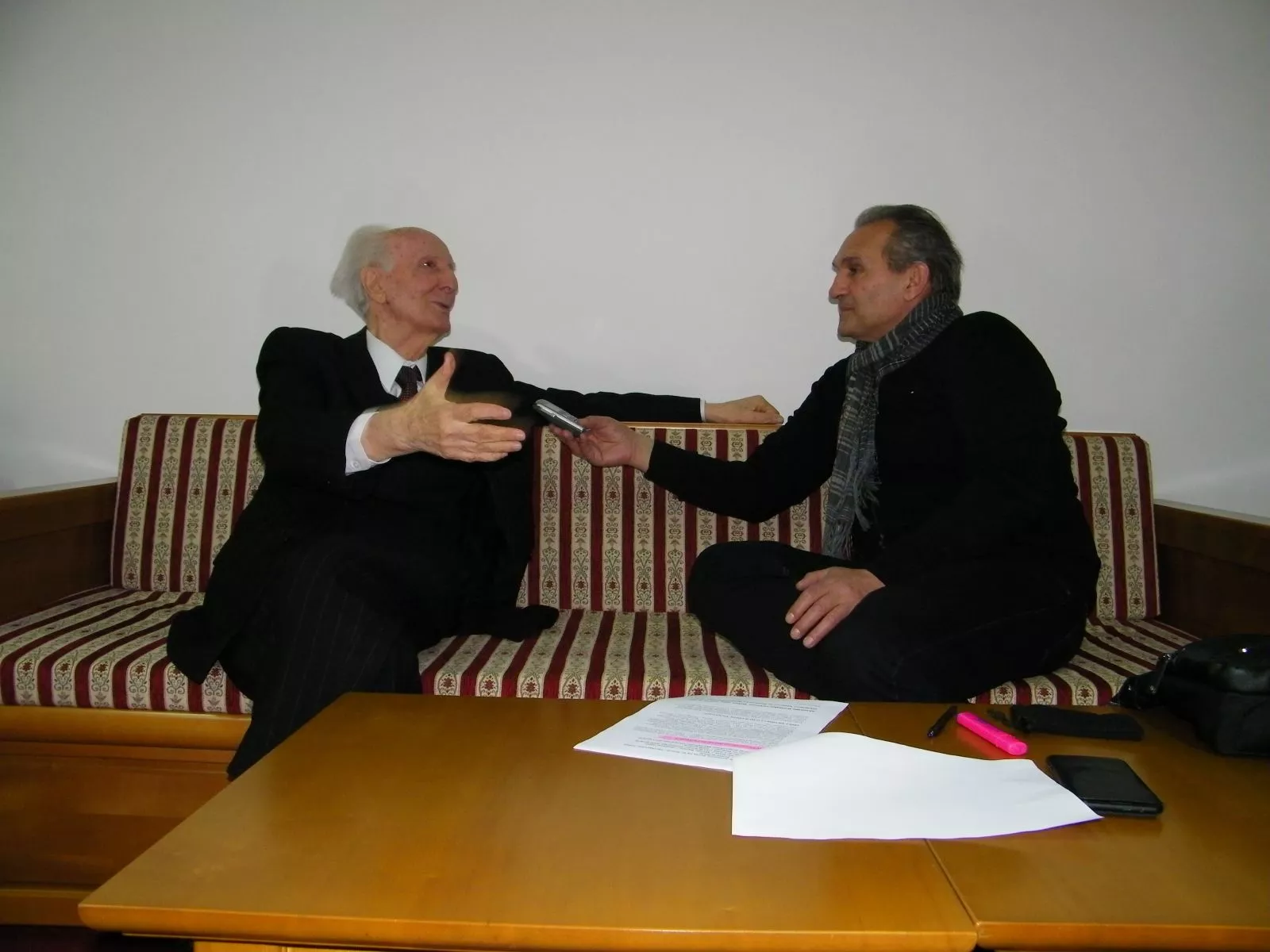
Interview by Amina Čorbo-Zećo
Academic Muhamed Filipović left us on February 26 this year, leaving behind works of immeasurable value for Bosnia and Herzegovina, especially the Bosniak people, but also for science as a whole.
Sarajevo journalist, publicist, and writer Ruždija Adžović is one of the few who had the opportunity to collaborate most directly with academician Filipović and to write a book about him that will soon be in print.

Respected academic Muhamed Filipović has left this world, you socialized and collaborated with him, what memories connect you to him?
Adžović: I truly had the privilege and honor to collaborate with Professor Muhamed Filipović and to be in his proximity in various circumstances and situations, when you get to know a person best. Professor Filipović's works, his life, and his free and untamed spirit, which often cost him dearly in life, speak best of him. He was not a man, like many intellectuals, who lived in the comfort of silence and not rocking the boat. I would not speak of him in eulogies now, especially not the cheap and worn-out platitudes that some shapers of our destinies uttered with irresistible ease after the news of his death, people who did absolutely nothing to ensure a peaceful and dignified old age for our greatest intellectual and one of the most significant figures in the entire history of Bosnia and Herzegovina.
Some important people, who, even during his lifetime, ranked Professor Filipović among the ten greatest living philosophers in the world, spoke the truth: Bosnian society has not built itself to recognize the value of Professor, scientist, and philosopher Muhamed Filipović.
Academician, poet Abdulah Sidran best described the significance of Professor Filipović and our society's attitude towards him: "Every official in this country has five or six offices where some advisors sit. Why wasn't Professor Muhamed Filipović one of them in the last twenty years? Whether you agreed with him or not, he was a 'museum on two legs'.
What is in his head is not in a thousand other heads. And when he is gone, we will have lost an immeasurable amount of data, memories, and intellect. These are not reasonable things," said Sidran. The news of Professor Filipović's death truly struck me. The cheap pathos in the hypocritical messages of those who "mourned" Professor Filipović from their comfortable armchairs and offices hurt me even more.
What could we have learned from academician Muhamed Filipović?
Adžović: If nothing else, we could have learned, especially our young people, that one should not bow their head to anyone, that one should fight for the truth, for their stance, even if it often brings unpleasantness in life. Professor Filipović felt this most keenly, but he departed to a better world as a winner, upright, steadfast, and with his head held high, just as he lived his entire life.
Many adorned themselves with his feathers, his knowledge, and attributed to themselves the results of the most significant processes in BiH that Professor Filipović initiated. But history will remember and embrace the inexorable facts and the people who gave it the most significant things. After all, who remembers the numerous ministers, deputies, and even some members of the Presidency of BiH? Professor Filipović's work is already etched in eternity.
His lucid rhetoric hurt many. Professor Filipović was attacked in all systems, and in every government, he was a "thorn in the side," precisely because he did not tolerate ideological or any other shackles. During communism, but also afterwards, commissioned texts, even books, were written about him with the aim of discrediting Professor Filipović. Such a fate for him was long ago "predicted" by his professor at the Faculty of Philosophy in Zagreb, Vladimir Filipović, which is discussed in my book. Namely, when the then young student Muhamed Filipović asked him to take his final exam, Professor Vladimir Filipović persuaded him not to rush, to stay another year in Zagreb where his works were already being published in reputable journals and newspapers.
Young Muhamed hesitated, wanting to return to Banja Luka, mostly because of his mother. And after several such dialogues between the student and the professor, Vladimir Filipović "opened up" completely: "Listen, Filipović, I've been beating around the bush and didn't want to say this: you are the kind of person who, with your appearance, attitude, behavior, speech, and knowledge, buys enemies for yourself."
These words of Professor Vladimir Filipović seem to be the answer to everything that happened during the long life of his student and namesake Muhamed Filipović, and those words accompanied him until the end of his life.
Academician Filipović was particularly a "thorn in the side" of Serbian and Croatian nationalist circles, who saw in him, his openness, his uncompromising fight for truth, and his courage the greatest danger to the realization of their ideology and their then-hidden dishonorable intentions towards BiH and Bosniaks. Filipović was constantly their target. On the other hand, he was also attacked by Bosniak nationalists.
It is interesting, for example, that many who today consider themselves the vanguard of Bosniak identity were "smaller than a grain of millet" during communism, when Professor Filipović was declared a Muslim nationalist by Serbian and Croatian ideologues, which even endangered his family's existence. Professor Filipović himself says in my book, among other things: "In your own country, you can only become significant after you die. They can't forgive you for being significant..."
How did you come up with the idea to write a book about academician Filipović and how did that book come about?
Adžović: For better understanding, I must first tell you our "prehistory." Namely, I got to know Professor Muhamed Filipović more closely in 2000 in the premises of the Trade and Information Mission of Montenegro in Sarajevo – the precursor to the Embassy of Montenegro in BiH – led by Montenegrin writer, intellectual, and university professor Novak Kilibarda. I had the privilege of attending incredible intellectual sessions and gatherings which, besides Professor Filipović and Kilibarda, most often included professors and top BiH intellectuals such as Vladimir Premec, Ljubomir Berberović, Vlatko Doleček, Adil Kulenović, and even Abdulah Sidran.
Thus, I witnessed many theoretical-philosophical-cultural discussions, as if they were literary-scientific circles, not informal gatherings with good drinks. I also witnessed numerous events that turned into unforgettable anecdotes. I was particularly interested in the intellectual duels, or rather, the intellectual sparring between two giants of the written, but also spoken word, Novak Kilibarda and Muhamed Filipović. It was a real treat and pleasure to listen to the "duel" of brilliant minds, the struggle, and most often the futile effort of both to snatch the word from each other.
In my book "Kilibarda – Sarajevo Days," published in 2014, I described many of these events. Professor Kilibarda, during his diplomatic engagement in Sarajevo and frequent socializing with Muhamed Filipović, understood his "status" in today's BiH society. He said of academician Filipović: "Such a polyvalent personality, such a devilishly complex intelligence, naturally has its friends and enemies. You will know best who Tunjo Filipović is when he is gone, because a man who can speak inspiringly not only about philosophical problems, for which he is an expert, but about any postulate of life, aesthetic, ethical, or any other, deserves great respect..."
One spring day in 2016, while walking through Baščaršija, I met Professor Muhamed Filipović near the entrance to "Morića han." We greeted each other as usual, and then he told me: "Ruždija, I read your book about Professor Kilibarda and I liked it very much. An interesting book and an interesting format in which it was done."
I couldn't wait for those words, because my next "victim" was supposed to be Professor Filipović himself. Knowing that he was very busy, always engaged somewhere, and that he was "short on time," and also known for being difficult, I hesitated for months to reveal my intention and desire to him. At that moment, encouraged, I readily approached him: "Well, Professor, I'm glad you liked my book. I've been planning to make a similar book about you, in the same format."
"Why not?" Professor Filipović replied. Although I had quite good cooperation and frequent meetings with him until then, although Professor Filipović had already reviewed one of my previously published books, although we had participated together several times at book promotions of other authors, such as our great writer, the late Isnam Taljić, I was somehow convinced that he didn't have time for our months-long conversations and meetings, which are necessary for the creation of a book dedicated to him.
When he "gave me the green light" during that chance encounter in Baščaršija, I began serious preparations. I called him at the beginning of April 2017, and soon our purposeful socializing and daily, hours-long conversations began. Our conversations, with short breaks, lasted from April to the beginning of August or September 2017. Then, a long period of work on the book followed to give it its final form. When the manuscript was finished, I sent it to Professor Filipović for authorization, which he later signed.
Tell me more about the book, what is it about and when could it see the light of day?
Adžović: The book is a kind of confession of Professor Muhamed Filipović, from his childhood to the present day. We talked about many topics, events that were fateful for BiH and our current society, then about the most important figures in political, cultural, and public life, figures who marked an entire period in the history of our country and who influenced the course of our new history.
In my book, Professor Filipović also addresses the attacks by some of his opponents, and his response to those people is not omitted. His attitude towards some personalities for whom the public in BiH has a very positive view, such as, for example, former US President Bill Clinton or writer Predrag Matvejević, is particularly interesting. However, Professor Filipović did not have a good opinion of them. All in all, it is a very interesting book, in which readers will find many facts that the BiH public, as well as the public in the region, did not know until now.
The cover of the book will feature a portrait of the late Professor Muhamed Filipović, created by the renowned Montenegrin painter Aldemar Ibrahimović. I was honored when he offered to do that portrait, respecting Professor Filipović. Ibrahimović also created my portrait especially for this book, which will be on the back cover, along with the usual author's notes.
I know you wanted to publish the book during academician Filipović's lifetime, which "Patria" has also written about before. At the memorial service for Professor Filipović, someone said that the greatest are best spoken of only after their death, is that really so?
Adžović: I truly regretted not publishing the book during Professor Filipović's lifetime, and it had been ready for some time. Unfortunately, it is difficult to find common ground with today's publishers, and that was the case this time as well during my contact with several publishing houses to whom I offered the manuscript. I wanted that book to be published while Professor Filipović was alive and in the strength and vitality for which he was known. I wanted him to participate in the book promotion, at least in Sarajevo. Unfortunately, these wishes were not fulfilled. However, I will do my best to ensure that the book is published as soon as possible. I hope it will be printed by the end of April or the beginning of May at the latest. I have promises from some of my friends and institutions that they will help me with this.
What was it like working with Muhamed Filipović? Can you tell us an anecdote from the creation of the book?
Adžović: Currently, an anecdote related to the publication of the book comes to mind. Namely, once while I was recording our conversations, Professor Filipović told me: "You know, Ruždija, I would like you to publish this book we are working on after my death." I was a little taken aback, but, as our people say, I quickly got my wits about me and replied:
"Then I will have to wait a long time, dear professor. You Filipovićs are long-lived. I hope I don't go before you." The professor laughed for a long time at that. Otherwise, there are many anecdotes in this book of mine that I often laughed heartily at while talking with Professor Filipović, who, with his wit, drove his interlocutors crazy, especially those who were not even close to his level in debates. This gives a special charm to this book, of which I am extremely proud.
I have saved the recordings of our conversations, which, I believe, are an invaluable treasure, and which I would like to hand over to an institution that will deal with preserving the work of academician Muhamed Filipović, perhaps even to a media house.
What are you currently working on. Is another book in preparation?
Adžović: Another significant BiH personality is in my creative focus. It's about Abdulah Sidran. Mr. Sidran has agreed to have a similar book made about him. We have been discussing this for a long time. However, since he is also very busy and engaged, I am waiting for a favorable opportunity to "catch" him, to finally sit down and start working. I hope it will be soon. My new novel is also on hold. About 60 percent of the novel is done, I need to find time to finish it. My priority was the book about Professor Muhamed Filipović.
Komentari (0)
Prijavite se za komentiranje
PrijavaJos nema komentara. Budite prvi!
Minuta
Sve →Iz drugih kategorija

High Representative Not Elected: Germans, French and British Sabotaged Americans, New Attempt at End of June

ČOVIĆ WITHOUT MERCY: How Those Who Brought Ademović to Office Created a Political Hell for Him



Sunny Saturday, quite warm



Tragedy in Albanian resort: Two minors drown












