
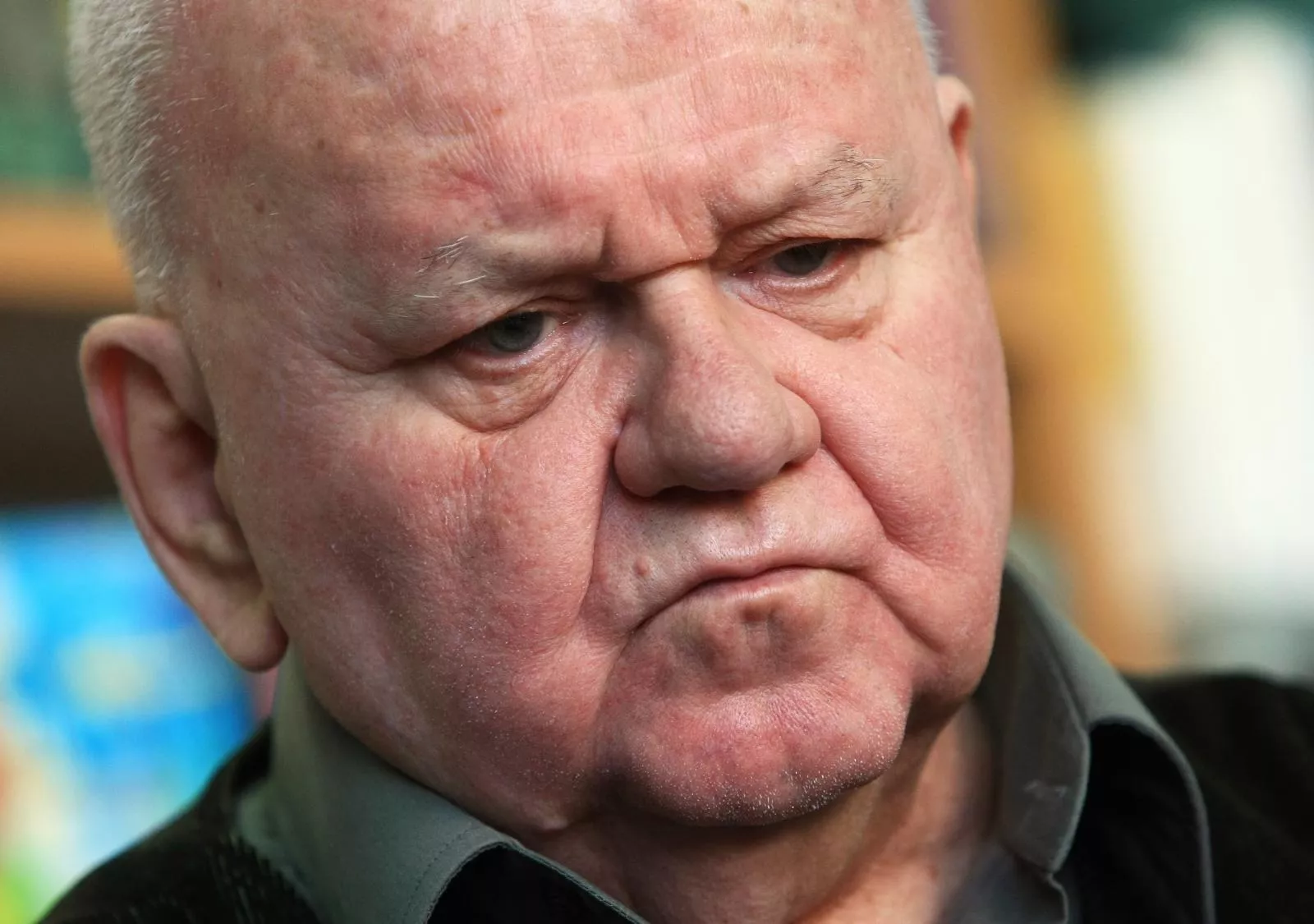
Interview by: Armin Aljović
The Municipal Court in Sarajevo has issued a final verdict according to which Goran Simić must pay compensation of KM 1,500 to the Sarajevo writer and poet Abdulah Sidran, plus interest, and publicly announce this verdict, due to the interview “Nostalgia is a terribly expensive disease” published in Slobodna Bosna in 2012, in which, among other things, Simić accuses that “at the beginning of the war (Sidran) wrote a column…” which, Simić assessed, was an incitement to his lynching.
Seven years later, the Court assessed that Simić's accusations were unfounded and slanderous, while Sidran himself says in an interview for the Patria News Agency that this verdict is one of the hardest battles for truth and justice he has fought.
How did you find yourself in such a chaos from which you have been trying to escape all these years? Was it a set of unfortunate circumstances, some personal revenge, or something else?
- I wouldn't call it chaos. Such abuse of an individual can cause occasional chaotic mental states, but they would lose their battles if they remained in them and surrendered to them. No! An abused individual knows that they are a victim of what is called “the continuation of the war by other means,” and I have called this entire post-Dayton era a period in which the “war for the interpretation of unfinished wars 1991-1996” is taking place. I said: “Whoever's interpretation wins will subsequently become the victor and write history as it suits them, regardless of truth and reality. It wouldn't be the first time for us.” In our micro-histories here, this has usually happened, not exceptionally. It's a very long story, but it's quite clear that I am one small stone in this – in the search for symmetry, in the need to destroy BiH values and authorities, especially those who have followers among all three dominant ethnicities here. So, it should be clear to everyone: in line with the overall policy of our eastern, and later western, neighbor, what happened from '92 to '95 has continued, the war aims have not changed, they are trying to achieve them by other means. In this regard, my humble self is a victim of the aggressor's need to find a strong enough figure in the literary sphere who could be presented in their propaganda as something like a “Bosniak poet ultra-nationalist.” Of course, they couldn't find such a person – with a Muslim name and surname – in our amateur literary circles, and in the selection process, my European recognition was very important.

Goran Simić's controversial interview with the then weekly Slobodna Bosna

Part of the verdict according to which Simić must pay Sidran compensation for defamation
Why was it so important for you to deny a newspaper interview, given all the awards and recognitions you have received, even, as you say yourself, from the 'eastern neighbor, and even the western one'?
- One must look at these things a bit deeper. All this time – and the slander about my alleged criminal behavior during the War Against BiH was placed on my shoulders back in 2000, with an article by journalist Nagorka Idrizović, in one of our then-respected daily newspapers – I was not fighting for myself, for the living Sidran, but for my descendants, and for the Sidran about whom, in future lexicons and encyclopedias, alphabetical entries will be compiled – as “notes for eternity.” I could not allow my descendants to carry the burden of monstrous lies about their father, grandfather, great-grandfather into their lives. I – who, in besieged Sarajevo, put my head on the line a hundred times to help a friend, a fellow citizen, a colleague, a friend of a different faith and nationality, and who, as a writer, wrote hundreds of pages during the war, under siege, with meanings directly opposite to what the slanders claimed – did not have the right to destroy several decades of my descendants' lives, as long as it would take for someone diligent, truth-loving, and authoritative to be born/created/found – to refute a lie that had lived as truth for so many years. Because the questions that my great-grandchildren would be asked in the future, in some France or Ireland, by their peers would not be: “Are you descendants of that Sidran whom some poet said incited the killing of Serbs in Sarajevo from '92 to '96, during the War against Bosnia?” – but the matter would be reduced over time to: “Ahaaaa, you are descendants of that poet Sidran who killed….” Etc. From that idiotic text by Nagorka Idrizović, from 2000, through the claims of Canadian citizen Goran Simić, from 2010 – I survived a process whose result is the realization that it is much harder to live under slander and defamation than in poverty and chains.
As for the verdict, that's a done deal. I am not interested in the financial aspects of this procedure; I am interested in social, public satisfaction, and I have received it with this verdict, as well as condemnation of the immoral act of a supposed intellectual and writer. However, at this moment, it is also very important to say that our legislation in that area – presumably copied from Anglo-Saxon law, with the help of bad translators and weak lawyers – is completely flawed. To sue someone for defamation, you must provide proof of suffering psychological pain (a completely elusive matter!) and state a precise financial claim. Courts do not accept lawsuits without this! That's America for you! Tell me, brother, how much money do you want for the emotional pain suffered, and then we'll start the job! I tried to explain to my lawyers that I did not suffer any emotional pain from that idiot (I did from the editor who published that abomination, and who knew it was a serious fabrication and lie, with terrible consequences!), that I am not interested in money but in public social satisfaction… but to all these logical objections, the lawyers shrug helplessly.
We, who have followed your years-long disputes with colleagues from literary associations here “from the outside,” could not have imagined that a newspaper interview could affect you so intensely. So many years, so many emotions?
- Yes, years, and emotions. One must not lie about it. I went through hell. That's why the Verdict – let's repeat: final! – deeply moved me, I cried, alone in my room, then among my loved ones… it got out of all control… Two MEMORIALS from 1941 came to mind (Ibrahim Sidran, Abdulah Sidran – Jasenovac), they stood on the wall throughout my childhood and youth. In tears, I thought about framing the Verdict and hanging it on the wall, next to them. But, let's move on. This is not the end. If the scoundrels and swindlers think that I will now retire and rest, that I will leave them alone – they are mistaken. As long as I breathe, I will point a finger at Injustice and Evil.
How is it that you were disparaged in your own country, yet received awards on the world stage? What did you discuss with French President Emmanuel Macron during your recent lunch at his Elysée Palace?
- As you know, I was part of a group of about 30 European intellectuals – including four Nobel laureates! – who completed work initiated online months earlier in France. We signed and sent a Resolution to the European public, titled “Europe, your house is burning!” which – with our email discussions and suggestions – was drafted by philosopher Bernard Henri Levy, highly respected in Europe as a first-class connoisseur of Balkan affairs and politics – for which he is often criticized for being biased in his “pro-Bosnian” stances. Well, of course, for Belgrade and Zagreb, anything that makes sense for truth and justice, and anything that is not unequivocally on the side of their expansionist policies, is pro-Bosnian. Bernard Henri Levy is a hero to all BiH patriots. The people here grew to love him during the war. We saw him as a European brother. Who knows how many times he passed through the Tunnel.
So, on the eve of the European Parliament elections, recognizing the danger of severe right-wing shifts and the fascization of Europe, he gathered the most respected European literary and philosophical names – with the hope that their authority and credibility, contained in their ideological diversity – might, on the eve of the elections, inject some strength into the “leftist winds” – so that the influence of threatening and locally strong populist, right-wing, and even fascist tendencies would be reduced within the European Parliament.
On June 21st, we spent almost the entire day at the Elysée Palace, with the President of France, Mr. Emmanuel Macron. I had been to important and significant places before, but this is still something above all of that. How did I get there, the only one from the Balkans? I think I recognized the premises that Mr. Levy followed in selecting the participants, but we will talk about that another time. As I notice, you have also registered the fact that this event, extremely important for the state of BiH, especially for its culture, was practically ignored by the domestic media. Nothing new for me. The cross of fabricated lies and slander that I have carried on my back for 20 years has also included various forms of media boycotts and abuse. So who, besides me, can boast of the fact that BHT published my obituary instead of a birthday greeting? No one has ever apologized to me, not even with a single word. I am used to that, I rarely talk about it, as they say: let them be. – But I must thank the advisors from the cabinet of President Željko Komšić, who nevertheless assessed that Mr. Komšić would have something to discuss with Sidran after the meeting between the Bosnian poet and the French president. It was an incredibly simple and intimate meeting and conversation.

Sidran and Levy with European intellectuals in the courtyard of the Elysée Palace. Photo: Private archive of Abdulah Sidran

Part of Macron's letter to Sidran. Photo: Private archive of Abdulah Sidran
It was very unusual, and many noticed it, that President Macron, as he bid farewell after that working lunch, kept you a little longer, and talked with you a little longer, than with the others he was seeing off. What actually happened there?
Yes, the doors to the central area, where the journalists were, were already open, so the cameras could be focused on that delicate peculiarity. A warm and long handshake, a distinctly friendly tone, no sign of haste or farewell. There was a young, very good translator, perhaps related to our minister Bevanda, a nice young man, Ivo, and I understood everything very well, including that I should not talk about those three or four sentences further in public. I immediately asked my daughter about it, because she has no secrets in that business. (She has been in BiH diplomacy since its inception, having met and befriended the future ambassador Bisera Turković in the refugee camp Gašinci in Croatia during the war in 1992/3). Miranda told me that such sentences are not said diplomatically/courteously, and if President Macron told me that I would soon receive a personal letter from him, asking me to reply “in a way that…” – then I will receive that letter, perhaps even very soon.
It wasn't soon, but I received the letter, and I feel honored.
So it happened that my mailbox delighted me twice in two days, which is very rare for pensioners, and for everyone else who dreads every blue envelope peeking out of the mailbox.
Komentari (0)
Prijavite se za komentiranje
PrijavaJos nema komentara. Budite prvi!
Minuta
Sve →Iz drugih kategorija

High Representative Not Elected: Germans, French and British Sabotaged Americans, New Attempt at End of June

ČOVIĆ WITHOUT MERCY: How Those Who Brought Ademović to Office Created a Political Hell for Him



Sunny Saturday, quite warm



Tragedy in Albanian resort: Two minors drown












