
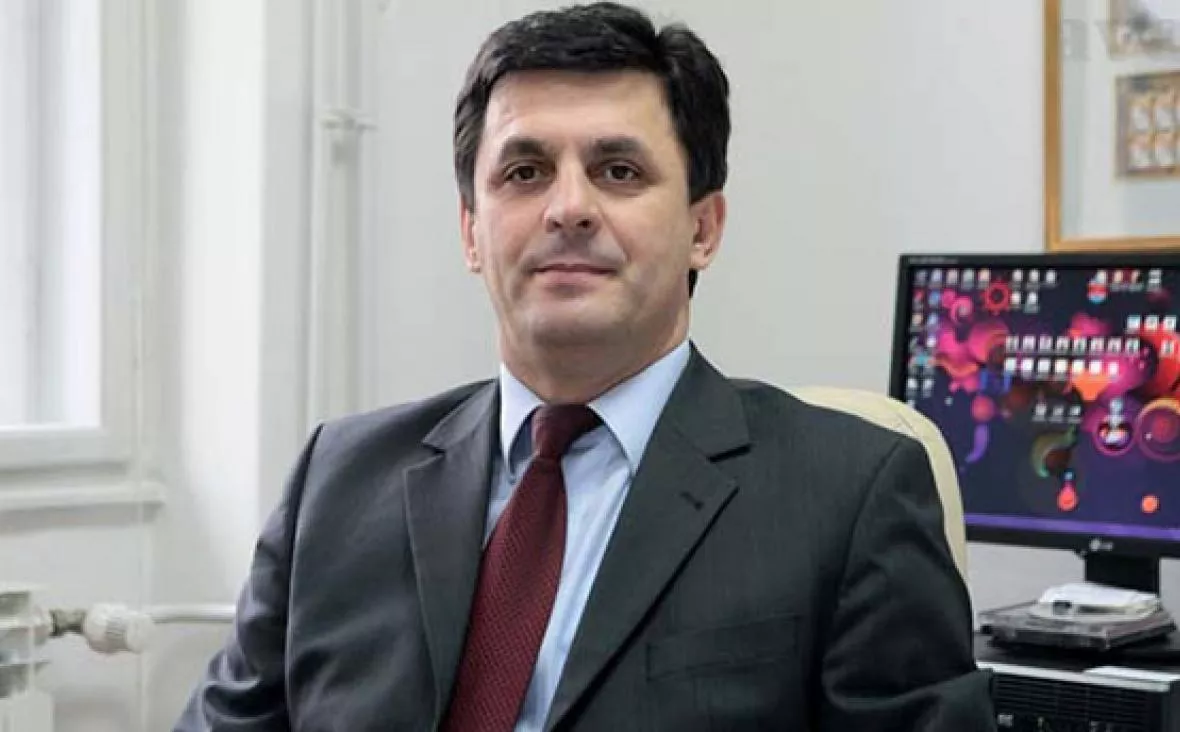
In this short text, I remind the public of several important thoughts on the place and function of social and humanistic sciences in society. At this point, it is not necessary to repeat the concept of Max Weber's methodology or to provoke the old dispute between natural and social sciences or, as it is formulated in the German-speaking area, between Geisteswissenschaften and Naturwissenschaften. That is a superfluous and unproductive dispute today.
In today's Bosnia and Herzegovina, questions about science, knowledge, and higher education should be directed in a different direction and in the context of other socio-pragmatic goals that differ from those of the 19th and the first half of the 20th century in Europe! It is unacceptable, in this regard, for overly vocal "technicians" to obscure the importance of focusing on the BOSNIAN QUESTION as the key issue of this country, its citizens, and its future. This difficult question is resolved by social and humanistic sciences!!! That is their task, and only they can do it. Who will speak and write about the dramatic phenomena and processes in the last thirty years of Bosnia? Who will understand the dirty role of French policy and its president Mitterrand during the aggression against the Republic of Bosnia and Herzegovina? Who will analyze the genocide in Bosnia and its consequences for the future of this country and its people? Who will describe the meaning of human life in the future of this country?
On the occasion of current events at the "cantonal level" of higher education, the tacit acceptance of the reduction of science and scientific research to the "canton" or one large city, it is necessary to say a few words of warning to all those who behave in a carnival-like and privatizing manner towards science and education, and to those who understand the importance of the historical moment and take responsibility for this issue. It has almost become self-evident that science has lost its state priority and care – there is no ministry for science and higher education at the state level. This opens the door to the arbitrariness of individuals and particular interests. The suppression of science from the sphere of the state's interest leads to the provincialization of the epistemic capacities of society and the rule of irrational explanations of social phenomena. Reducing science and education to the cantonal level is a strategic danger to the state and society, meaning: science cannot yield results at the cantonal level! It is a strategic activity of every developed culture and nation-state today.
In a post-war and post-genocide society, such as Bosnia and Herzegovina, science has a special place and task. Answers to the BOSNIAN QUESTION today can only be provided by science – and primarily by humanistic and social science! The following should be said about this:
First, and most importantly, science aims to offer us scientific explanations of phenomena and events, thereby shaping the structure of truthful statements about what is happening. This is the basis of social knowledge and a bulwark against the relativism characteristic of irrational environments. Where there are no scientific explanations of social phenomena and processes, prejudice, superstition, and ideological falsehood prevail.
Second, science provides the epistemic basis for social organization or the entire order within a state. It delivers knowledge or produces knowledge about processes. In doing so, its basis is ethical! This asserts that the epistemic starting point of social knowledge (episteme) is, in fact, ethical, or in other words, the scientist is guided by moral conduct and the demand to speak the truth and present it to other people. Without epistemic qualities, state institutions cannot be maintained at a functional level, and immorality, corruption, and irresponsibility then loom over them. Therefore, it is necessary to emphasize that the basis of every episteme is ethical!
Third, science and education cannot be reduced to a techno-managerial narrative. Today, unfortunately, science is caught in a system of bureaucracy, and it happens that people who are not scientists but managers, technicians, politicians, parts of budget lobbying groups, speak about science, which testifies to the dangerous bureaucratization of the scientific "engine" in which "professors/researchers" are turning into "wage laborers," into "employees" to whom some "employer" prescribes rules of conduct in science. The commercialization of science in a poor society leads to the monopolization of education (only some will "be able to educate" and only some will "be educated") and a destructive stratification of society, often called a "knowledge-based society." Science certainly cannot be treated as some communal enterprise or agricultural farm, of course, with respect to these activities, nor can science be defined by ethnic attributes in the grim ethnopolitical reality.
Fourth, science cannot be reduced to a "citation narrative". A text or partial participation in a project can never be a measure of science. Today, citation is a quantitative indicator of reference to some "text," but it is not a decisive or exclusive proof of quality and scientificity. Journals and citations mostly appear within large publishing houses (private businesses). They impose the "importance" of texts to be "elaborated." Quantification and quantophobia are not necessarily conditions of scientificity.
Fifth, science should provide guidelines for a (post-war) society. If social science is subordinated to daily political views and interest positions, then the direction of finances for research and development will depend on "party affiliation" or affiliation with the lobby that controls scientific research institutions. Political commissars will appear there who will devise "criteria" according to which funds for "research projects" will be allocated. There will be very little science or just the "things of science"... Society will be left without a real guiding force or structure that provides rational orientation.
Sixth, decisions about science in a society should be made by logicians, methodologists, epistemologists, sociologists of science, historians and theorists of science, semioticians, lawyers, and some other modalities of knowledge. Science is not a technical matter in a society or a form of political directive. In both cases, science is destroyed and becomes a fruitless form of social manipulation. The last thirty years bear witness to this!
Seventh, laws on higher education cannot be made according to the "subjective assessments" of individuals and interest groups, but according to the historical context in which a state and its society find themselves. The law should ensure the highest functioning of science and ensure its unimpeded production of knowledge. It is especially important to define the place of the scientist in society! The law must be motivational, encouraging for the few and courageous people of knowledge, because it may happen that young and educated people will see nothing attractive or appealing in engaging in the scientific endeavor and building a scientific career. Only then will the difficult question of young scientific staff and the future of science at the university arise!
These methodological-epistemological positions should help the academic community in constructing the legal framework for scientific research activities and education at the university level. The law must regulate this and ensure that science is preserved in our society. Of course, it should not be forgotten that science cannot be "cantonal," but someone has imposed a system that does not yield results and has confined us within it.
Science must be protected from the privatization of science, and society from doctored reforms and the profanation of higher education.
Prof. Dr. Senadin Lavić
Komentari (0)
Prijavite se za komentiranje
PrijavaJos nema komentara. Budite prvi!
Minuta
Sve →Iz drugih kategorija

High Representative Not Elected: Germans, French and British Sabotaged Americans, New Attempt at End of June

ČOVIĆ WITHOUT MERCY: How Those Who Brought Ademović to Office Created a Political Hell for Him



Sunny Saturday, quite warm



Tragedy in Albanian resort: Two minors drown












