
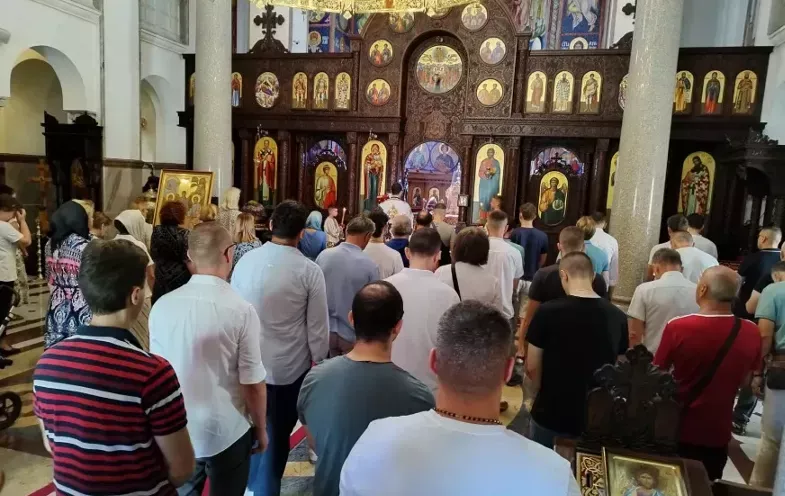
(Patria) - A memorial service was held today in the Cathedral of Christ the Saviour in Banja Luka in memory of Dragoljub Draža Mihailović on the occasion of the anniversary of his death.
Draža Mihailović was the leader of Chetnik formations during World War II. His fighters committed crimes during that period.
In 1946, Mihailović was sentenced to death for war crimes and collaboration with Nazi Germany, and was subsequently executed, reports Radio Free Europe.
The organizers of the memorial service were the Cathedral of Christ the Saviour and the Serbian Assembly Baštionik.
According to the website of this organization, it is a “voluntary, non-profit, and non-partisan gathering of Orthodox Serbs and all people of good will who accept the principles and goals of the Assembly” which advocates for “the preservation of the spiritual, cultural, historical, and other heritage of the Serbian people”.
The glorification of Draža Mihailović's image and work is present in Bosnia and Herzegovina 77 years after World War II and 28 years after the end of the last war in Bosnia and Herzegovina. This is evidenced by street names that bear his name or the names of members of the Chetnik movement.
A monument in honor of Mihailović has been erected in Bileća in southeastern Bosnia and Herzegovina, he has a street in Istočno Sarajevo, and murals with his image have been painted in Gacko, in southeastern Bosnia and Herzegovina, and in Foča, in eastern Bosnia and Herzegovina.
Bosnia and Herzegovina does not have a Law prohibiting the activities of fascist and neo-fascist organizations or the wearing of their symbols.
No ban on glorifying Nazi-fascist movements from World War II
The House of Peoples of the Parliamentary Assembly of Bosnia and Herzegovina (PS BIH) did not ban the glorification of leaders of Nazi-fascist movements from the World War II period in April 2021.
The proposer of the initiative was the then delegate Denis Bećirović from the Social Democratic Party of Bosnia and Herzegovina (SDP), who requested that all cities and municipalities in Bosnia and Herzegovina ban any direct or indirect form of glorification or affirmation of leaders of Nazi-fascist movements from World War II.
This applied to the leader of the Ustaše movement Ante Pavelić and the leader of the Chetnik movement Dragoljub Draža Mihailović, as well as all other members of Nazi-fascist movements, organizations, military formations, and associations.
The reason for Bećirović's initiative was the decision by the Municipal Assembly of Bijeljina, a city in northeastern Bosnia and Herzegovina, to erect a bust of Dragoljub Draža Mihailović, based on the initiative of the Chetnik Veterans Association “Semberija”.
Subsequently, a memorial bust of the leader of the Chetnik movement from World War II, Dragoljub Draža Mihailović, was erected in Bijeljina, in a square bearing his name.
16 Chetnik Associations in Bosnia and Herzegovina
There are 16 registered Chetnik associations in Bosnia and Herzegovina.
Data on the total number of members and sympathizers are not known.
According to current laws, the activities of certain associations can be banned in Bosnia and Herzegovina if they act contrary to the Constitution, or incite religious, racial, or national hatred or discrimination.
Chetnik associations were identified as a threat to the national security of Bosnia and Herzegovina in the Strategy for Prevention and Fight Against Terrorism from 2006 to 2009. They were not mentioned in two subsequent documents.
In the 2017 Security Report for Bosnia and Herzegovina, the Ministry of Security of Bosnia and Herzegovina stated that the Ravna Gora Chetnik Movement, by promoting inter-ethnic division, “has a negative psycho-social impact on the returnee population and members of constituent peoples in Bosnia and Herzegovina who are a demographic minority in certain areas of Bosnia and Herzegovina”.
According to data from the Intelligence-Security Agency of Bosnia and Herzegovina, as stated by the Ministry of Security in 2017, “certain leaders, activists, and groups from these structures, in the wider area of Bosnia and Herzegovina, use various occasions, namely gatherings and religious ceremonies, to express in various ways certain forms of individual or group, intolerant, provocative attitudes towards members of other peoples and religions, glorifying the image and work of persons accused of criminal offenses under international humanitarian law, both from World War II and the recent war”.
All together, the Ministry assessed at the time, sends worrying messages about the impossibility of living together in those areas.
Komentari (0)
Prijavite se za komentiranje
PrijavaJos nema komentara. Budite prvi!
Minuta
Sve →Iz drugih kategorija

High Representative Not Elected: Germans, French and British Sabotaged Americans, New Attempt at End of June

ČOVIĆ WITHOUT MERCY: How Those Who Brought Ademović to Office Created a Political Hell for Him



Sunny Saturday, quite warm



Tragedy in Albanian resort: Two minors drown












