
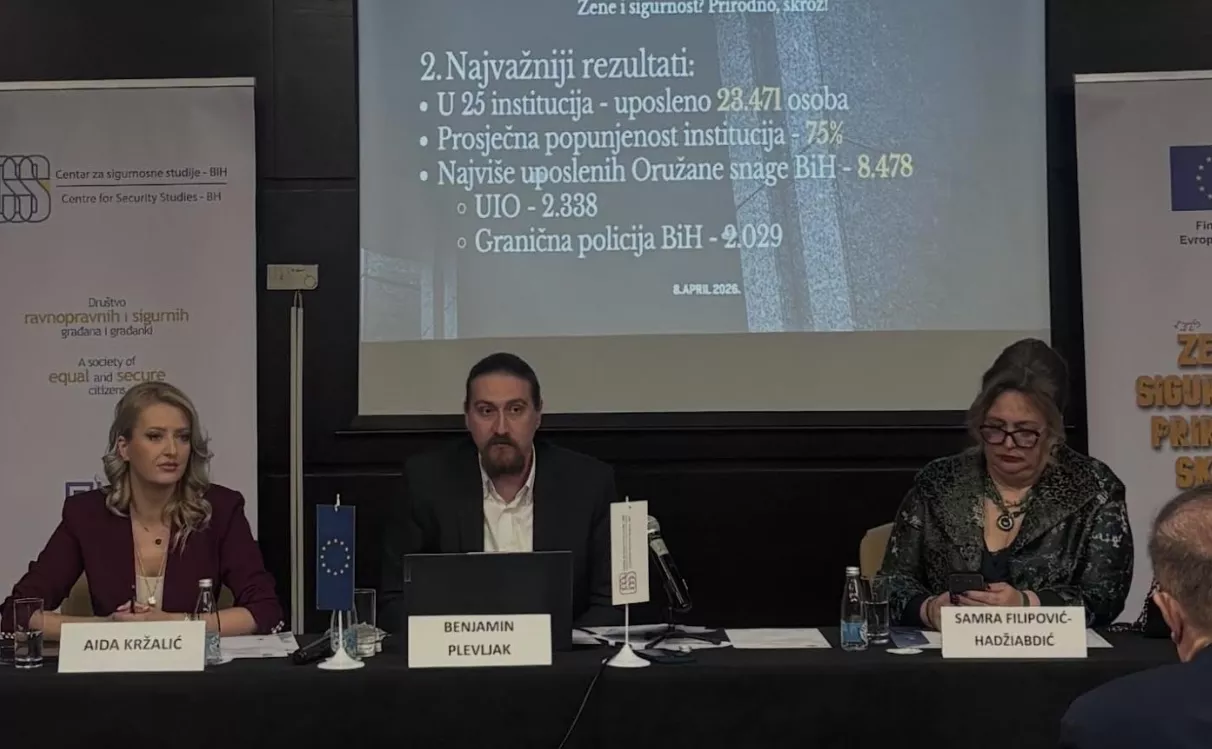
(Patria) - Within the initiative "Women and Security? Naturally, completely!", funded by the European Union, the Center for Security Studies (CSS) officially presented the study "The Position of Women in the Security and Defense Sector in BiH" in Sarajevo today.
The study is based on empirical research involving 25 institutions of the security and defense sector at all levels of government in BiH, making it the most comprehensive overview of its kind in our country.
In the security and defense sector in BiH, out of a total of 23,471 employees in the 25 analyzed institutions, women constitute only 21% and are mostly assigned to administrative functions.
The three most populous institutions are at the state level - the Armed Forces of BiH (8,478 employees), the Indirect Taxation Authority of BiH (2,338), and the Border Police of BiH (2,029).
In the aforementioned 25 institutions, the average occupancy of systematized job positions is around 75%, with significant differences between institutions. This indicates the need for serious systemic reforms in human resource management, if decision-makers in this country care about the security function and, consequently, about the well-being of all citizens.
The analysis of the police sector, which included 13 institutions with a total of 8,918 police officers, shows that women are represented in this status by 11%. Their representation in leading police positions is only 4%, while the largest number of women are in the lowest police rank - police officer.
Similar trends were recorded in the Armed Forces of BiH, where women constitute 11% of the total employees. When discussing the status of professional military personnel in the Armed Forces of BiH, out of 7,895, women constitute 10%. Their participation in command and leadership positions is 6%, and the largest number of women are in the lowest rank - soldier.
The conducted research emphasizes the need to move from declarative support for gender equality to concrete and systemic measures.
Recommendations include improving gender-sensitive human resource management, introducing affirmative measures in employment and advancement, as well as strengthening institutional and parliamentary oversight over the implementation of equality policies, the CSS announced.
Komentari (0)
Prijavite se za komentiranje
PrijavaJos nema komentara. Budite prvi!
Minuta
Sve →Iz drugih kategorija

High Representative Not Elected: Germans, French and British Against Americans, New Attempt at End of June

ČOVIĆ WITHOUT MERCY: How Those Who Brought Ademović to Office Created a Political Hell for Him



Sunny Saturday, quite warm



Tragedy in Albanian resort: Two minors drown












