
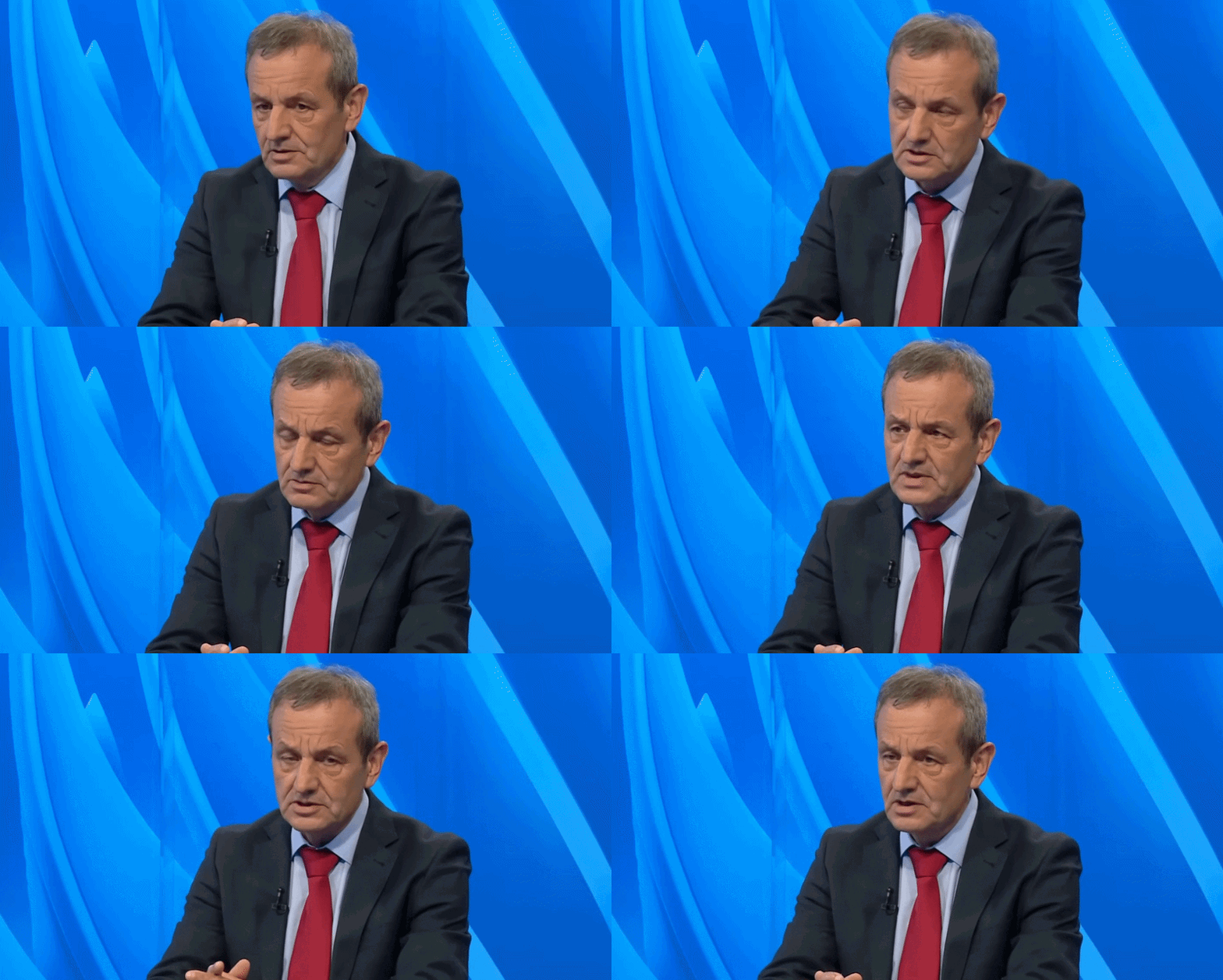
Written for NAP by: Prof. Dr. Hazim Bašić, member of the Presidency of Krug 99
The post-Cold War order, the one that transformed the Republic of Bosnia and Herzegovina through the Dayton Peace Agreement, including the Office of the High Representative with the Bonn Powers, is today in a phase of reassessment. What is colloquially called the 'new world order' in global politics is in practice actually the process of the old consensus disintegrating and a new, multipolar world emerging. The war in Ukraine, the redefinition of transatlantic relations, the rise of new centres of power, the crisis of the European security architecture and energy issues are leaving a strong mark on the Western Balkans as well.
In this realignment, Bosnia and Herzegovina is becoming a breaking point. This is not the first time; the difference is only in the instruments. Once borders were drawn by armies, today they are drawn by political blockades, energy dependencies, lobbying, media operations, legal manipulations and the production of permanent institutional instability. This is particularly clearly manifested due to the imperfect constitutional model, external political influences and insufficiently consolidated state institutions.
The American paradigm shift and abandonment of liberal democracy
One of the key changes shaping today's geopolitical context is the transformation of American foreign policy. The system based on the values of liberal democracy and human rights, and sometimes the 'export of democracy', has been replaced by a model of transactional politics and pragmatic geopolitical realism. Already at his inauguration for his second term, Trump announced the end of the era of liberal democracy, along with the simultaneous withdrawal of the US from dozens of multilateral organisations.
In an unpredictable new framework and a lack of political consistency, the focus in Bosnia and Herzegovina is no longer on 'democratic consolidation', but on building a broader investment, security and energy mosaic. The consequence is very concrete: the space for internal political destruction is growing.
The first contours of the new order: Gas as the first domain of state division
Energy sources and corridors for their transport are becoming the basis for drawing a new geopolitical map. On the one hand, the US continues its strategy of placing LNG gas in Europe, which makes the Western Balkans a potential new market and transit space. On the other hand, Russia, despite sanctions and geopolitical pressure, still strives to maintain or redefine its energy influence through various infrastructure projects.
The example of the 'project' Southern Gas Interconnection shows that Bosnia and Herzegovina in this context has almost no say. Gas pipeline routes, which are becoming an instrument of political influence, destroy everything in their path: laws, public companies, energy strategies, constitutions... If necessary, the territory of BiH (hidden under the euphemism 'state property') can be rapidly divided between the entities, just so that LNG can flow... At the same time, from the entity of RS, the Republic of Serbia and the Russian Federation, legal actions have been initiated for the construction of a new eastern interconnection (Zvornik – Bosanski Novi), with literally no reaction from the EU and the US. The story about 'reducing Russian influence' was absent. The contours of the new order are, therefore, already being reflected in the domain of energy, western LNG for the FBiH, and eastern, Russian gas for the RS. The state is nowhere, although there is a constitutional basis for public corporations of this type to be at the state level.
This further deepens internal political divisions, as energy routes are also interpreted through ethno-political and foreign policy loyalties.
The High Representative, Bonn Powers, state property
In the new context, the institution of the High Representative (OHR) and his powers gain particular importance. The Bonn Powers were created as an instrument of stabilisation after the war; today they are simultaneously a reserve pillar for maintaining the functionality of the state. Their application in situations of blockades and institutional crises is not political interventionism, but a mechanism for preserving peace.
Advocates for closing the OHR, moving it out of Sarajevo, or reducing the powers of the High Representative are essentially gambling with peace. At the same time, they hold in their hands the instruments of blockade with which they have already almost paralysed the state. It is precisely such policies that are the meaning and reason why the OHR with the Bonn Powers must still exist.
The fabricated 'issue' of state property is particularly sensitive, as its incorrect resolution seeks to create the basis for a future configuration (division) of the state. Control over land, forests, water resources and infrastructure is a domain of state sovereignty. Property is unquestionably state-owned, and the real 'issue' is actually the blockade of adopting an appropriate law on the disposal and use of state property. Any attempt at fragmentation or entity appropriation of state property (territory) opens space for the de facto dismantling of the unique sovereign framework. No investments, regardless of where they come from and how much they amount to, can be a reason to impose an unconstitutional law on state property, one that would not respect the decisions of the Constitutional Court of BiH, the Agreement on Succession and the constitutional continuity of the Republic of Bosnia and Herzegovina.
State sovereignty or a network of foreign pipelines?
Bosnia and Herzegovina is undergoing a kind of test: how far can the combination of a weak Western consensus, energy interests and internal ethno-political blockades go while the state formally remains functional. The problem is that 'functionality' and democracy are increasingly measured by the minimal maintenance of peace (stabilitocracy), and less and less by the actual strengthening of institutions, human rights and progress on the European path.
Bosnia and Herzegovina is a sovereign state, integrated into the global order, but the real ability to independently decide on key political, energy and institutional issues is increasingly subject to external pressures and internal constraints. The state is once again becoming a space through which other people's power relations are resolved.
The new High Representative will be under pressure from two policies. The first is an agile, unpredictable, impatient, reckless and corruptible policy of creating a 'new order' (hence the great interest of the US in the personnel solution). The second is an inert and divided policy of EU integration and fulfilling the unfinished 5+2 agenda. Today, this first, stock-market-like and non-transparent policy has the initiative and is in the lead, while not offering a clear vision for the future of Bosnia and Herzegovina. The uncertainty in which the future of the state finds itself is more than enough reason to take to the streets in protest.
Komentari (0)
Prijavite se za komentiranje
PrijavaJos nema komentara. Budite prvi!
Minuta
Sve →Iz drugih kategorija

High Representative Not Elected: Germans, French and British Sabotaged Americans, New Attempt at End of June

ČOVIĆ WITHOUT MERCY: How Those Who Brought Ademović to Office Created a Political Hell for Him



Sunny Saturday, quite warm



Tragedy in Albanian resort: Two minors drown












