
By: Sead Trebinjac
Many authors have written about the background of the sevdalinka "Zaplakala šećer Đula", from Alija Bejtić, Dr. Fikret Karčić, Safet Bandžović. There is always a historical background. There is also something personal and hitherto undiscovered, writes the news agency Patria.
Zaplakala šećer Đula
Osman Pasha's faithful wife
my Osman, where have you been
where have you lost your army
Here I am, young Đula
near Pleven, the old city
all the army the emperor gave me
all of it, Đula, fell for the faith
I, Đula, have fallen into captivity
my sharp saber has been taken off
so now I have no one of my own
except the one God
Young Đula, remarry
never hope for me again
the enemy has captured me
separated me from you
It is evident that in Bosnia, they were in a hurry to create a song about the great warrior Osman Nuri Pasha, better known as Gazi Osman Pasha or the legendary "Lion of Pleven".
Osman Pasha served in Bosnia and reached the peak of his career there. He would spend about ten years in Bosnia and Herzegovina and gain a reputation as an honorable officer, which he would later confirm in a series of battles.
Osman Pasha had already been captured before the events in this sevdalinka about šećer Đula. He fell into captivity when he was captured in 1876 due to Montenegrin military cunning. At that time, Montenegrin Prince Nikola allowed him to meet with his Đula and children in Dubrovnik, on the Stradun, after which he would dutifully return to prison. That captivity lasted until the end of 1876, when Osman Pasha left Trebinje and took his family to Istanbul, as great battles for the survival of the Ottoman Empire were imminent.
Who was šećer Đula, Osman Pasha's wife?
All storytellers about the background of this beautiful sevdalinka fail to explain who šećer (sweet) Đula was, that beauty for whom the famous Gazi Osman Pasha pines and to whom he turns only in the most difficult moments. According to some oral traditions, she was a sweet Sarajevan, but some claim she was a honey-sweet girl from Trebinje.
Pleven is today's Pleven, a city in northern Bulgaria, the size of our Tuzla or Zenica, with about 170,000 inhabitants. The well-known Bosnian haste made the warrior and love song historically inaccurate.
Therefore, in Bosnia and Herzegovina, they hurried to sing about the love of Osman Pasha and šećer Đula as soon as they heard that Pleven had fallen.
The scale of the Battle of Pleven was talked about for decades. The European military elite admired the abilities of Osman Pasha. His courage was a special story. The Russians set out to conquer the European East to fulfill their long-standing dream of reaching the Mediterranean. With unstoppable charges, the fortresses of Svishtov and Ruse were conquered. Only Pleven remained isolated. If it had fallen immediately, the path for the Russian army towards Thrace, Edirne, and Istanbul itself would have been opened. In mid-July, the great siege of Pleven began. The Russians had about 185,000 soldiers in that small area.
After heavy Russian bombardments of the fortress, infantry attacks followed. In those first attacks, almost 12,000 Russian soldiers were killed. Another 28,000 Romanian warriors came to help. The Russo-Romanian army at one point had 314,000 soldiers and 1943 cannons, which was incomparably more than the Turkish army in terms of manpower and artillery with 411 cannons. After several fierce assaults, the Russians and Romanians lost numerous soldiers. Then, Russian General Gurko decided to encircle the fortress by building two rings of trenches.
The siege would last a full five months and claim the lives of 38,000 Russian and Romanian soldiers from July 16 to December 10, 1877. Inside the fortress were mostly Bosniak warriors whom Osman Pasha had brought from Sarajevo, Trebinje, and other smaller towns. Every few days, the Russians and Romanians would launch surprise attacks on the Pleven garrison. No one knows how the Turkish army survived starvation, how it endured the fierce attacks, but the resistance lasted for all five months. Finally, Osman Pasha launched a counter-attack, leading his army. At first, the first ring of the Russian army was broken. Then it was rumored that Osman Pasha had died, causing panic and despair in the ranks of the Turkish army. In the chaos, about 5,000 Turkish soldiers were killed. Pleven was suddenly abandoned, and a great retreat towards the south began.
The Emperor's Saber as a Token of Admiration
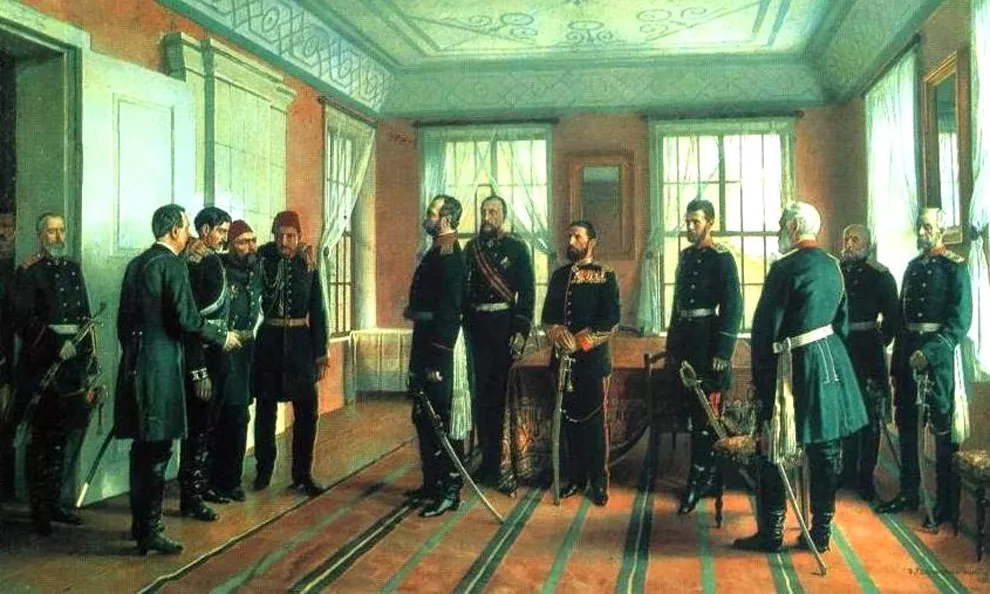
Osman Pasha, severely wounded, returned to the fortress and organized the remaining soldiers, mostly Bosniaks. Soon, a Russian offer to surrender followed. Osman Pasha accepted, with the promise that his army could leave Pleven safely. When the armistice and the surrender of the fortress were being signed, the Russian Tsar and army commander Alexander II Nikolaevich himself came to the negotiations. Gazi Osman Pasha arrived, properly dressed in his marshal's uniform. Russian generals jostled to see the Gazi, while his two escorts held him upright, and the over two-meter-tall Alexander II Nikolaevich addressed him ceremonially.
The song says that Osman Pasha fell into captivity, but he did not. It also says he took off his saber. He did not. When the Tsar asked him to sit in his place at this gathering, he presented him with his saber as a gift and a token of honor for his unprecedented bravery.
The kind-hearted Tsar Alexander II was assassinated just four years after this meeting with Osman Pasha, in 1881. He was an unusual figure. In 1861, he abolished serfdom in Russia. Russian chauvinists tried to kill him several times, but he somehow survived. On March 13, 1881, in Moscow, a bomb was thrown at his carriage, killing and wounding people around him. He remained unharmed, but instead of taking cover, he got out and began to help the wounded. The assassin threw another bomb at him, which killed Alexander II.
Many spoke highly of Tsar Alexander II. The Russian writer, Nobel laureate, Ivan Bunin describes him with admiration in the novel "The Life of Arsenyev". His grandson Nicholas II Romanov, along with his wife and five children, was murdered, doused with acid, and buried in a forest in western Siberia. It was not until 2007 that the last remains of their 13-year-old son Alexei, a great-grandson of Alexander II, were found.
Unlike the fate of Alexander II and his family, Gazi Osman Pasha returned to Istanbul to his šećer Đula. He lived, respected and praised, for another 23 years with his Bosniak wife and died on April 5, 1900. He was buried with all honors, and his honorable name stepped into the twentieth century, an era with the least honor.
Komentari (0)
Prijavite se za komentiranje
PrijavaJos nema komentara. Budite prvi!
Minuta
Sve →Iz drugih kategorija

High Representative Not Elected: Germans, French and British Against Americans, New Attempt at End of June

ČOVIĆ WITHOUT MERCY: How Those Who Brought Ademović to Office Created a Political Hell for Him



Sunny Saturday, quite warm



Tragedy in Albanian resort: Two minors drown












