
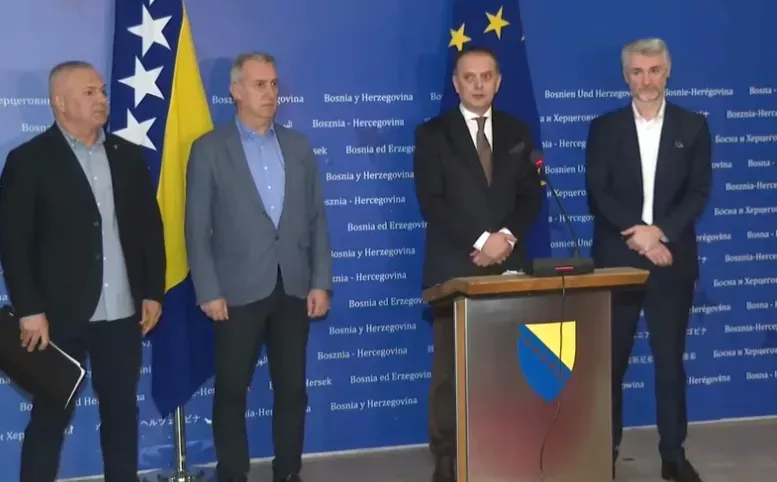
The problem of drivers from Bosnia and Herzegovina staying in the Schengen zone has escalated in recent days to such an extent that representatives of institutions and the economy are warning of serious consequences for the entire economy. At the first meeting of the Working Group for the coordination of activities regarding this issue, held in Sarajevo, it was stated that a solution is not yet in sight, while the transport sector warns that it is already "on its knees".
The Minister of Transport and Communications of BiH, Edin Forto, said that only after recent protests did this topic gain the attention of European institutions.
“It seems that without the recent protests, which were regional in nature, this issue of our drivers staying in the European Union would not have even reached the attention of those who were supposed to hear it. I am primarily thinking of certain structures within the European Commission, but also of EU member states that could also suffer damage due to this situation.”
He emphasized that the problem is treated as a migration issue, even though it is a trade matter.
“This is treated as a migratory stay, when it is actually a trade matter. That is why we expect the European Commission to quickly resolve an exemption for professional drivers licensed for international transport.”
He stressed that quick solutions are not realistic, but that the problem must be solved.
“We never harbored illusions that a quick solution could be reached, but that a solution must be reached – we all certainly think so. It is not certain that silence or running away from the problem will make it disappear.”
Forto presented the key conclusions of the Working Group:
“The first conclusion is that we insist that the Council of Ministers urgently request a meeting with the Government of the Republic of Croatia on the topic of drivers' stay in the Schengen zone. The second conclusion is that the working group will seek a more tolerant application of the border crossing regime for professional drivers.”
He also added that the Ministry of Foreign Affairs will inform the EU embassies.
“Also, the Ministry of Foreign Affairs will urgently send a summary of the problem to all EU member state embassies in BiH.”
“We did not solve this problem today, we did not postpone the protests, but this is an opportunity for everyone to wake up and realize the seriousness of the situation.”
The President of the Chamber of Commerce of FBiH, Mirsad Jašarspahić, emphasized that the problem far exceeds the transport sector.
“This is not just a transport problem, but a problem for the entire business community of Bosnia and Herzegovina and the Western Balkan region.”
He warned of a domino effect on the economy.
“If companies that use transport services start losing business and falling out of global supply chains, then in the second round, transport companies will also have no business.”
He adds that the consequences could be long-term and that without a stronger approach and resolution of this problem at the EU level, the economy of BiH could fall into a difficult situation.
The President of the Chamber of Commerce of RS, Goran Račić, warns that this is an unprecedented crisis.
“This is the biggest challenge for the Bosnian-Herzegovinian economy from the war to date. It threatens to completely shut down the transport industry.”
He highlighted the consequences for competitiveness and called on the Council of Ministers of BiH for an urgent reaction and to address this issue.
“If we shut down the transport sector, logistical costs will increase, and our economy will lose competitiveness.”
Račić also warned of concrete financial consequences.
“One company from Laktaši had daily losses of 600,000 euros during the previous protests. If partners like Scania do not receive goods on time, penalties will follow.”
He added that border blockades would have huge consequences.
“If protests and border blockades occur, the economy will suffer great damage.”
Zijad Šarić from the Logistics Consortium presented alarming data.
“Today, we have 875 drivers who have been returned from the border with the Republic of Croatia. We never know when a driver will cross the border, whether they will be turned back or not.”
He pointed out the inconsistent application of rules.
“We have border crossings where the rules are applied, and at others, they are not. We have the same problem in Serbia and Croatia. We ask – why has nothing been done to date?”
Šarić confirmed that protests are still an option.
“If there are no results, protests are scheduled for the 23rd and can no longer be postponed. We have already given diplomacy a chance once.”
He emphasized that the goal is not to block other sectors.
“We do not want to block anyone, we are protesting at the border because we are blocked. The transport sector is on its knees.”
N1
Komentari (0)
Prijavite se za komentiranje
PrijavaJos nema komentara. Budite prvi!
Minuta
Sve →Iz drugih kategorija

High Representative Not Elected: Germans, French and British Against Americans, New Attempt at End of June

ČOVIĆ WITHOUT MERCY: How Those Who Brought Ademović to Office Created a Political Hell for Him



Sunny Saturday, quite warm



Tragedy in Albanian resort: Two minors drown












