
By: Rasim Belko @rasimbelko
While a debate about the integrity of the electoral process and the alleged salvation in introducing technologies is underway in the Bosnian public, the convocation of representative bodies at the state level and the FBiH entity level show that party presidents have alienated the electoral will of citizens, all in accordance with the Election Law.
With a very simple play on numbers, it is easy to conclude that neither Schmidt's FBiH Government, which was imposed by suspending the FBiH Constitution, nor the state government are a product of the electoral will of the citizens of Bosnia and Herzegovina.
The legislative and executive framework of power in our country has thus been brought into a dependent position on compensatory mandates, and these mandates are actually lists of narrow party leaderships on which consolation prizes are most often awarded to candidates not elected by the people.
The House of Representatives of the Federation Parliament has 98 deputies. In this representative body, where, according to the Constitution and the Election Law, citizens' representatives should sit, almost a quarter of the deputies are representatives of parties. This is because 25 deputies were elected from compensatory lists created by party leaders and their close leadership.
A majority in the House of Representatives consists of 50 deputies, and the current parliamentary majority has 51 "votes". This majority includes 15 deputies elected from compensatory lists, i.e., party representatives. Thus, the Federation Government, imposed by Schmidt and supported by 51 deputies, was actually supported by 36 elected and 15 installed deputies. Viewed this way, Nermin Nikšić's Government absolutely lacks popular support, as it was not supported by the people in the two-stage election process (Schmidt's and parliamentary).
For comparison, the parties Narod i pravda (People and Justice) and Naša stranka (Our Party) have roles in the FBiH Government. These parties have a total of 13 deputies in the House of Representatives. Of these, eight deputies were elected by party headquarters, and five by the people. Only two deputies from Our Party were elected by the people, and 4 are from the compensatory list, while three NiP deputies were elected by the people, and four by Konaković and the leadership.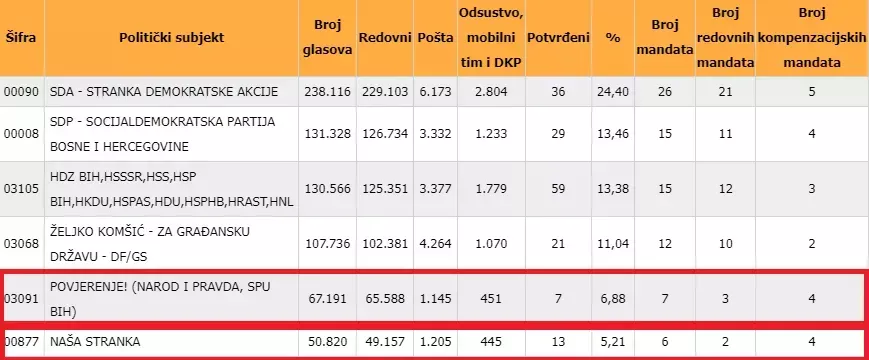
And then Schmidt wants to talk about the integrity of elections! You can imagine.
In the House of Representatives of the Parliamentary Assembly of Bosnia and Herzegovina, out of 42 deputies, 30 were elected by the people, and 12 by party headquarters. Thus, almost a third of the deputies in the representative body were not elected by the people.
Six selected deputies from party lists sit in the parliamentary majority of the House of Representatives of the BiH PA, so the Council of Ministers of BiH is also a direct product of the will of party leaders, not the will of the people.
Narod i pravda, for example, has two compensatory and one elected deputy in the BiH House of Representatives, while in Naša stranka the ratio is 1:1. Demos and "Ujedinjena Srpska", parties from the smaller BiH entity RS, have deputies they elected as compensatory, they do not have deputies elected by the people. 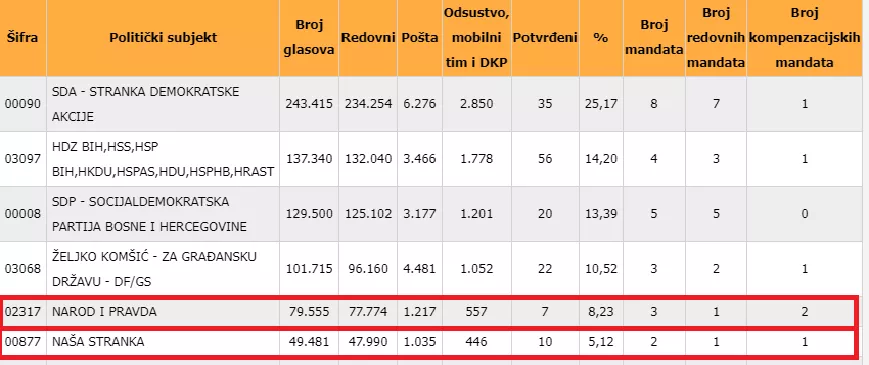
The story about the democratic nature of elections is not what the German bungler in the High Representative's chair is talking about. Because, for representative bodies to be elected by the people, which is a condition for democracy, the compensatory mandate must be abolished, and that would lead to fair elections.
Similarly, fair and, above all, democratic elections would be achieved if, for example, the High Representative, the international community, and all other actors in the election story amended the Constitution and the Election Law, integrating into them the decisions of the BiH Constitutional Court, as well as the European Court of Human Rights.
As long as this is not the case, i.e., as long as every citizen of this country is not enabled to elect and be elected where they live, no one, not even Schmidt, has grounds to talk about the election law, its democratic nature, transparency, and so on.
It has long been established that the democracy installed in Bosnia and Herzegovina does not exist in that form anywhere in the world, and therefore we do not need solutions that will further spoil that wrong premise. The government we have was not elected by citizens, and now they want to impose expensive technologies on us through which Putin or someone else can determine election results and the composition of the government.
Or perhaps Ambassador Murphy convinced Schmidt that only Washington will be able to influence election results. Anything is possible!
Komentari (0)
Prijavite se za komentiranje
PrijavaJos nema komentara. Budite prvi!
Minuta
Sve →Iz drugih kategorija

High Representative Not Elected: Germans, French and British Against Americans, New Attempt at End of June

ČOVIĆ WITHOUT MERCY: How Those Who Brought Ademović to Office Created a Political Hell for Him



Sunny Saturday, quite warm



Tragedy in Albanian resort: Two minors drown












