
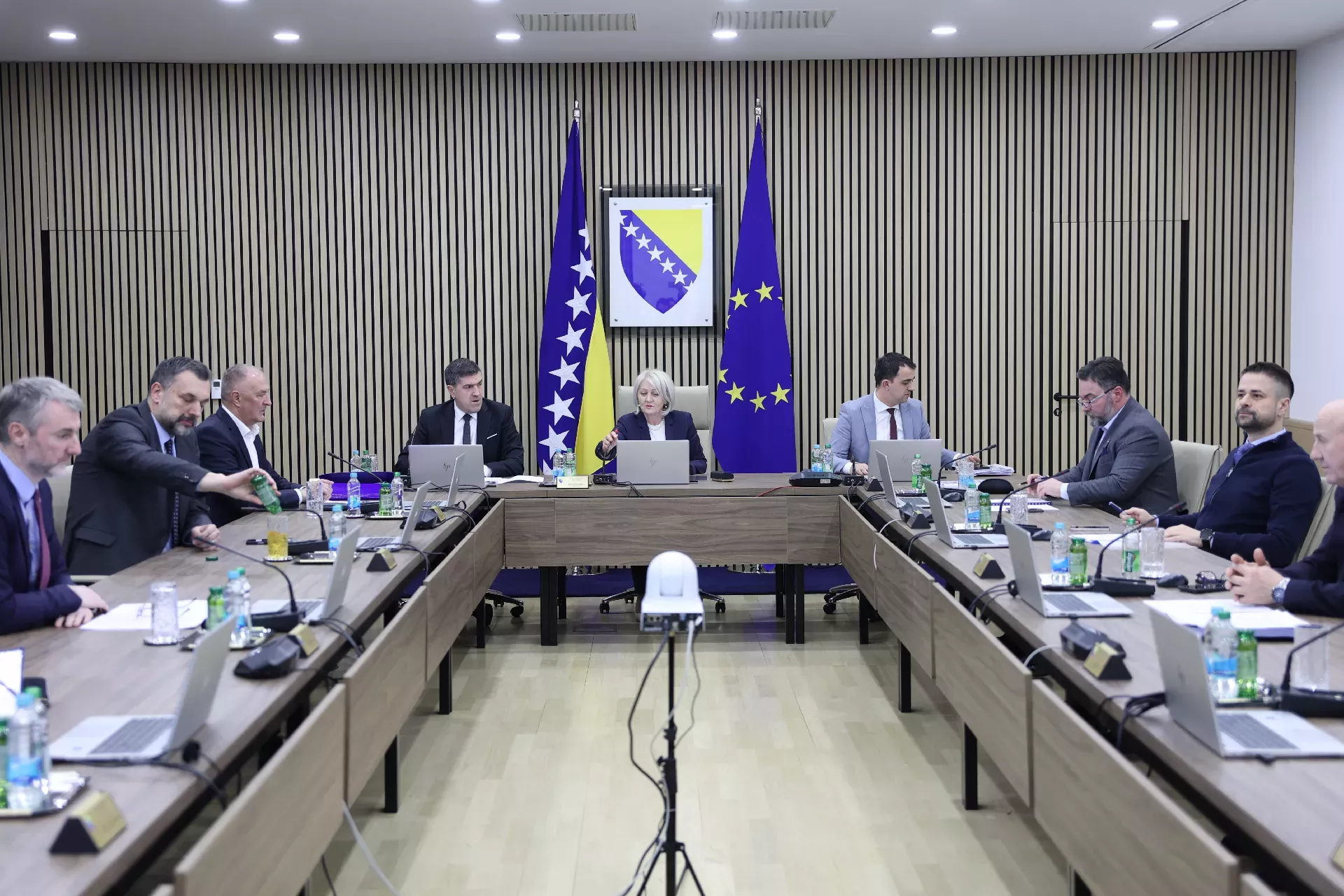
(Patria) - A session of the Council of Ministers of BiH has been scheduled for Tuesday, December 2nd, which will also include items on which there is still no agreement.
Thus, at the proposal of the Chairwoman of the Council of Ministers of BiH Borjana Krišto, ministers will vote on the establishment of the Office of the Chief Negotiator of Bosnia and Herzegovina with the European Union as a temporary body of the Council of Ministers of Bosnia and Herzegovina in the second round of voting.
Under the guise of the European path, Krišto is trying to secure a sufficient number of votes for this decision. The House of Representatives of the BiH Parliamentary Assembly passed a decision requesting parliamentary clubs to propose the chief negotiator and two deputies. The SNSD filed a request for an assessment of constitutionality of that decision with the Constitutional Court of BiH.
In addition to this decision, the session of the Council of Ministers of BiH also includes the Draft Law on the High Judicial and Prosecutorial Council of Bosnia and Herzegovina, proposed by the Ministry of Justice of BiH.
The Minister of Justice of BiH, Davor Bunoza, has sent a law for procedure around which there are still many doubts and objections. Thus, at the HJPC session this week, the discussion on the Draft Law on the HJPC was closed to the public, but the HJPC adopted certain remarks on the law itself. Transparency International BiH has also warned that the adoption of such a law would further undermine the judiciary.
"Instead of ethnic quotas being a temporary corrective mechanism, as recommended by the Venice Commission, the draft permanently incorporates them into the law, making them a permanent rule for the election of HJPC members. The transitional provisions even leave the possibility for quotas to remain in force until potential EU membership, and even after that, thereby consolidating the practice of electing members of the most important judicial body based on ethnicity, rather than expertise, experience, and professionalism. In addition to national affiliation being established as a permanent instrument of control over the Council's work, this form of political influence can have serious consequences for its independence and functionality in the years to come," stated TI BiH.
The new law provides for an increase from 15 to 20 members of the HJPC, of which at least four members are from the constituent peoples and one from the others. However, such a division is contrary to the principle of expertise, which should be the primary criterion for a HJPC member.
Bunoza rejects all criticism, and the parties of the Trojka have not yet taken a unified stance. Whether they will support the flawed law under the guise of the "European path" and further polarize the umbrella body in the judiciary will be clearer on December 2nd.
The Council of Ministers of BiH's agenda also includes the Draft Law on Amendments to the Law on the Court of Bosnia and Herzegovina. It is still unknown what these amendments precisely stipulate, i.e., where the seat of the Appellate Court (department) is planned. For the Trojka parties, East Sarajevo was acceptable, while the SNSD requested it to be Banja Luka. There was also a proposal from the opposition from RS for the court's seat to be in Pale.
Komentari (0)
Prijavite se za komentiranje
PrijavaJos nema komentara. Budite prvi!
Minuta
Sve →Iz drugih kategorija

High Representative Not Elected: Germans, French and British Against Americans, New Attempt at End of June

ČOVIĆ WITHOUT MERCY: How Those Who Brought Ademović to Office Created a Political Hell for Him



Sunny Saturday, quite warm



Tragedy in Albanian resort: Two minors drown












