
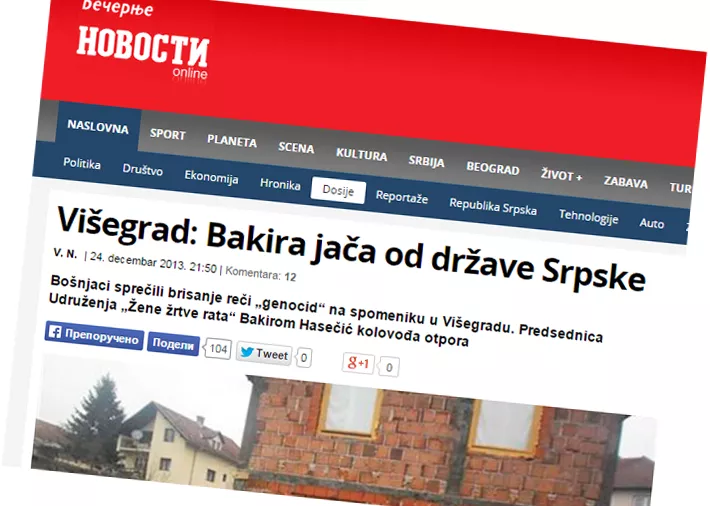
Serbian daily "Večernje novosti" does not acknowledge that a horrific crime was committed in the house of Sumbula Žeba in Pionirska Street in Višegrad during the aggression against Bosnia and Herzegovina in 1992, in which more than 50 Bosniaks were burned alive, even though the perpetrators Milan Lukić, a member of the Army of Republika Srpska, and others were convicted for it before the International Criminal Tribunal for the former Yugoslavia as early as 2009, writes the BiH news agency Patria (NAP).
The Appeals Chamber of the Hague Tribunal confirmed the first-instance verdict against Milan Lukić for crimes committed against Muslims in Višegrad from June 7, 1992, to October 10, 1994.
In July 2009, Milan Lukić was sentenced to life imprisonment by the Tribunal's first-instance verdict.
His cousin, Sredoje Lukić, had his first-instance sentence of 30 years in prison for crimes in Višegrad reduced to 27 years.
The Appeals Chamber confirmed that Milan Lukić is guilty of "live pyres," extermination, beating of prisoners, and other inhumane acts and persecution.
The Chamber concluded that 59 victims perished in the live pyre in Pionirska Street, for whose murders the Lukićs are responsible, writes NAP.
However, despite the verdicts of the International Court, the Serbian "Večernje novosti" does not acknowledge that a crime against Bosniaks occurred in Pionirska Street in 1992, reporting it as an alleged crime.
In an article titled "Višegrad: Bakir is stronger than the Srpska state," in which a "Večernje novosti" journalist writes about the conflict between Višegrad Bosniaks and local authorities, including regarding the renovation of the house – the execution site in Pionirska Street, it is stated that the crime in the house happened – allegedly.
- Although this house, in which a crime allegedly took place during the war, is in the expropriation phase due to the construction of a road to the Glavica settlement, a group of Bosniaks, despite the ban, and without any construction or other permits, renovated it – the article of the daily "Večernje novosti" states, while the daily simultaneously does not explain how the ban on renovating the existing house by the local authorities is illegal, and represents one of a series of cover-ups of crimes committed against the Bosniaks of Višegrad during the 90s, writes NAP.
Komentari (0)
Prijavite se za komentiranje
PrijavaJos nema komentara. Budite prvi!
Minuta
Sve →Iz drugih kategorija

High Representative Not Elected: Germans, French and British Against Americans, New Attempt at End of June

ČOVIĆ WITHOUT MERCY: How Those Who Brought Ademović to Office Created a Political Hell for Him



Sunny Saturday, quite warm



Tragedy in Albanian resort: Two minors drown












