
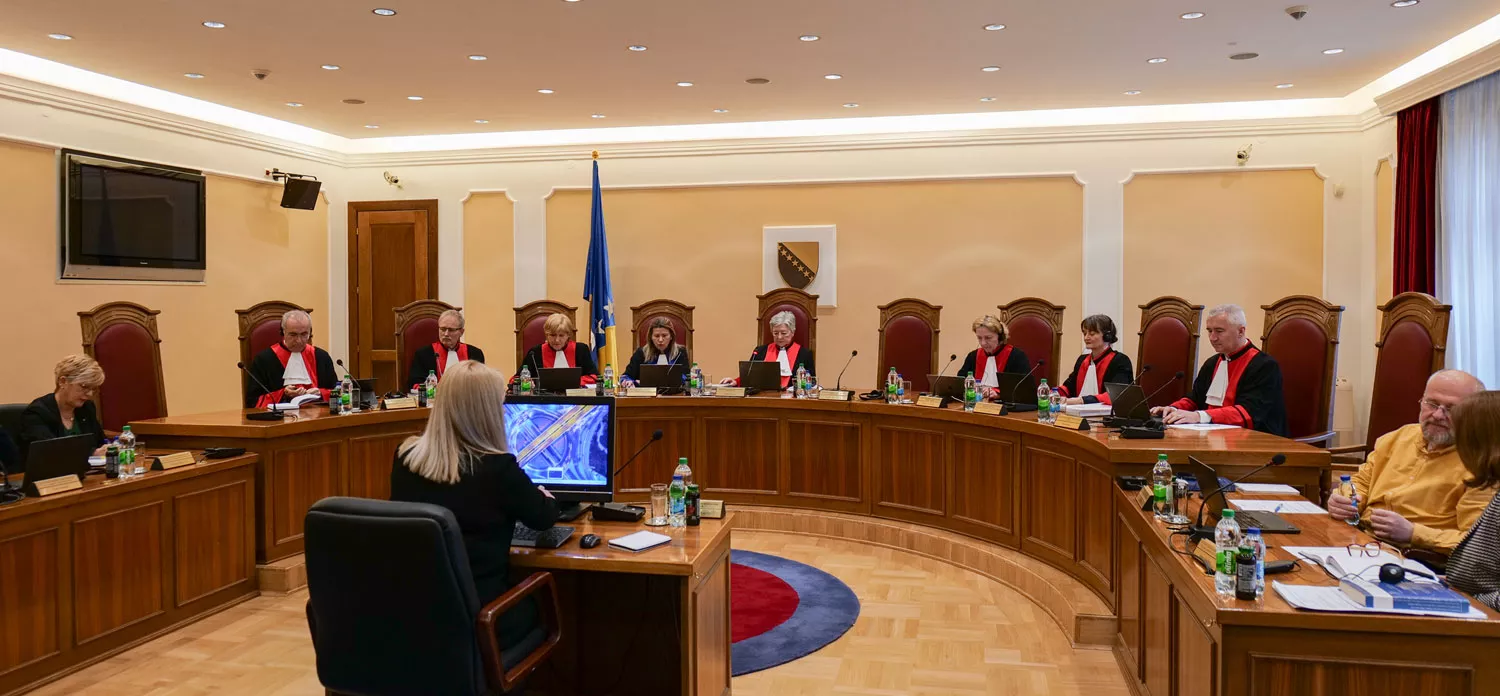
(Patria) - The Constitutional Court of Bosnia and Herzegovina held its 157th plenary session electronically today.
At the session, the Constitutional Court adopted appeals related to the violation of the right to a fair trial within a reasonable time, finding that some proceedings before regular courts lasted longer than 12 years, without regular courts providing reasons for such lengthy proceedings.
On the other hand, one criminal proceeding, which is not complex, has been ongoing for over three years and three months, significantly contributed to by the Municipal Court, which took one year, three months, and 11 days to prepare and deliver the first-instance verdict to the appellant.
The Constitutional Court also made a number of decisions rejecting appeals as inadmissible because they were manifestly (prima facie) unfounded.
This means that there is nothing in the appeal and the contested decision to indicate that the appellant's claims raise constitutional issues to which they refer, nor is there anything to suggest an "arguable claim," within the meaning of Article 18(4) of the Rules of the Constitutional Court, that warrants substantive examination, and therefore these claims are manifestly (prima facie) unfounded.
The Constitutional Court considers it useful to inform citizens about situations where they should not unnecessarily pursue litigation in courts and burden regular courts, thereby incurring costs for proceedings that have no prospect of success.
One such situation is where the appellant's request for exemption from paying property transfer tax was finally rejected.
In that case, the appellate court explained that it was established during the proceedings that the appellant was obliged to pay tax on the property transfer for which she acquired co-ownership rights through inheritance from her deceased husband, partition, and adverse possession.
Namely, the appellant is already registered as a co-owner in the land registry for the part of the property acquired by inheritance from her husband, and this transfer is not subject to the obligation to pay tax. However, the remaining co-ownership share that the appellant acquired based on a final court decision is subject to the obligation to pay tax.
The appellant filed a lawsuit to establish co-ownership rights based on partition and adverse possession, regarding which the Municipal Court issued a verdict. In this case, it concerns the transfer of property by a court decision of a competent court, which is subject to the obligation to pay tax.
In another case, the appellant's lawsuit was finally rejected. The Cantonal Court explained that it is not disputed between the parties that the appellant and the defendant were in a business relationship, and that the appellant, as a lawyer, concluded an agreement with the defendant for the provision of legal services.
The defendant (represented) fulfilled all obligations towards the appellant related to the payment of a "monthly fee in the agreed amount." However, the disputed payment is the one agreed upon in addition to the monthly fee, which stipulates that the appellant is also entitled to a fee in the amount awarded to the defendant in each successfully concluded proceeding.
The appellate court pointed out that at the time of concluding the disputed agreement, the Tariff on fees and reimbursement of costs for lawyers' work was in force, and that it constitutes relevant substantive law in the specific legal matter.
Therefore, the appellant and the defendant could not agree that the appellant, in addition to the monthly fee in a lump sum (stipulated by Article 38 of the Tariff), would also receive a fee in the amount awarded by the court to the defendant in a successfully concluded proceeding.
The third decision worth noting relates to a proceeding concluded by the contested decision of the Cantonal Court, by which the appellant was found guilty of an offense under the Law on the Fundamentals of Road Traffic Safety in BiH.
In its explanation, the Cantonal Court pointed out that the first-instance court, based on the testimony of the witnesses heard and the inspection of photographs from the scene, correctly determined that the appellant had parked his vehicle in a space designated for persons with disabilities by horizontal and vertical signage.
The fact that the horizontal signage was painted white and not yellow, as the appellant pointed out, does not change the factual description of the committed act, nor does it exclude the existence of the offense committed by the appellant.
The Constitutional Court also made a number of decisions rejecting appeals for reasons set out in Article 18 of the Rules of the Constitutional Court, which stipulates various grounds for inadmissibility of appeals (the Constitutional Court is not competent to decide, the deadline for submitting the appeal has passed, the appeal is filed by an unauthorized person - no special power of attorney, changed legal circumstances, the appeal is ratione materiae incompatible with the Constitution, the appellant has not exhausted legal remedies available by law, the appeal is premature, and other reasons).
All decisions adopted at the plenary session will be published on the website of the Constitutional Court of Bosnia and Herzegovina and delivered to the appellants no later than one month from their adoption.
Komentari (0)
Prijavite se za komentiranje
PrijavaJos nema komentara. Budite prvi!
Minuta
Sve →Iz drugih kategorija

High Representative Not Elected: Germans, French and British Against Americans, New Attempt at End of June

ČOVIĆ WITHOUT MERCY: How Those Who Brought Ademović to Office Created a Political Hell for Him



Sunny Saturday, quite warm



Tragedy in Albanian resort: Two minors drown












