
(Patria) - The idea of ethnic balance or ethnic parity in a practical sense already exists through the evident ethnic imbalance in Bosnia and Herzegovina when it comes to the division of power.
Ultimately, ethnic balance or ethnic parity benefits ethnic oligarchies closely connected with the authorities of neighboring countries, which, through them, exert key influence in Bosnia and Herzegovina, thus hindering its progress and conditioning it with their state interests.
Further strengthening the principle of ethnic balance, advocated by the outgoing High Representative in BiH Christian Schmidt, weakens the state of Bosnia and Herzegovina and indirectly strengthens separatist ethnic policies within Bosnia and Herzegovina.
It follows that the idea of further strengthening ethnic balance is inherently destabilizing because it strengthens factors of political destabilization in Bosnia and Herzegovina.
As a reaction to the recent emphasis on strengthening ethnic balance or ethnic parity, the idea of proportional representation of ethnic groups within the government has emerged, originating from Bosniak circles.
This idea can be interpreted as a response that respects ethnic logic in the formation and division of power, but in an ethnic ratio that guarantees each ethnic group a share in power proportional to its participation in the demographic structure of society.
Unlike the idea of ethnic balance, the idea of proportional representation significantly reduces the possibility of neighbors strengthening their influence on the process of forming and distributing power.
There is also a third ideological current advocated by representatives of the civic political spectrum (primarily Željko Komšić), which is based on democratic and European standards.
A segment of society in Bosnia and Herzegovina that shares this opinion, as opposed to the idea of ethnic balance or ethnic proportionality, advocates for the idea of civic equality.
More precisely, it is a democratic and civic idea that the ethnic principle cannot be the basis for forming and distributing power, nor can or should it be the criterion or basis by which society as a whole functions.
This vision relies on respecting human rights and abolishing ethnic discrimination by implementing the judgments of the European Court of Human Rights.
Looking at the current political and social reality, it can be said that there are three main ideological currents: first, the further strengthening of ethnic balance, advocated by the outgoing High Representative Christian Schmidt, which is completely undemocratic; second, the concept of proportional ethnic representation, which is partially democratic; and third, the ideological current that aligns with democratic norms and standards.
Looking at the political positions of parties in Bosnia and Herzegovina, it can be stated with certainty that the ruling coalition parties, which have formed the government based on this principle, SNSD, HDZ, and the Trojka, which by accepting their officials holding positions exclusively from quota B, have accepted the principle of ethnic balance/parity, agree with the idea of further strengthening ethnic balance/parity.
Furthermore, based on numerous media appearances, it can be observed that SDA has recently favored ethnic proportionality, while on the other hand, the Democratic Front, ideologically speaking, remains the sole actor in parliamentary life among parties of the civic spectrum seeking full democracy, in contrast to political parties advocating for ethnic balance, ethnic parity, or ethnic proportionality, which undermines democracy and its principles. In the distribution of power or political power in democratic states, political parties participate, not ethnic communities.
Other political actors are in a state of ideological wandering or align with existing ones.
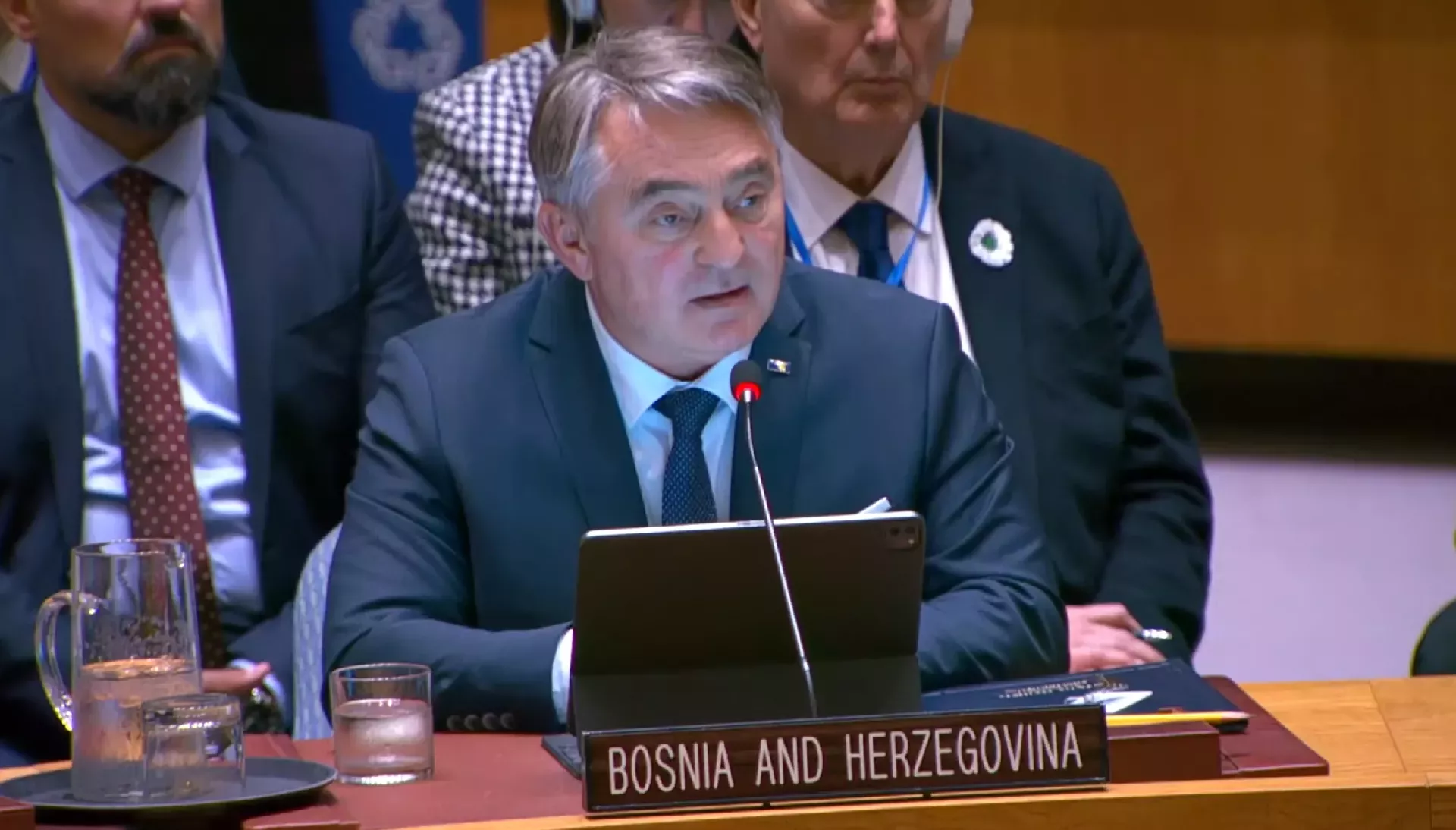
The last address by the Chairman of the Presidency of BiH, Željko Komšić, also revealed how the transition to a civic system is envisioned.
"The current concept on which BiH functions, which the High Representative incorrectly calls 'ethnic balance of power,' because a more accurate term is 'ethnic imbalance of power,' is a conflict-ridden concept in itself," stated the Chairman of the Presidency of Bosnia and Herzegovina at the last session of the Security Council.
In his address, he advocated for a civic concept within a transitional process.
Komšić, speaking about the second option, the alternative to the existence of the OHR, emphasized that this option is long-term but permanent.
"The essence of this option lies in the need for BiH to truly become a democratic country, to abolish discrimination against its own citizens in the area of human rights, to abandon the conflict-ridden concept of 'ethnic balance or imbalance of power,' to constitutionally protect individual human rights and the principles of the rule of law, and thus for BiH to become ready for integration into the EU," said Komšić.
"The time for the transition and evolution of the political and legal system in Bosnia and Herzegovina has come, and we must begin it together without delay as soon as possible. Anything else is a dangerous game with the security and stability not only of BiH but of the entire region and potentially the European continent," Komšić concluded.
Contrary to the prevailing opinions that Komšić advocates for a "utopia of a civic state," his latest statement clearly indicates a transition, i.e., a process of accepting democratic standards that lead to a civic state.
(M.T.)
Komentari (0)
Prijavite se za komentiranje
PrijavaJos nema komentara. Budite prvi!
Minuta
Sve →Iz drugih kategorija

High Representative Not Elected: Germans, French and British Against Americans, New Attempt at End of June

ČOVIĆ WITHOUT MERCY: How Those Who Brought Ademović to Office Created a Political Hell for Him



Sunny Saturday, quite warm



Tragedy in Albanian resort: Two minors drown












