
By: Dr. Merisa Karović-Babić, Institute for Research of Crimes Against Humanity and International Law UNSA
In early 1993, the Vance-Owen peace plan for Bosnia and Herzegovina entered the international political scene, according to which a large part of eastern Bosnia (most of the municipalities of Zvornik, Vlasenica, Bratunac, Srebrenica, Rogatica, Višegrad, Goražde, and Foča) was to belong to Province No. 5. This was one of three provinces where, according to the provisions of the Vance-Owen peace plan, Bosniaks would constitute a majority.
According to the 1991 census, the aforementioned cities had a majority of Bosniak population. This was the only logical principle – ethnic representation of peoples according to the 1991 census, i.e., non-recognition of territories occupied by war and genocidal policy. However, this would also mean the withdrawal of "all Serb forces" from the mentioned areas, as well as demilitarization to be carried out under the supervision of UNPROFOR.
Since the drawing of maps by mediators for former Yugoslavia was in complete contradiction with the genocidal "strategic goals of the Serb people," which aimed at erasing borders on the Drina River, instead of the withdrawal necessary for the implementation of the current peace plan, the VRS and VJ units hurried to achieve these goals, as specified by VRS Directive No. 4 of November 1992, as well as many other documents.
Thanks to the engagement of the Užice Corps of the Yugoslav Army, and intensive pressure, shelling, and the use of heavy artillery on civilian targets, Serb forces occupied Cerska, Kamenica, and Konjević Polje in March 1993. During the first half of March 1993, a large number of refugees, accompanied by constant ambushes and shelling by the VRS, moved towards villages that were still under the control of the ARBiH, eventually arriving in Srebrenica. In that offensive, Žepa was completely separated from Srebrenica, becoming an isolated enclave on its own, separated by a narrow corridor controlled by the VRS.
The humanitarian situation was "completely tragic," with thousands of displaced persons sleeping on the streets, "in the open air, without any shelter," and in the snow.
Prompted by reports of the desperate situation in the city, after visiting Cerska and Konjević Polje, UNPROFOR commander, General Morillon, visited Srebrenica on March 11. After a meeting with the commander of the 28th Division of the ARBiH, Naser Orić, Morillon was surrounded by many women and children who expected him to resolve the newly created situation, not allowing him to leave the city. To appease the dissatisfied crowd, the UNPROFOR commander uttered the famous sentence: "I have now decided to stay in Srebrenica. You are now under the protection of UN forces..."
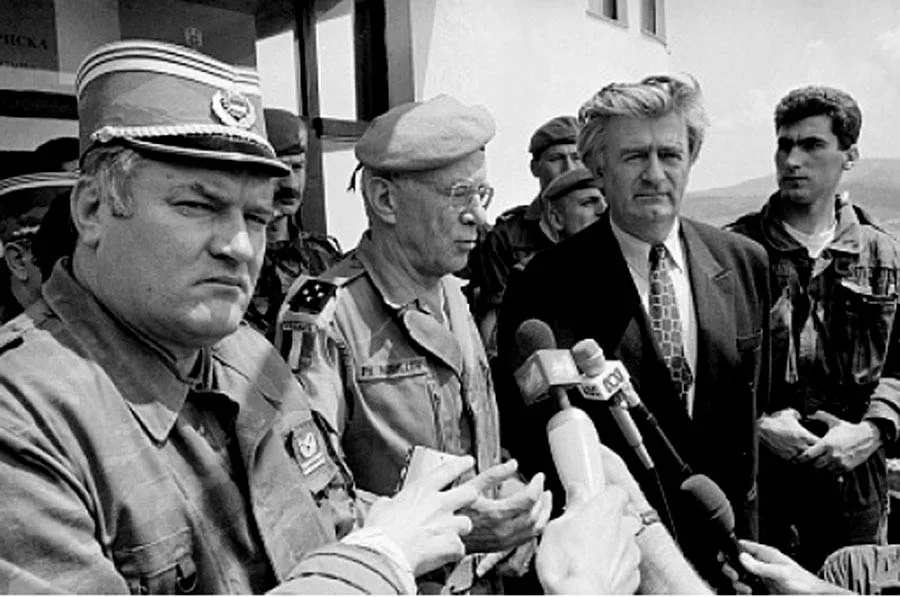
In order to convince Ratko Mladić that it was necessary to deploy Canadian troops to Srebrenica, UNPROFOR commanders, Generals Wahlgren and Morillon, met with him, Milošević, and Gvero in Belgrade on April 9, 1993. Two days after this Belgrade meeting, on April 12, while General Wahlgren was again trying his negotiation skills, this time at the Sarajevo airport, convincing General Mladić that UNPROFOR had the mandate to deploy its forces to Srebrenica, the concrete playground in front of the Secondary School Center was shelled from VRS positions, killing 70 and wounding over 100 civilians. "The hospital was full of wounded. Many lay in the corridors. Amputations were performed with a hand saw without anesthesia."
UNPROFOR officials, who were in Srebrenica at the time, informed the UNPROFOR command about this crime, after which General Wahlgren sent a message to Pale, as "an expression of his deep concern for this terrible development in an already dire situation, which is rapidly worsening." The city was intensively shelled the next day as well, when "Serbs sent an ultimatum for surrender through UNHCR" within 48 hours.
Resolution 819 was adopted by the Security Council – the first of two resolutions declaring six Bosnian cities as safe zones. This meant that it was still unclear what safe zones would actually represent, and at the time it was adopted, more concrete actions, such as military intervention against VRS positions, were being foreshadowed. These fears were the main reason why Karadžić issued the aforementioned order to the VRS General Staff to halt their forces at the achieved positions in and around Srebrenica.
Since the Resolution confirmed "the sovereignty, territorial integrity, and political independence of Bosnia and Herzegovina," and demanded that the FRY "immediately cease the flow of military weapons, equipment, and services," as well as "take all measures within its power to prevent the commission of the crime of genocide," not a single paragraph of the Resolution's text hinted at anything that could lead to the conclusion that members of the ARBiH in Srebrenica should surrender their, already scarce, weapons. Therefore, although the text of the Resolution itself did not mention the disarmament of Srebrenica residents anywhere, on the contrary, the day before, an initiative to lift the arms embargo was launched, it seems that it served as a pretext for the implementation of the UNPROFOR command's plans on the ground through General Morillon.
During the discussions about the Resolution, the Council was not aware that negotiations were taking place, in which the UNPROFOR commander actively participated, persuading the ARBiH commander to sign a demilitarization agreement. Aware that the size and equipment of the Canadian unit, which consisted of a small group of 143 lightly armed soldiers, "was not impressive" and "did not inspire much confidence," the UN Secretariat stated that "the demilitarization of Srebrenica was a step agreed upon by the parties, not something proposed by the United Nations."
Meanwhile, the Canadian government, justifying itself by stating that it thought the task of its soldiers would be "strictly humanitarian in nature," emphasized that their position was very insecure, and concluded that the UN presence in Srebrenica should be internationalized, demanding reinforcements with British and French soldiers.
On April 18, 1993, a preliminary Demilitarization Agreement was signed, according to which it was decided to "form a commission for ceasefire control, handover of weapons and military equipment of Muslim units, and resolution of all issues regarding the demilitarization of the wider Srebrenica region. Three VRS members were approved, who, under the protection of UNPROFOR forces, were to come to Srebrenica on April 19 and begin their work."
The report submitted by the UNPROFOR General Staff for Bosnia and Herzegovina to the command in Zagreb states that the weapons were placed under UNPROFOR control and that the city's demilitarization process was complete. After this report, the UN Secretariat admitted that, along with "brave statements about UNPROFOR's readiness to resist attacks on Srebrenica," they were aware that "the burden remains on the parties to treat Srebrenica as a safe zone."
In order to assess the situation on the ground and prepare a report on it, in accordance with paragraph 12 of Resolution 819, a Mission of Security Council members visited Bosnia and Herzegovina from April 22-27, 1993. The mission, led by Venezuela's representative Diego Arria, also included representatives from France, Hungary, New Zealand, Pakistan, and Russia. They stayed in Srebrenica on April 25, where they visited UNPROFOR observation posts on the hills surrounding the city.
The mission gave a rather negative assessment of the implementation of Resolution 819, noting that in the past week, i.e., after the demilitarization agreement was signed, "Serbs dug 47 new trenches. Tanks and heavy weapons can be seen from 900 meters away from one observation post. It is evident that not only are Serb paramilitary troops not withdrawing as required by Resolution 819 (1993), but they are even increasing pressure on the city." The report further emphasized that the city was overcrowded, without drinking water, electricity, or medical assistance, that people were sleeping on the streets, which also served as toilets, and that a "slow-motion genocide" was precisely happening in Srebrenica. Unfortunately, we see similar scenes today with the Palestinian people in the Gaza Strip.
Considering such a negative view on the application of the safe zone in Srebrenica, as well as subsequent events, led Diego Arria, then Venezuela's representative as a non-permanent member of the UN Security Council, to state as a witness for the ICTY Prosecution in the "Slobodan Milošević" case, 10 years after these events, that this resolution "provided a political cover from international public opinion, but not actual protection for the residents of Srebrenica. We knew from the very beginning that Resolution 819 was a complete farce. A deception that I believe would not have been possible without the support of the permanent member states of the Council and the UN Secretary-General himself."
Although neither Resolution 824, which declared five more Bosnian cities as safe zones, nor any paragraph thereof hinted that the areas declared "safe" should be demilitarized, two days after its adoption, on May 8, 1993, an agreement on the demilitarization of Srebrenica and Žepa was signed, emphasizing that "demilitarized areas should include areas within the current lines of conflict." According to Article 2 of the said Agreement, UNPROFOR was to mark the demilitarized zone using signs that should read in English, Serbian, and Bosnian, in Latin and Cyrillic script: "Demilitarized Zone, any military operation is strictly prohibited, Article 60, First Additional Protocol to the Geneva Conventions."
Unlike the earlier demilitarization agreement of April 18, 1993, this one refers to Article 60 of Additional Protocol I on the protection of victims of international armed conflicts to the Geneva Conventions of August 12, 1949, which relates to the definition of demilitarized zones. Also, it is interesting that this agreement singled out only Žepa from the other five cities declared safe zones and, linking it to Srebrenica, declared it a demilitarized zone.
The genocide committed in Srebrenica and Žepa indicates that the Agreement on their demilitarization, signed in April and May 1993, already meant the capitulation of these areas at that time, given that the lack of a clear UNPROFOR mandate, as well as an insufficient number of troops, did not make the mentioned zones "safe" in any way.
The text is based on the author's scientific work published in 2021, reference: RESOLUTION 819 – Srebrenica, April 1993, "Genocide against Bosniaks, Srebrenica 1995-2020: Causes, Scale, Consequences" (Collection of Papers), University of Sarajevo - Institute for Research of Crimes Against Humanity and International Law, 2021, pp. 334-360.
Komentari (0)
Prijavite se za komentiranje
PrijavaJos nema komentara. Budite prvi!
Minuta
Sve →Iz drugih kategorija

High Representative Not Elected: Germans, French and British Against Americans, New Attempt at End of June

ČOVIĆ WITHOUT MERCY: How Those Who Brought Ademović to Office Created a Political Hell for Him



Sunny Saturday, quite warm



Tragedy in Albanian resort: Two minors drown












