
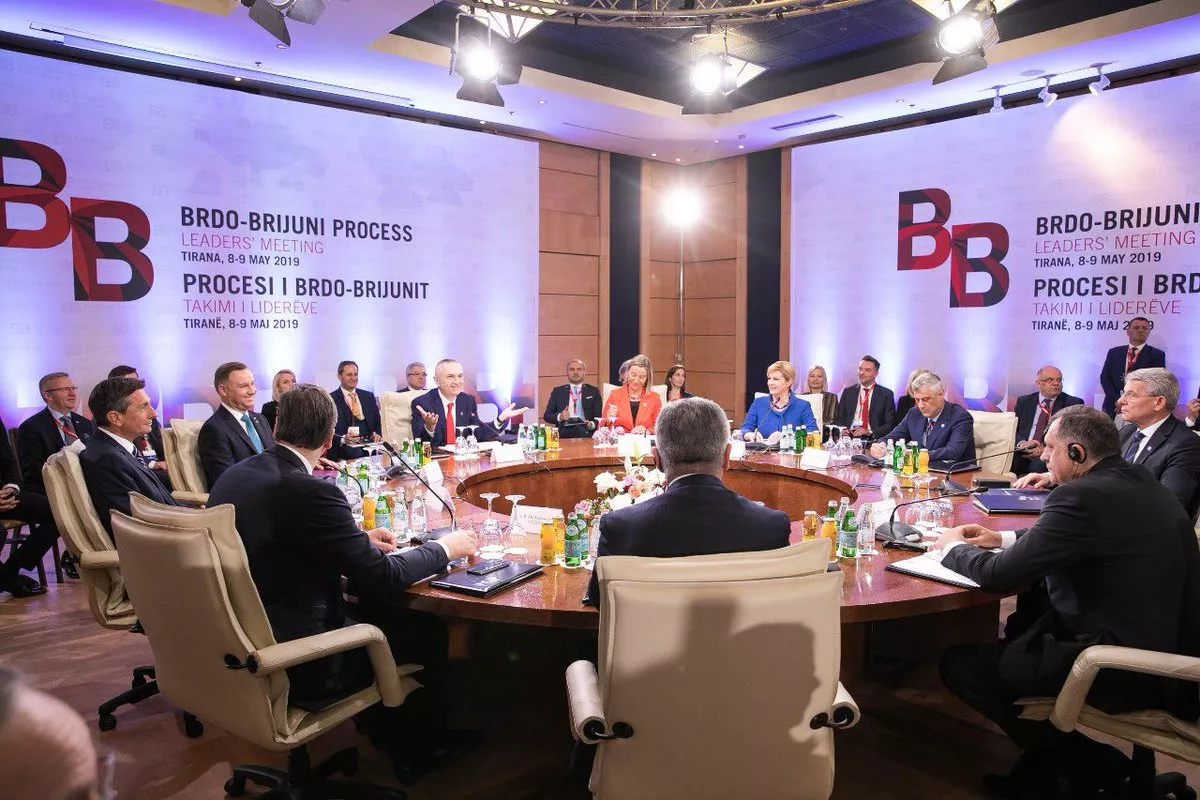
Participants of the Brdo-Brijuni Process summit called on the European Union on Thursday to consider geopolitical reasons in the enlargement process to the Western Balkan countries, stating that full integration of these countries into the European value system would be important for overall European stability.
"We call on the European Union to consider its enlargement to the Western Balkans as a matter of geopolitical importance," reads the joint statement adopted at the summit of this initiative held in Tirana.
"Full integration of the Western Balkan countries into the European value system is an important factor for overall European stability," it adds.
This is a regular annual meeting of the leaders of the countries involved in the initiative, which was jointly launched by Croatia and Slovenia in 2013.
This year's summit was organized by Albanian President Ilir Meta, and in addition to the co-presidents of the initiative, Croatian President Kolinda Grabar-Kitarović and Slovenian President Borut Pahor, the leaders of Bosnia and Herzegovina, Serbia, Montenegro, North Macedonia, and Kosovo, countries in various stages of the EU accession process, also participated.
The summit was also attended by the EU High Representative for Foreign Affairs and Security Policy, Federica Mogherini, and, as an honorary guest, Polish President Andrzej Duda.
In the final statement, the participants of the meeting emphasized that candidate countries must meet all European Union standards, and called for the negotiation process to be conducted "more flexibly and faster," writes N1.
They also welcomed the Prespa Agreement between Skopje and Athens on changing the name of Macedonia to North Macedonia, which opened up the possibility of continuing the country's Euro-Atlantic integration.
"We conclude that such examples show the way towards strengthening European and Euro-Atlantic ties within the Western Balkan region," the statement reads.
The summit in Tirana is being held a few weeks before the EU leaders' summit in early June, where a decision is to be made on the possible formal start of EU accession negotiations with Albania and North Macedonia, countries that have candidate status for membership in the Union.
In her address, Croatian President Grabar-Kitarović supported the opening of accession negotiations with these countries, but emphasized that all candidates and potential candidates for EU membership must implement all necessary reforms and align their foreign and security policy with EU policy.
"The EU must not abandon the countries of Southeast Europe, and Croatia will continue to be your advocate within the EU," Grabar-Kitarović said.
She also stated that Croatia, during its EU presidency in the first half of next year, will place the issue of enlargement to Southeast Europe high on the agenda and will organize a summit on this topic.
However, at a press conference, Grabar-Kitarović emphasized that she is concerned about the lack of progress in the region and the lack of interest in Brussels.
"When I talk to colleagues in Brussels, I see not only a lack of understanding of the situation in Southeast Europe, but unfortunately also a lack of interest, and this also applies to the public in these countries," said Grabar-Kitarović, adding that the Brdo-Brioni Process is important to maintain attention on the region.
"I am also concerned about the lack of progress in the region... unfortunately, the situation we have now, especially due to discussions in the EU that are focused on internal problems. We have created a dangerous vacuum in Southeast Europe... people increasingly doubt and lose faith in whether progress is possible, and this vacuum is being filled by third parties, which are not necessarily good for the region," said Grabar-Kitarović, adding that "a battle of ideas or ideologies is almost being waged here."
Slovenian President Pahor warned that the next European Commission after the European elections will likely not have the issue of enlargement to the Western Balkans at the top of its priorities. "Therefore, the leaders of this region must do everything to make the issue of enlargement more attractive to the rest of the European Union," said Pahor.
The participants of the Brdo-Brijuni summit also supported the Union's stance that one of the conditions for membership is the resolution of open bilateral issues between neighboring countries. "We will actively strive to continue the dialogue and deepen trust in the region we represent. All open issues will be resolved peacefully, in a spirit of mutual respect and cooperation," the final statement reads.
In this regard, the summit also discussed the relations between Serbia and Kosovo, as the recent meeting on this topic in Berlin, organized by German Chancellor Angela Merkel and French President Emmanuel Macron, had failed ingloriously.
Albanian President Meta said that the atmosphere at the summit was constructive, and expressed his desire for the dialogue between Pristina and Belgrade to continue. "I would like to praise the constructive dialogue between Serbia and Kosovo, even if no progress has been made. If we had resolved all problems today, I would think we were living in Benelux," said Meta.
It was decided at the summit that the next summit of the Process will be held in Slovenia. Pahor said that he and the Croatian president had drafted a letter in which they invited UN Secretary-General Antonio Guterres to be a special guest at that summit. If Guterres agrees, the next Brdo-Brijuni Process summit will likely be held in mid-November this year in Brdo pri Kranju, Pahor said.
Komentari (0)
Prijavite se za komentiranje
PrijavaJos nema komentara. Budite prvi!
Minuta
Sve →Iz drugih kategorija

High Representative Not Elected: Germans, French and British Against Americans, New Attempt at End of June

ČOVIĆ WITHOUT MERCY: How Those Who Brought Ademović to Office Created a Political Hell for Him



Sunny Saturday, quite warm



Tragedy in Albanian resort: Two minors drown












