
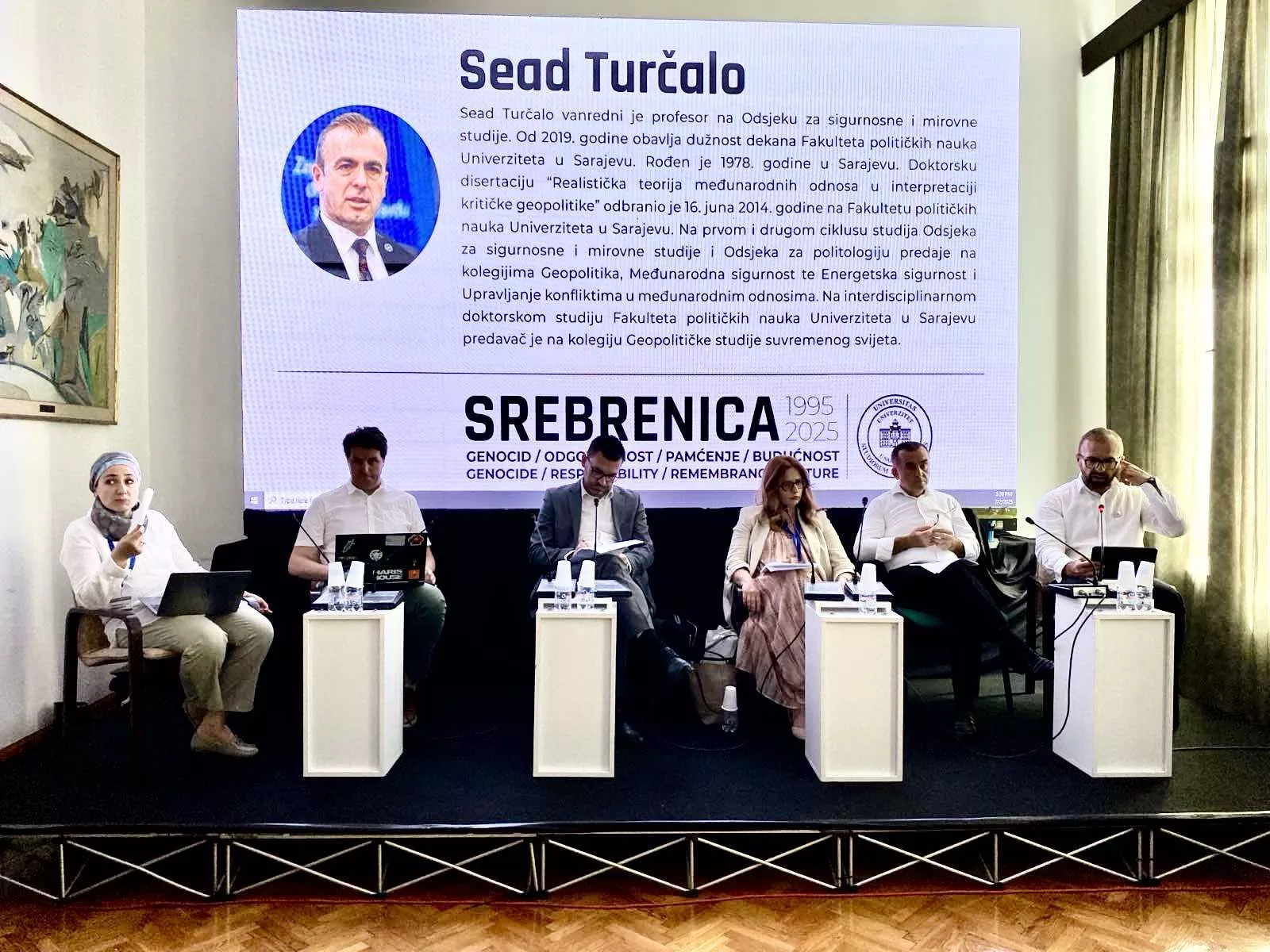
(Patria) - The conference titled "Srebrenica 30 Years After the Genocide: Remembrance, Responsibilities, and Challenges of Denial" continued in Sarajevo today.
Kim Sadique from De Montfort University presented her work, which problematizes learning about genocide, intended as a transformative experience that seeks to encourage students and visitors of memorial museums to take initiative and act towards preventing the recurrence of such and similar crimes in the future, and to contribute to the realization of the principle of 'never again', proposing the application of 'pedagogy for social change'.
Pinar Akarcay from Istanbul University introduced interesting concepts into the field of genocide research.
- The main characteristic of politicides and democides is a coordinated and persistent attempt by the state or dominant social groups to partially or completely destroy a social or political group.
The genocide in Srebrenica, arguably the first genocide committed in Europe, is not only an example of genocide but also an example of politicid and democid - Akarcay points out.
In the last thirty years, numerous attempts have been recorded to recognize the political responsibility of the Netherlands regarding the genocide in Srebrenica.
According to Nika Wentholt (University of Humanistic Studies, Utrecht), these attempts have resulted in only partial, minimal recognition.
In a joint scientific article, Wentholt and Alma Mustafić argue that Dutch politics and society did not seize the opportunity when numerous civil lawsuits resulted in the determination of Dutch responsibility for the murder of over 350 Bosniaks.
- With the conclusion of the war in Bosnia and Herzegovina, the international community incorporated the idea into the Dayton Peace Agreement that the return of Bosniaks represents a human right and a form of justice, restoring property rights and displaced communities.
In reality, the return process was - and remains after 30 years - complex and uneven. This presentation examines the experience of returning home through two prisms: 'domicide' as a description of the damage inflicted during the war, on one hand, and 'restoration of belonging' as an idealized goal of the post-war period, on the other - said David Simon (Yale University).
At the end of the day, Sead Turčalo (UNSA) emphasized that the denial of the genocide in Srebrenica is not a spontaneous phenomenon nor a legitimate 'second opinion', but an organized and institutionalized phenomenon.
Through systematic denial of judicially established facts, victims and survivors are deprived of the right to truth and dignity, they are subjected to renewed humiliation, and the very possibility of justice is undermined.
- Revisionist narratives about Srebrenica employ recognizable methods of deception and manipulation - a complete inversion of facts, where victims are declared guilty, and the crime is presented as alleged 'revenge'.
A key tactic is also the constant discrediting of sources of truth, from the testimonies of survivors, through victims' associations, to the Hague Tribunal, which is baselessly labeled as a 'political court', all with the aim of destroying trust in evidence and facts - Turčalo concluded.
This evening at the "Meeting Point" cinema at 7:30 PM, a special screening of the film "Quo Vadis, Aida?", directed by Jasmila Žbanić, and the short feature film "Mother", by the acclaimed Turkish director Rasit Gorgulu, will be organized.
Tomorrow, after the planned visit to the Srebrenica-Potočari Memorial Center, the conference will conclude with a concert by the Sarajevo Philharmonic Orchestra at the National Theatre, starting at 8:00 PM - which is open to the public.
At this particularly emotional concert, the work "Kindertotenlieder" (Songs on the Death of Children) by the famous composer Gustav Mahler will be performed - a cycle of songs that powerfully and poignantly express the pain of parental loss and the fragility of human life.
The orchestra will be led by conductor Samra Gulamović, and the mezzo-soprano Amila Ravkić will perform as the soloist.
On this occasion, a video essay directed by Danis Tanović, combining photographs by Damir Šagolj with poetry by Faruk Šehić, will also be shown.
The concert pays tribute not only to the children who perished in the Srebrenica genocide but also to children who have suffered in wars and conflicts around the world.
Komentari (0)
Prijavite se za komentiranje
PrijavaJos nema komentara. Budite prvi!
Minuta
Sve →Iz drugih kategorija

High Representative Not Elected: Germans, French and British Against Americans, New Attempt at End of June

ČOVIĆ WITHOUT MERCY: How Those Who Brought Ademović to Office Created a Political Hell for Him



Sunny Saturday, quite warm



Tragedy in Albanian resort: Two minors drown












