
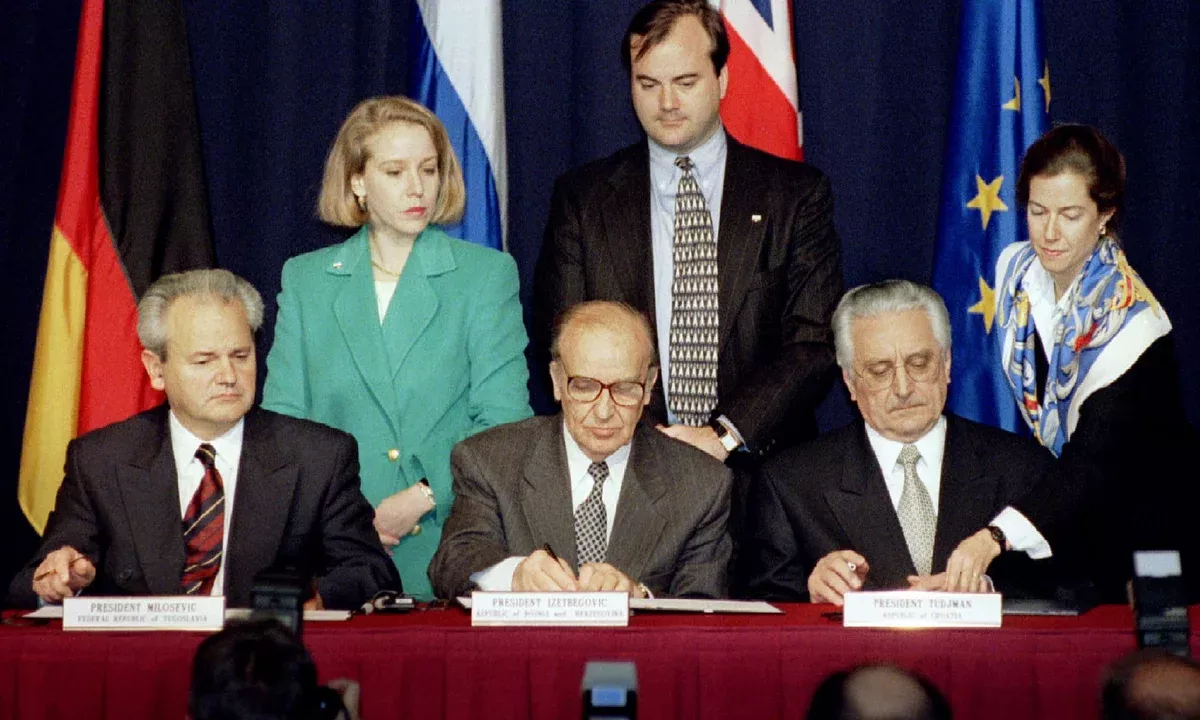
(Patria) - On this day 29 years ago, the Dayton Peace Agreement was signed in Paris.
This document officially ended the four-year war, and Bosnia and Herzegovina was established as a state of three constituent peoples and others, and two entities - the Federation of Bosnia and Herzegovina and the Republika Srpska.
The main actors of the peace negotiations were ultimately also the signatories of the Dayton Agreement - President of the Republic of Bosnia and Herzegovina Alija Izetbegović, President of Croatia Franjo Tuđman, and President of Serbia Slobodan Milošević, on December 14, 1995, at the Élysée Palace in Paris.
All three states emerged from the breakup of the Socialist Federal Republic of Yugoslavia.
- This is not a just peace, but it is more just than continuing the war. In a situation like this, and in a world like this, a better peace could not have been achieved - said Alija Izetbegović after the signing ceremony of the Dayton Agreement in Paris.
These words perhaps to this day represent the best description of the moment in which the Peace Agreement for Bosnia and Herzegovina was reached. At the time of signing, the Dayton Agreement brought long-desired and expected peace to war-exhausted citizens of Bosnia and Herzegovina.
At the same time, it brought a completely new constitutional order of the country, about which, at the time it was signed, at least as far as ordinary citizens in Bosnia and Herzegovina were concerned, few thought in a country where more than a hundred thousand people were killed, more than a million were expelled from their homes or fled to other countries, while houses, factories, schools, universities, infrastructure, cultural and historical monuments were destroyed.
- It did not bring either political or economic integrity to Bosnia and Herzegovina. It did not bring a single voice of Bosnia and Herzegovina in the European Community, i.e., the EU, nor in international frameworks.
If we analyze that, then we must draw a line between what was, what is now, and what awaits Bosnia and Herzegovina in the future.
Of course, it is now pointless to discuss the genesis of the Dayton Peace Agreement itself in that part, why it has many shortcomings or why it has not been fully implemented on the territory of Bosnia and Herzegovina - said earlier Jusuf Pušina, former Minister of Internal Affairs of the Republic of Bosnia and Herzegovina and advisor to the Chairman of the Presidency of Bosnia and Herzegovina Alija Izetbegović.
Former member of the Presidency of Bosnia and Herzegovina and Minister of Foreign Affairs of the Republic of Bosnia and Herzegovina during the war period, Haris Silajdžić, was also a member of the delegation of Bosnia and Herzegovina in the negotiations for the Dayton Peace Agreement.
He previously stated that the Dayton Peace Agreement was created symbolically in Bosnia and Herzegovina, but through weapons, soldiers, tanks.
- When we were admitted to the UN on May 22, 1992, that was our last chance for the war to be recognized as aggression against the state, and not just against the territory. It is good that we succeeded in that - Silajdžić said earlier.
The greatest contribution to the creation of the Dayton Agreement was made by Richard Holbrooke, former deputy of US Secretary of State Madeleine Albright, and its presence was guaranteed by US President Bill Clinton, UN Secretary-General Boutros Boutros-Ghali, former French President Jacques Chirac, then British Prime Minister John Major, NATO Secretary-General Javier Solana, German Chancellor Helmut Kohl, Russian Prime Minister Viktor Chernomyrdin, as well as Swedish Prime Minister Carl Bildt, who also co-chaired the peace conference on behalf of the EU.
The Agreement consists of 11 annexes, including Annex 4 - the Constitution of Bosnia and Herzegovina, which confirmed the sovereignty, territorial integrity and independence of Bosnia and Herzegovina as a state.
It was determined that Bosnia and Herzegovina consists of two entities, the Federation of Bosnia and Herzegovina and the Republika Srpska, and that it is made up of constituent peoples, Bosniaks, Croats and Serbs, together with others. The competencies of Bosnia and Herzegovina and the entities were prescribed, as well as relations between the institutions of Bosnia and Herzegovina, and the manner of amending the Constitution of Bosnia and Herzegovina.
Komentari (0)
Prijavite se za komentiranje
PrijavaJos nema komentara. Budite prvi!
Minuta
Sve →Iz drugih kategorija

High Representative Not Elected: Germans, French and British Against Americans, New Attempt at End of June

ČOVIĆ WITHOUT MERCY: How Those Who Brought Ademović to Office Created a Political Hell for Him



Sunny Saturday, quite warm



Tragedy in Albanian resort: Two minors drown












