
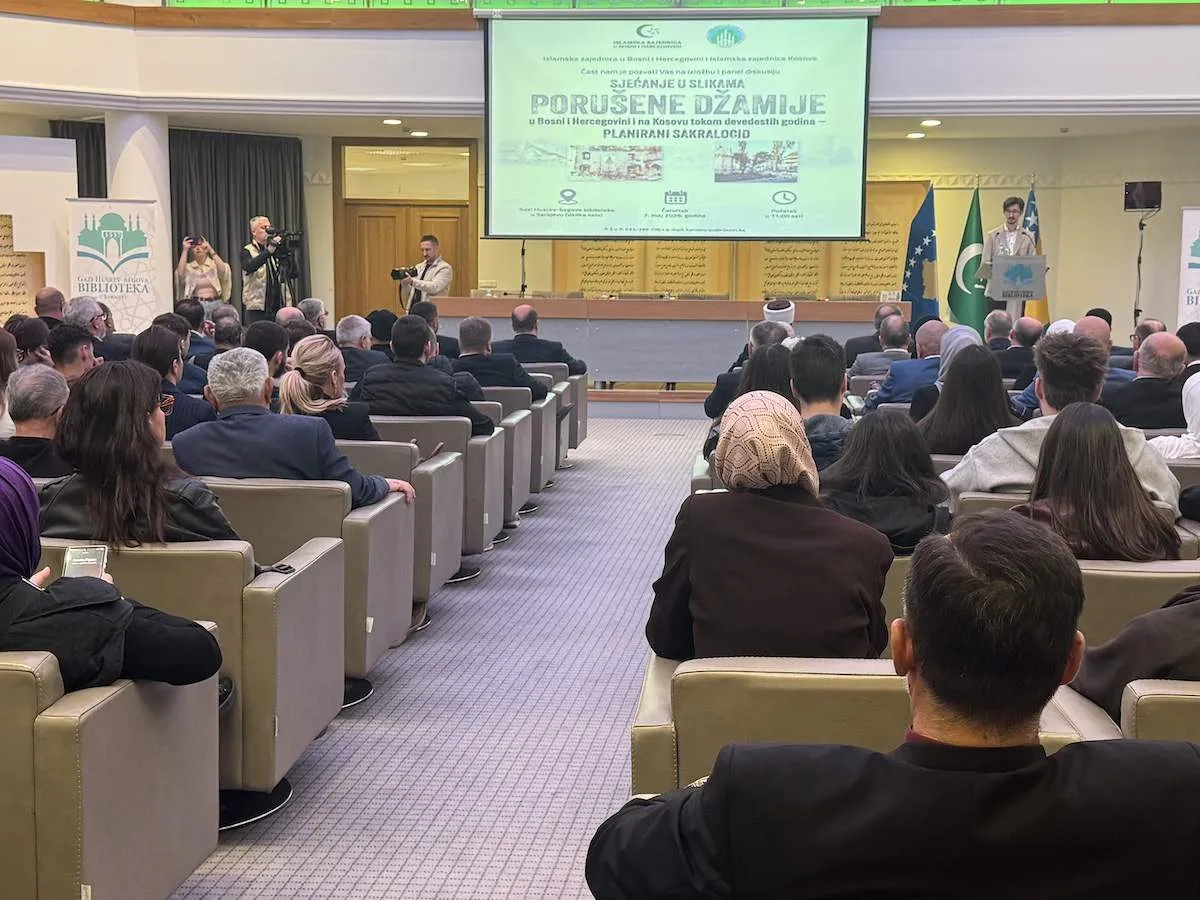
(Patria) - On the occasion of marking the Day of Mosques, a joint exhibition of the Islamic communities in BiH and Kosovo dedicated to the destruction of mosques and Islamic cultural heritage during the wars in BiH and Kosovo was opened today at the Gazi Husrev-beg Library in Sarajevo.
Speaking about the significance of marking the Day of Mosques, Deputy Reis-ul-Ulema Enes-ef. Ljevaković emphasized that the Islamic Community, through the manifestations Days of Waqfs and Days of Mosques and Communes, nurtures a culture of remembrance and reminds of the suffering of religious buildings during the war.
He recalled that on May 7, 1993, during the aggression against Bosnia and Herzegovina, the Ferhadija Mosque, one of the most recognizable symbols of Banja Luka, was demolished, and that the Islamic Community designated this date as the Day of Mosques for all demolished mosques in Bosnia and Herzegovina.
- It is an opportunity to remember all the demolished mosques, and there were more than 600 of them - said Ljevaković, adding that mosques in Kosovo suffered a similar fate during the war there.
Speaking about the joint exhibition of the Islamic Community in BiH and the Islamic Community of Kosovo, which, after its premiere in Pristina, was also presented to the Sarajevo public, he emphasized that the photographs and documents clearly testify to the systematic destruction of mosques and attempts to erase the identity of a people and its culture.
- Mosques were systematically destroyed and damaged, people were persecuted, and the goal was to erase the traces of the existence of a people and its culture in these areas - said Ljevaković.
He stressed that the purpose of marking the Day of Mosques is to remind of the horrors of war, but also to send a message that such crimes and destruction should never be repeated to any people, culture, or civilization.
- We will do everything to preserve peace, freedom, and security for all people and nations in Bosnia and Herzegovina, as well as wider in the Balkans and Europe. Without peace, there is no development, no progress, and no better life - Ljevaković conveyed.
The Director for Publishing and Culture at the Islamic Community of Kosovo, Ramadan Shkodra, conveyed greetings and regards from the Mufti of Kosovo, Naim Tërnava, thanking those present for attending the opening of the exhibition organized in cooperation between the two Islamic communities.
He emphasized that the documented photographs and archival materials are strong evidence of the systematic destruction of Islamic cultural heritage in Bosnia and Herzegovina and Kosovo.
- The purpose of this exhibition is not to produce intolerance among peoples, but to preserve collective memory and serve as a warning so that such crimes and destruction are never repeated again - Shkodra conveyed.
The Director of the Administration for Foreign Affairs and Diaspora of the Riyaset of the Islamic Community in BiH, Muhamed Jusić, stated that the exhibition is being presented to the public of Bosnia and Herzegovina for the first time today, after touring several cities across Kosovo during the past year.
According to him, it is planned that the exhibition will be presented in other parts of Bosnia and Herzegovina, as well as in European Union countries in the coming period, through joint activities of the two Islamic communities.
- This is our contribution to building peace, confronting the past, and strengthening cooperation between the Islamic Community in BiH and the Islamic Community in Kosovo - Jusić conveyed.
On the occasion of the Day of Mosques, the Minister for Human Rights and Refugees of BiH, Sevlid Hurtić, also addressed the audience, recalling the destruction of Ferhadija and numerous other mosques across Bosnia and Herzegovina during the war.
He emphasized that the Islamic Community, with the help of the citizens of Bosnia and Herzegovina, has rebuilt almost all demolished mosques, including a large number of mosques in the RS area.
- Whoever forgets what happened risks it happening again. We must nurture a culture of remembrance and teach our children what happened - said Hurtić.
He added that other religious communities in Bosnia and Herzegovina should also organize similar exhibitions about the suffering of their religious buildings in order to document the destruction of churches, synagogues, and other places of worship during the war.
During the Serb-Chetnik aggression against BiH (1992-1995), 614 mosques, 218 mesjids, 69 mektebs, 4 tekkes, 37 turbets, and 405 other waqf objects were destroyed.
Of the 614 demolished mosques, 534 were in the territory controlled by the Army of Republika Srpska, and 80 were in the territory controlled by the Croatian Defence Council (HVO).
In Banja Luka, a city where there were no war operations, all mosques were demolished. No churches were demolished in the territory controlled by the Army of the Republic of Bosnia and Herzegovina.
During the Liberation War in Kosovo (1998-1999), Serbian forces, through various forms of violence and aggression, attacked and destroyed a large part of the Islamic heritage.
218 mosques out of a total of 560 that existed in Kosovo at that time were burned, shelled, and desecrated. Also, the headquarters of the Presidency of the Islamic Community of Kosovo was burned, the "Alauddin" madrasa was damaged, the buildings of four old historical madrasas, three tekkes, one hammam, and 78 business premises, property of waqfs and local boards across the country were demolished.
Komentari (0)
Prijavite se za komentiranje
PrijavaJos nema komentara. Budite prvi!
Minuta
Sve →Iz drugih kategorija

High Representative Not Elected: Germans, French and British Against Americans, New Attempt at End of June

ČOVIĆ WITHOUT MERCY: How Those Who Brought Ademović to Office Created a Political Hell for Him



Sunny Saturday, quite warm



Tragedy in Albanian resort: Two minors drown












