
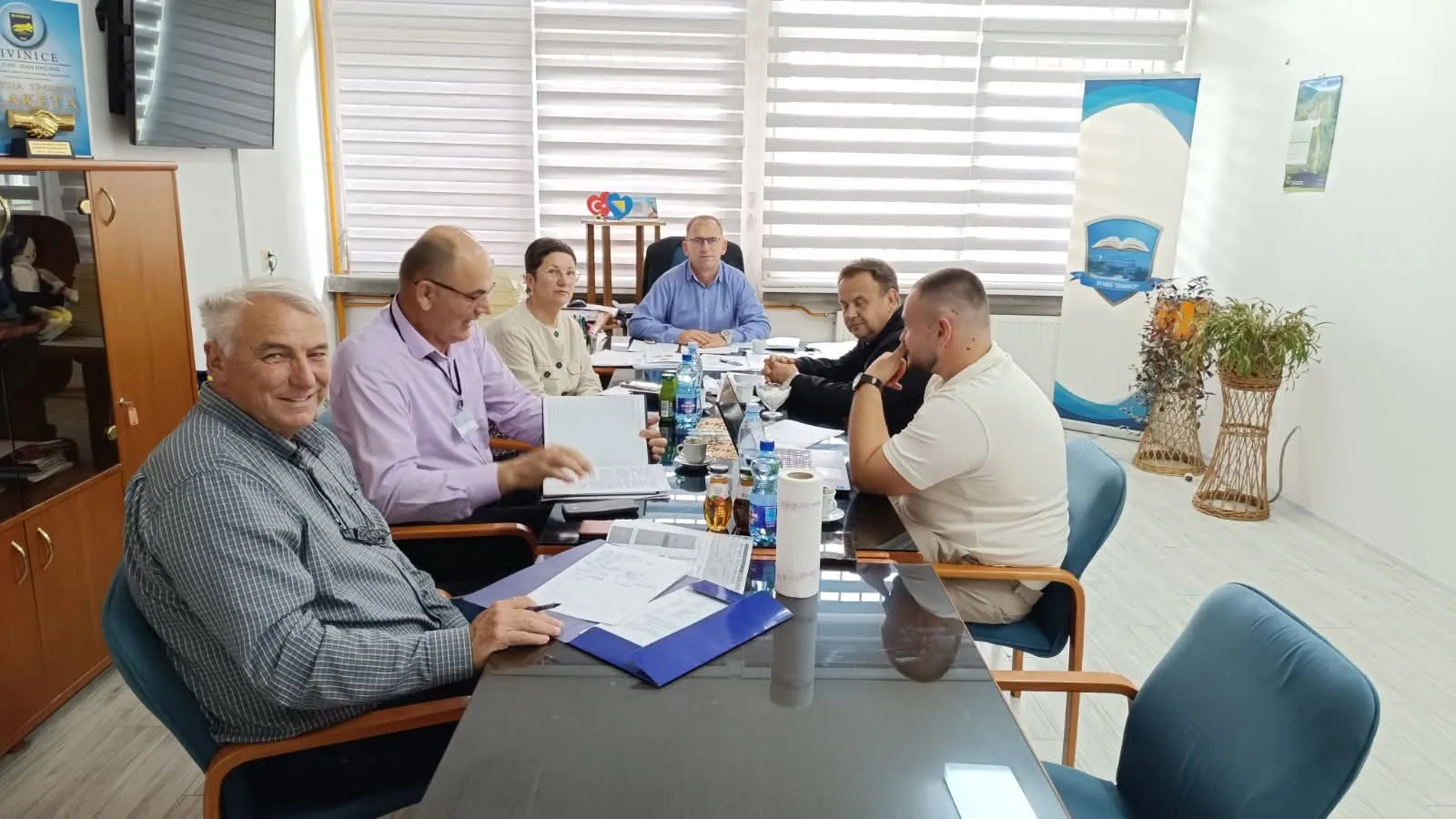
(Patria) - A working meeting was held at the Mixed Secondary School Živinice with representatives of the Ministry of Education and Science of Tuzla Canton, the Pedagogical Institute of Tuzla Canton, school management, agricultural profession professors and representatives of MFR Živinice, with the aim of improving practical teaching through the application of the MFR (Maison Familiale Rurale) education model.
The meeting represents an important step towards introducing an experimental part of practical training for the profession of florist-gardener, based on the principles of alternating pedagogy, for which the MFR model is recognized throughout Europe, especially in France.
During the meeting, changes to the curriculum for the practical training subject were agreed upon within the legally permitted possibilities, as well as the adaptation of the teaching method so that students acquire a significant part of practical knowledge outside school, on agricultural farms, with craftsmen and other economic entities engaged in agricultural production.
The MFR education model is based on the principle of alternating pedagogy, which connects school, family and the economy. Students spend part of their time at school and part on family farms, cooperatives and companies, where through practical work they acquire knowledge and skills that are directly applicable in everyday life and the labor market. This approach contributes to better education, greater student motivation and better preparation for future professional engagement.
For Bosnia and Herzegovina, this model has special significance because it represents much more than an educational reform. Its goal is to strengthen rural communities, develop family agricultural farms and create conditions for young people to stay in the countryside. At a time when villages are facing depopulation and interest in agricultural professions is declining, the MFR model offers concrete solutions by linking education with the real needs of rural areas.
The Family Rural Educational Center (PREC) Živinice, as the bearer of the development of the MFR concept in Bosnia and Herzegovina, has been developing cooperation with MFR schools and organizations in France for years, working on establishing a system that will enable young people to have better education and greater opportunities for professional development.
Special value to this process is given by the international partnership with French MFR networks, which opens opportunities for students and teachers to exchange experiences, study trips and professional visits to France. Through direct contact with successful examples of rural development, modern agricultural practices and European education models, young people acquire new knowledge, develop professional, language and social competencies and increase their competitiveness in the labor market. At the same time, teachers and educational institutions have the opportunity to adopt positive experiences and apply them in the local environment.
Launching this pilot project in Tuzla Canton represents a significant step towards the modernization of vocational education and opens the possibility for Bosnia and Herzegovina to adopt a proven European model that successfully connects education, agriculture, economy and rural development. The long-term goal is to create conditions for young people to see their future precisely in their local communities, using the knowledge and experience gained through education and international cooperation.
"The MFR model does not only bring more practical teaching. It opens the doors of Europe to our young people through student exchanges, professional internships and study trips to France, while at the same time creating conditions for them to use the acquired knowledge and experience for the development of their villages and local communities. We want education that will not educate young people to leave, but to stay and develop rural areas of Bosnia and Herzegovina."
Komentari (0)
Prijavite se za komentiranje
PrijavaJos nema komentara. Budite prvi!
Minuta
Sve →Iz drugih kategorija

High Representative Not Elected: Germans, French and British Sabotaged Americans, New Attempt at End of June

ČOVIĆ WITHOUT MERCY: How Those Who Brought Ademović to Office Created a Political Hell for Him



Sunny Saturday, quite warm



Tragedy in Albanian resort: Two minors drown












