

• In the leading magazine "Foreign Affairs" of April 9, 2025, in an article by Bosnian-Herzegovinian author Ismet Fatih Čančar, the attention of the American public, ahead of the NATO Parliamentary Assembly from May 22 to 25, Dayton, is strongly focused on Bosnia and Herzegovina with a key message: "If Europe, with the help of the United States, is unable to stop Dodik, the question is how will it stop Putin".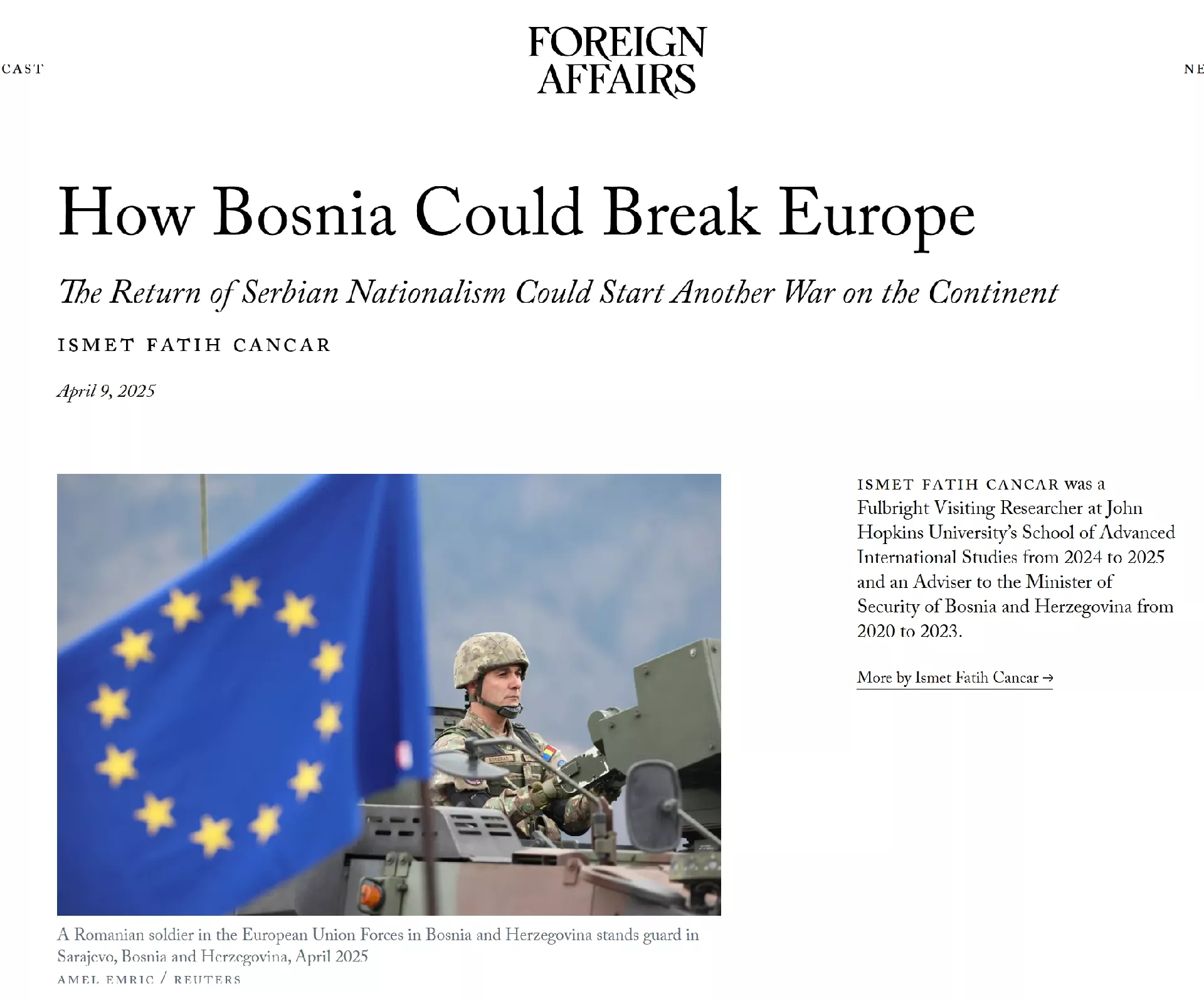
By: Fuad Đidić
America's best connoisseurs of diplomacy, through the pages of the leading magazine "Foreign Affairs", often know how to send messages to countries or leaders of individual countries through their choice of topics and authors.
When the article by Ismet Fatih Čančar, a young Bosnian-Herzegovinian Fulbright scholar, titled "How Bosnia Can Divide Europe" (April 9, 2025) appeared on the pages of this magazine, several important messages were certainly sent to the public.
The American foreign policy community has clearly assessed that the time has finally come to hear, not the voice of an observer of Bosnian-Herzegovinian affairs, but to hear the authentic voice of an author who belongs to Bosnia and Herzegovina, academically and professionally.
The message for Bosnia and Herzegovina is quite encouraging: "You have the right to your voice, and we want to hear your voice...". It should be recalled that this is the first article by a Bosnian author in "Foreign Affairs" since 2017, and it comes before the public at quite important moments, especially on the eve of the 30th anniversary of the Dayton Agreement, with strong impetus for the renewal of American resolve in Bosnia, which the United States demonstrated in 1995 by sending its troops to protect the peace established by the Dayton Accords in Bosnia and Herzegovina.
Trump's opportunity lies where Biden failed, and where he, like Europe itself, catastrophically "failed" on the issue of Bosnia. Almost in the spirit of an offensive realist, he detects that a problem that has been postponed for decades can be solved not on the basis of a new military intervention, but on the basis of creative policy and bold initiative, with certain control mechanisms.
An additional reason for such resolve, Čančar sees in the fact that America has already understood and detected that something fundamentally "different" is happening in the fate of their greatest diplomatic achievement in the last thirty years.
This fundamentally "different" thing best reveals the changed geopolitical circumstances and a "sleeping" Europe, which, without much-needed confidence in stopping Dodik's secessionist ambitions, has been pushing Bosnia and Herzegovina's Euro-Atlantic path to the back of the line for decades.
Such a diplomatic project no longer serves America's interests but paradoxically, has turned against America's interests: Putin is becoming a dominant player in the Balkans, Moscow and Serbian secessionists are quite encouraged in reactivating and implementing the bloody policies of the 1990s, Orban and Vučić are becoming the basis for an alliance of authoritarian states, and a divided Europe on the issue of Bosnia is a danger to America itself.
At the root of the Dayton project lie political contradictions, and based on this, Čančar publishes a roadmap for Dayton 2.0 in the renowned "Global Policy". In it, he rightly calls for action from the OHR and the High Representative to initiate constitutional reforms, adopt legislation to prevent ethnic and entity abuse of the veto right, strengthen central institutions with the function of a real state prime minister, at least 6 new ministries, establish an independent military intelligence agency, and a host of other security measures, including the deployment of EUFOR peacekeeping forces to the borders with Serbia, and correctly suggests paying special attention to the Brčko District.
However, as a key priority, Čančar suggests that America establish a "quadrilateral" partnership alliance with Great Britain, Turkey, and Norway, through which security guarantees would be provided for Bosnia and Herzegovina before joining NATO.
It is quite correct that for the security of Bosnia and Herzegovina, a type of multilateral framework is necessary as a future basis for strengthening its defense capabilities and capacity, which exists precisely within this quadrilateral. The idea of a multilateral framework for Bosnia and Herzegovina is all the more justified as a "trilateral initiative" of Croatia, Albania, and Kosovo has already been established in the region, and a new "military alliance" of Serbia, Hungary, and the entity of Republika Srpska has been announced.
An important advantage of this "quadrilateral partnership" initiative is the irreversible involvement of European powers in providing security guarantees for Bosnia and Herzegovina, which, in addition to having good diplomatic relations with all countries in the region, already have a military presence in the Balkan countries (EUFOR and KFOR), as well as production defense capacities (Kosovo, Albania, Croatia...).
In the mentioned article, Čančar is explicit in his assessments that the prosecution for unconstitutional actions and the removal of Milorad Dodik and his associates are necessary, and that ultimately, stopping Belgrade's policy is the only way to resolve the issue of historical Serbian irredentism and a firm commitment to the policy of European leaders like Orban and other European right-wingers in the "sitting on two chairs" project.
After all, he points out the justification for European sanctions against Dodik as a way to isolate him and believes that this is precisely the key test for the European trio: Starmer, Merz, and Macron, and whether they are capable of filling the vacuum that would arise from the eventual departure of the Americans.
In a conversation with Jim O'Brien in Washington in the final days of his service at the State Department, Čančar recognized that one of the main creators of the legal content of the Dayton Agreement sees the solution to the political "stalemate" and "breakdown" of Bosnia in the "pacification" of Belgrade and Zagreb in relation to Bosnia and Herzegovina. In other words, this means pacification through concessions at the expense of the Bosnian state.
However, such a policy has also led to the most serious political and security crisis in the Balkans and Bosnia and Herzegovina. By adopting any "Serb-centric strategy," American diplomacy falls into the realm of brutal realism of power, and such an approach guarantees the deepening of the crisis in Bosnia and Herzegovina with serious consequences.
The lion's share of Čančar's activities in Washington, whether through a series of round tables, conversations, or lectures, has culminated in a unified conclusion that the idea of "pacification" that has predominated in the political discourse of most American decision-makers cannot yield any results, because this pacification project essentially breeds - the continuation of the "Putinization" of the region, and ultimately leads to the pre-designed destruction of Bosnia and Herzegovina within the Greater State projects of its neighbors.
In some other articles in renowned Western magazines, Čančar appeals to shed the illusion that we will easily get along with the Trump administration, judging by several earlier encouraging statements from Trump's circle. Not necessarily because of possible changes in relations between Bosnia and Herzegovina and the United States, but rather because the nature of global geopolitics is rapidly changing before our eyes towards the establishment of an uncomfortable transactional diplomacy as a completely new fact in resolving the Bosnian issue. This does not mean that cooperation with America should cease, but it implies the adoption of new realities in the creation of Bosnia and Herzegovina's future strategic actions.
The era of our reliance on the paradigm of exclusive American defense of the European security framework has most likely ended, and this is supported by statements from US Secretary of Defense Pete Hegseth, who announced this break in transatlantic relations in the regime that prevailed in previous decades several months earlier.
In such a constellation, Bosnia and Herzegovina is facing the greatest risk of destruction in its recent history, Čančar wrote for "Foreign Affairs". If the European Union wants to see success in the current project of military security unification, then its key test is in Bosnia and Herzegovina.
If Europe can stop Dodik's territorial seizure, the continent will demonstrate its defense seriousness. Čančar has turned the attention of the American public, which closely follows what is happening with Europe, and in which direction it will move - British or French-German - towards Bosnia and Herzegovina by linking the future of the European political peace project with the survival of Bosnia and Herzegovina.
If Europe (certainly with the help of Americans) is unable to stop Dodik, the question, Čančar concludes, is how it will be able to stop Putin...
Komentari (0)
Prijavite se za komentiranje
PrijavaJos nema komentara. Budite prvi!
Minuta
Sve →Iz drugih kategorija

High Representative Not Elected: Germans, French and British Sabotaged Americans, New Attempt at End of June

ČOVIĆ WITHOUT MERCY: How Those Who Brought Ademović to Office Created a Political Hell for Him



Sunny Saturday, quite warm



Tragedy in Albanian resort: Two minors drown












