
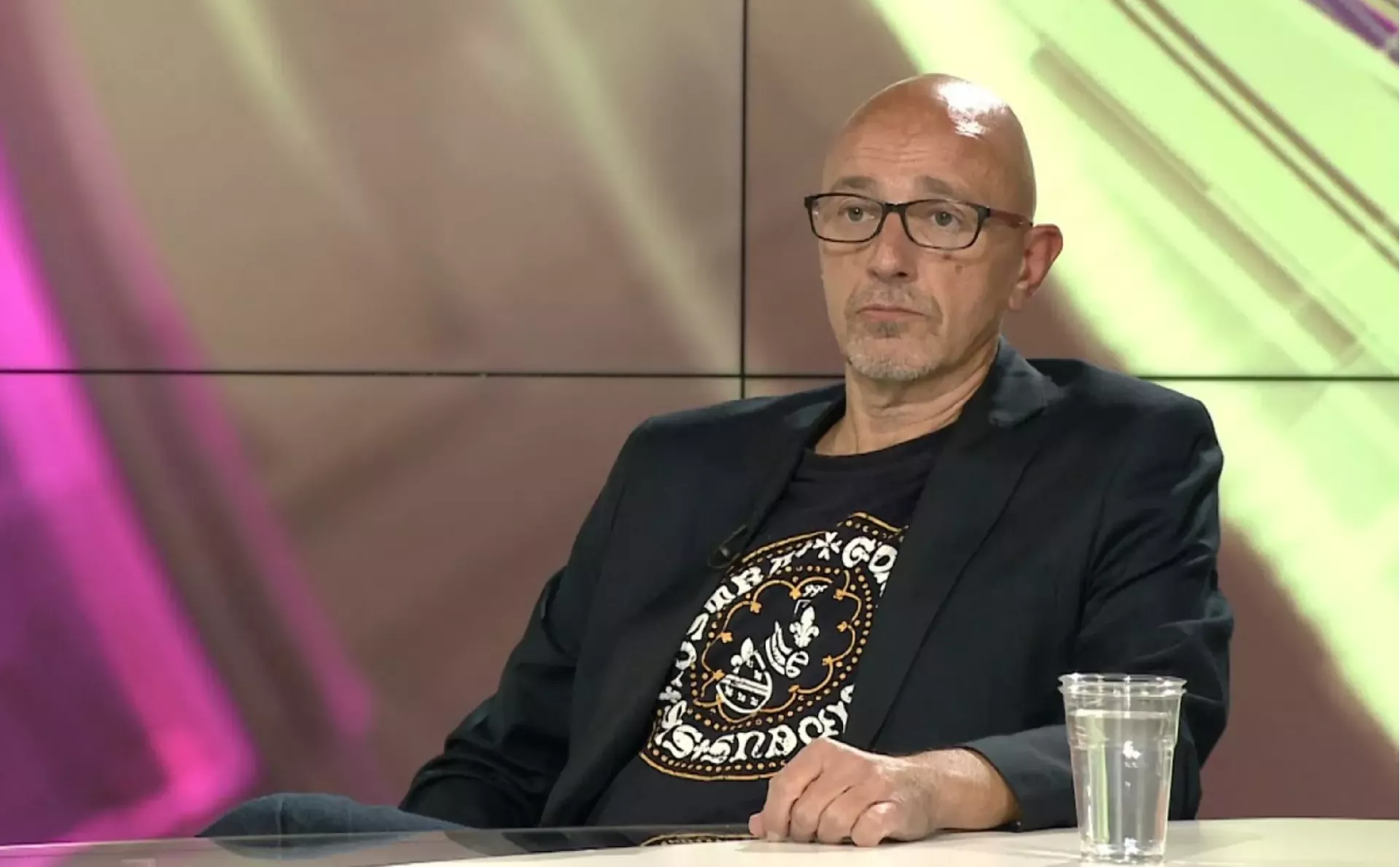
Interview by Delvin Kovač
In Bosnia and Herzegovina, a triple coup d'état is underway, jointly carried out by Milorad Dodik, Dragan Čović, and the Troika, stated political scientist Zlatko Hadžidedić in an interview with the Patria News Agency (NAP).
Professor Hadžidedić analyzes the current political situation and the attitude of neighboring countries towards our country. He also discusses the dire consequences of potential amendments to the BiH Election Law according to the wishes of the HDZ BiH leader Dragan Čović, as well as the passivity of the Troika, and reveals which friends BiH can count on in the international community.
How would you assess the current situation in Bosnia and Herzegovina; what are we actually witnessing on the heated Bosnian-Herzegovinian political scene?
Hadžidedić: I don't think I'm revealing anything new by saying that we are witnessing a coup d'état. The fact is that we have the subversion of the constitutional order, an attempt to secede Republika Srpska, and an attempt to impose certain constitutional arrangements through Čović's Election Law that would lead to a three-part division or the re-establishment of Herceg-Bosna territory with its own administration, separate from the rest of the Federation of BiH.
Therefore, in any case, we have something that is either a single coup d'état by Milorad Dodik, or if you prefer, a double coup d'état by both Dodik and Čović. And we have something that I would call a kind of passive coup d'état by the so-called Troika. They do not intend to oppose either Dodik or Čović and their attempts to subvert the constitutional order. So, I can say it's either a triple attempted coup d'état or a joint criminal enterprise, where everyone is in it together.
These days, we see that both Dodik and Čović can do whatever they want against this country, and at the same time, you have someone like Nermin Nikšić or Dino Konaković saying they don't intend to do anything about it. Simply, the very idea of Bosnia and Herzegovina as a state, of its possibility to have its own sovereignty, has been systematically destroyed for years. Instead of it, decisions are made by Serbia, Croatia, or the US, or the EU, or anyone from outside.
The very idea that sovereignty exists and that this can be a state has been systematically killed over the past 30-something years. And now we have the result we have, that people no longer believe in this state. Now people believe that they should mind their own business, their own petty personal gain, survive as best they can, perhaps gain something materially, and they don't believe the state is even needed anymore. They don't believe in the idea itself.
Of course, this is a dangerous delusion because if you lose your state, then the consequences begin. And we have seen so far that the consequences we have had are the result of the disintegration of the state. However, when the state completely collapses, then citizens simply no longer enjoy any legal or any other protection. Then anything becomes possible.
I fear that the citizens of this country are also in a dangerous delusion, thinking - 'well, as long as they stop bothering us with bad news, as long as there's no state, what's the harm, what will happen, nothing will be missing, it will be the same as before'. It won't be the same as before, it will be much worse. Because if others directly manage you, that has its consequences and price. Even this provisional state that we have had so far had its advantages compared to the lack of any state. I say, the state is there to provide us with physical and legal protection, and if it's gone, none of that will exist.
The leader of HDZ BiH, Dragan Čović, seems to have embarked on his strongest campaign yet regarding amendments to the BiH Election Law. He is, as expected, receiving wholehearted support from our western neighbor. Will the Troika eventually give in, considering that some of its leaders have already made statements suggesting such a scenario?
Hadžidedić: Well, I wouldn't agree that we need to guess too much about this; I think the Troika made a deal with Dodik a long time ago - to let him do what he's doing, and with Čović - to let him dismantle the existing constitutional order and establish something that is even more defined by an apartheid system, where it is predetermined who will be appointed to power, who represents whom, who is allowed to represent whom, and so on.
I will only warn that all of this is the dismantling of the last remnants of the Dayton Constitution and the Dayton Peace Agreement. If the Election Law is established as Čović wants it and as the Troika helps him, we will again have the situation I spoke about earlier - we won't even have this provisional state. We won't have any state, but we will have the possibility for Serbia and Croatia to do whatever they want in this territory.
How do you view the behavior of Croatia, which, despite being a member of the European Union, constantly interferes in the internal affairs of BiH? Our European path is currently stalled, and even if we were to take some steps forward, we wouldn't get far because Croatia would block us until Čović's wishes regarding the Election Law are fulfilled.
Hadžidedić: I have never seen anything good in the European Union, and I don't see it now. The European Union organized the Lisbon Conference, and at that time it was called the European Community. It was directly behind the initiative to divide this country along ethnic lines and establish ethnically pure territories. To achieve this, a war was organized to carry out ethnic cleansing and genocide. That idea initially came from London, and Lord Peter Carrington brought it with his maps, who chaired the conference on former Yugoslavia, as well as the Lisbon Conference itself, along with José Cutileiro.
However, the then European Community, today's European Union, accepted all of this, and it sponsored it all. And it has never given up on it. Therefore, I see nothing good in the European Union for this country. The European Union has consistently been in favor of the ethnic division of this country. There are, of course, countries within the European Union, like Austria and Germany, that opposed this and were for the preservation of Bosnia and Herzegovina. However, the oligarchy in Brussels that dominates the European Union itself has, from the early 90s - from 1991-1992 to today, always been in favor of the disintegration and ethnic division of Bosnia and Herzegovina.
Therefore, nothing good awaits us in the European Union. This story about joining the European Union should only serve to make us give further concessions to someone like Čović or Croatia, or again to Serbia and Dodik. It's all just ordinary deception that I don't know how adults can still fall for. But it speaks to our deep inferiority complex, where we think that Europe is the bearer of some higher values, and that we should adapt to them.
Europe is a creation born out of the Crusades; there is nothing in Europe that is inherently positive. Europe is an exporter of colonialism, an exporter of subjugation of the rest of the world. One could talk a lot more about this. Someone once said that Europe is the source of all evil. Well, I might refrain from saying that, but in Europe, nothing good certainly awaits us.
Bosnia and Herzegovina represented everything that Europe does not represent. Europe is a creation that is exclusive, that is against Orthodoxy, and against Islam, and against all other world religions, that accepts only Western Christianity, that has, after all, waged war within itself. The great Thirty Years' War between Catholics and Protestants says a lot about what Europe is. But Europe, in any case, does not accept anyone who is different.
Europe is something that should not be strived for. And the sooner we abandon the idea that we should be part of Europe, the sooner we will start looking at ourselves and the sooner we will start looking for solutions to our own situation within our own potentials. It is important not to have that inferiority complex, to understand that nothing good awaits us in Europe and that it wishes us no good, above all.
Fugitives from BiH justice Milorad Dodik, Nenad Stevandić, and Radovan Višković continue to move freely within BiH, but also travel abroad and return without any problems. We could hear from those in power - let the (police and judicial) institutions do their job. Are they doing it?
Hadžidedić: It is evident that the part of the job that the judicial institutions were supposed to do has been completed. But what about what the executive branch is supposed to do? The agencies are at the crossroads between the executive and judicial branches, and if they don't do their job, who will order them? The court can issue a warrant, but a direct order for action must be issued by the executive branch, i.e., the Council of Ministers of BiH. But in any case, the executive branch is obliged to act. It cannot withdraw from all of this, it cannot say - let someone else do it, because they are also part of it.
The president of our eastern neighbor - Serbia, Aleksandar Vučić, as well as other high-ranking officials, are threatening that the arrest of the fugitive secessionist Dodik and his associates would be very bad for BiH and that it must not happen. How do you view these threats and how dangerous are they?
Hadžidedić: Well, they are threats, less dangerous than in 1992 because today's Serbia does not have the potential of the former Serbia that the JNA had at its disposal. However, there should be no doubt that it has the will to act aggressively towards Bosnia and Herzegovina.
Vučić has said countless times that he respects the territorial integrity of Bosnia and Herzegovina, but from the time he came to power until today, he has never uttered that he respects its sovereignty - always only its territorial integrity. So, we won't attack your territory with the army, but we won't respect your sovereignty in any way.
Serbia today does not have better intentions than it had then, only that it does not have the military capacities it had then. And it does not have the support it had at that time from London and Paris - quite openly, and the rest of Europe. Today, a larger part of Europe would not be so openly on Serbia's side, because there is this idea that it is colluding with Russia, and with China, and that it is not loyal to the West. Serbia, in any case, is in a worse position than it was in 1992. But there should be no doubt that its intentions are aggressive.
What is the role of the international community in Bosnia and Herzegovina today? Does our country, as some politicians claim, have friends, and in what does this friendship manifest itself?
Hadžidedić: I have always considered Austria to be the only friend of this country in Europe, and outside of Europe, probably only Iran. And that's it. You know, there are states that, within their geopolitical projections, have recognized that it would not pay them at all for Bosnia and Herzegovina to disintegrate and be ethnically divided, and they are against these ideas of ethnic division.
But to claim that Bosnia and Herzegovina has gained friends through its foreign policy would be ridiculous, because it has had no foreign policy at all. If it had any traces of foreign policy, it was, let's say, during the war when Haris Silajdžić led it entirely on his own, without a ministry behind him. And later, when the ministry took over, that policy completely disappeared.
Therefore, there is no foreign policy, and if there is no foreign policy, one should not expect to have more than one or two friends, who are with us simply because, in their own worldviews, they do not see any advantage for them if Bosnia and Herzegovina were to be ethnically divided.
Komentari (0)
Prijavite se za komentiranje
PrijavaJos nema komentara. Budite prvi!
Minuta
Sve →Iz drugih kategorija

High Representative Not Elected: Germans, French and British Against Americans, New Attempt at End of June

ČOVIĆ WITHOUT MERCY: How Those Who Brought Ademović to Office Created a Political Hell for Him



Sunny Saturday, quite warm



Tragedy in Albanian resort: Two minors drown












