
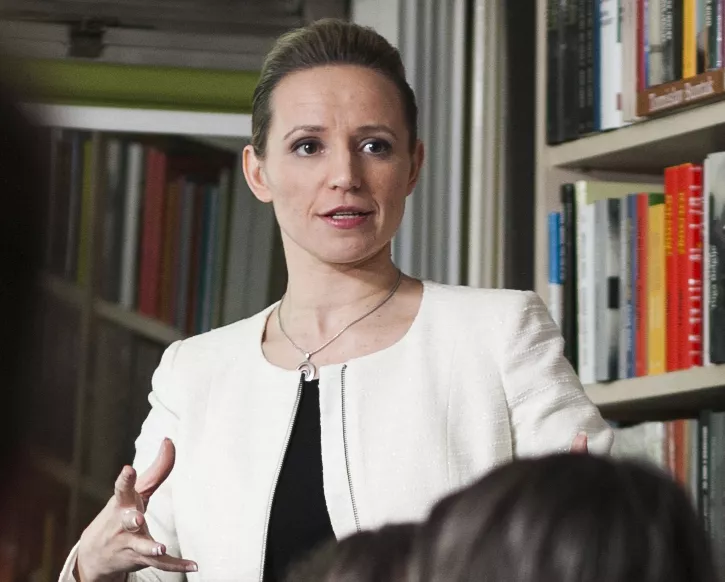
I personally believe that every good teacher should bear witness to what they teach with their lives. That is why, before I decided to start teaching and therapy, I first tried all the tools, techniques, and training on myself, after which I tried to use them in practice and only then started helping others, stated one of the most prominent Croatian gurus of personal growth and development, Mirta Fraisman-Čobanov, in an exclusive interview for the Bosnian news agency Patria (NAP).
She will hold a workshop in Sarajevo on March 28 and 29 this year in the field of personal growth and neurolinguistic programming (NLP), reports the Bosnian news agency Patria (NAP).
She is a young, energetic, and inspiring woman who, for years, daily, through various world-renowned and popular methods and techniques, transfers her valuable energy, knowledge, and skills in the particularly popular method of neurolinguistic programming.
Behind her always smiling face and enthusiastic, energetic disposition, this Zagreb native has years of work and effort during which she earned an MBA and an Executive Certificate from Henley Management College in London, became certified as an NLP and HNLP trainer, and as a hypnotherapist at the American Board of Hypnotherapists.
She is also obtaining qualifications as a psychodrama psychotherapist and an Art Clinical Expressive therapist. Part of her journey also includes numerous trainings in the globally popular field of personal and business coaching.
On this occasion, Mirta Fraisman-Čobanov also gave an exclusive interview to the Bosnian news agency Patria (NAP), which is the media sponsor of this unique event.
NAP: For many years, you have been conducting personal growth training and helping people achieve their life goals. Can you describe a participant before and after your training, especially NLP?
Fraisman-Čobanov: Usually, people start NLP looking for magical tools to quickly solve all their problems. In the meantime, they realize that NLP does not mean vaccination against life's difficulties, but it is certainly a tool that helps in better understanding oneself and others, and provides techniques and develops a way of thinking with which we can cope with all life challenges and situations in a good and quality way.
What people most often describe in their testimonials after training is that they have discovered a lot about themselves, that they have opened new horizons, that they live more fully and see the world around them more clearly, and that they have found a safe harbor where they can always enter and find the solution they need.
In reality, participants often find better jobs or advance and get higher salaries, improve relationships with other people, are healthier, happier, and more successful, take better care of their bodies, so after NLP they normalize their body weight, achieve their goals that they have put aside for years because they seemed unattainable, and generally achieve a higher level of self-awareness and self-confidence.
Also, they learn a lot about themselves and other people, so they communicate and present their ideas better, develop a higher degree of tolerance, and what I think is most important, they are reminded that their life is in their hands.
NAP: How would you best present NLP?
Fraisman-Čobanov: Neurolinguistic psychology is the psychology of excellence. It originated from modeling extremely successful people to obtain information about certain mental programs that enable successful people to be successful in their field of expertise. Somewhat later, it was discovered that there are certain laws that distinguish successful people from those who are not. This was the basis for the development of a large number of techniques and tools that help us today in achieving goals and desired results.
What is wonderful about NLP is that new techniques and tools are created day by day, as participants eventually learn to model their own and others' mental programs and transfer their knowledge. It is used by successful business people, in education, healthcare, the military, police, child-rearing, for developing quality relationships with other people, and in various other fields. Once you learn to understand your own and others' mental programs, you learn to see the world through different eyes. This gives us power, but also the responsibility that comes with that power to use the learned knowledge in the best possible way.
NAP: What are your life philosophy and motto?
Fraisman-Čobanov: My life philosophy could be summarized in a few key sentences: "Life is a heroic journey in which it is important not to give up on one's mission, dreams, visions, and goals, but it is important to do so in cooperation with others, always keeping in mind the greater good for the community. To live means to learn, and everything that happens to us in life happens for a reason, even if we sometimes don't understand those reasons. We have only one life, so it is important to make the most of it, to enjoy every day and every breath as if it were our last."
NAP: Is there a universal recipe for happiness?
Fraisman-Čobanov: When you ask people what happiness is for them and how to achieve it, everyone will have their own idea. As many people, as many ideas. I wouldn't say there is a universal recipe for happiness, as happiness is the result of each person's inner feeling. However, there may be certain prerequisites for achieving happiness, and these are: gratitude for what we have, love for ourselves and others, and acceptance of ourselves and others as they truly are.
Carl Gustav Jung once said... "I would rather be whole than good." Nurturing one's authenticity, or as Viktor Frankl best described it, faith in the meaning of life, are certainly some of the main guiding principles on the path to a happy and fulfilling life. It is also worth adding some wisdom that lies in learning to calmly accept things we cannot change, to find the strength to change things we can change, and to find the wisdom we need to distinguish between the two. If we could do all of that, I believe we would be truly happy. In reality, we are just human beings of flesh and blood, and we have our good and bad days.
What is important is that the balance at the end of the week, month, year still records more happy moments than unhappy ones. If that is the case, we can safely say that we have succeeded.
NAP: You once said that you live what you teach. Can you illustrate that?
Fraisman-Čobanov: Here I always remember the story of a psychotherapist who took a boy into therapy who wanted to get rid of his addiction to sweets. The boy walked for hours with his mother to get to the office. The psychotherapist saw them and said he couldn't help them at the moment, but asked them to come back in three weeks. After three weeks, the mother and boy returned, and the therapist looked the boy in the eye and said: "I want you to stop eating sweets." The mother recoiled and asked the therapist: "Why didn't you tell him that the first time? Do you know how far we traveled to get to you?" to which the psychotherapist replied: "Because when you first came, I myself was indulging in sweets immoderately."
I personally believe that every good teacher should bear witness to what they teach with their lives. That is why, before I decided to start teaching and therapy, I first tried all the tools, techniques, and training on myself, after which I tried to use them in practice and only then started helping others. I believe that the path described is difficult, but I personally believe it is the best. Even if we don't manage to fix everything that bothers us, it is important to gain the experience of going through such a journey in order to be aware of the phases our clients go through.
NAP: What are you preparing for the meetings in Sarajevo, and can we expect some form of impetus for positive transformation – so needed after the last, quite obscure, years?
Fraisman-Čobanov: My desire in this introductory workshop is to present the world of NLP, share my knowledge and experience, motivate and inspire people for change and a different perspective on life, and provide concrete tools for dealing with challenging life situations. I am extremely looking forward to coming to Sarajevo, as it is a city I have always wanted to visit, but haven't had the chance to yet. I am coming with great enthusiasm and hope that this introductory workshop will be just the beginning of a beautiful new journey together.
Komentari (0)
Prijavite se za komentiranje
PrijavaJos nema komentara. Budite prvi!
Minuta
Sve →Iz drugih kategorija

High Representative Not Elected: Germans, French and British Sabotaged Americans, New Attempt at End of June

ČOVIĆ WITHOUT MERCY: How Those Who Brought Ademović to Office Created a Political Hell for Him



Sunny Saturday, quite warm



Tragedy in Albanian resort: Two minors drown












