
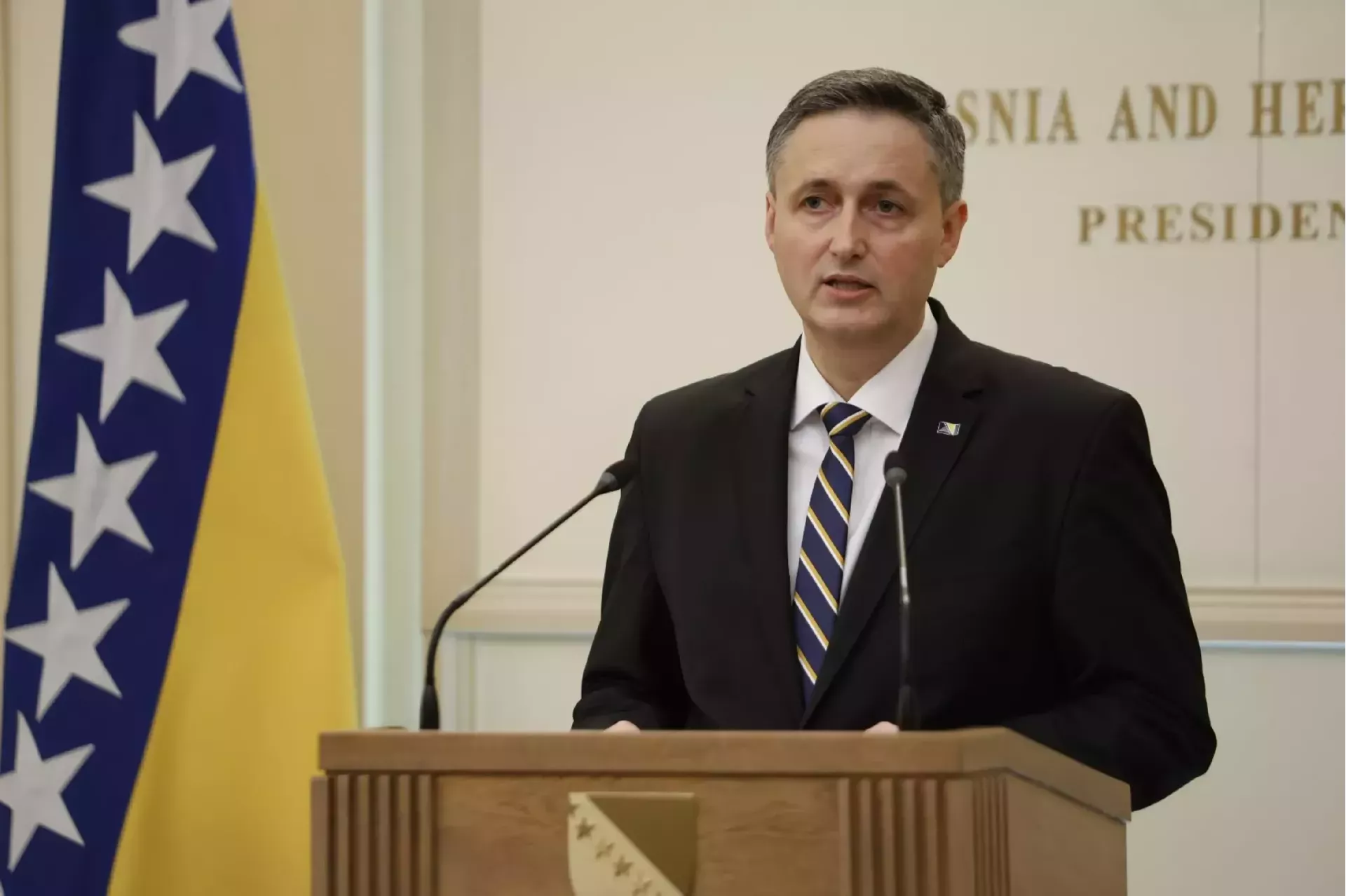
The Troika and the non-Bosniak political context cannot remain in power in Bosnia and Herzegovina after next year without a new victory for Denis Bećirović for a member of the Presidency of Bosnia and Herzegovina.
What are we talking about when we talk about a non-Bosniak political context? It is precisely this context in which the majority Bosniak, and thus the overall Bosnian political will, is not represented in power in parliamentary terms, while on the other hand, the majority Serb and Croat political will is represented, vertically, in full meaning and capacity.
Denis Bećirović is currently a sovereign without power, because he cannot exercise his power, given that the coalition (Troika and others) that nominated and elected him as a member of the BiH Presidency, with only two ministers in the Council of Ministers, plays a completely subordinate role compared to the dominant factors, HDZ and SNSD.
Bećirović, as a sovereign without power, does not participate at all in decision-making within the Bosnian-Herzegovinian government. A sovereign without power makes (diplomatic) science out of protocol meetings and formalities, while on the other hand, he has almost no influence on the processes in the country.
However, this has always been an integral part of Bećirović's agreement with the Troika parties and even with his own party. The foundations of this informal agreement, which may not exist on paper, but certainly exists in political practice, consist of the following:
The Troika and its partners will provide Bećirović with the necessary votes for election to the three-member Presidency, and Bećirović, on the other hand, will support the formation of the Troika's government with Serb and Croat political representatives, regardless of whether the Troika has electoral legitimacy and capacity among citizens.
And that is where Bećirović's obligations to the Troika, and the Troika's obligations to Bećirović, end until the next elections. Evidence of this is Bećirović's vote for Borjana Krišto and the formation of the non-Bosniak political context that is currently in place.
The importance of Denis Bećirović's re-election as a Bosniak member of the Presidency of Bosnia and Herzegovina for the non-Bosniak political context is best evidenced by the calls from the "good guy" of official Zagreb, Elmedin Konaković, to Denis Bećirović to accept the candidacy (supposedly Bećirović is in doubt).
For Konaković, Denis Bećirović's election is almost more important than his party's results, because Konaković, in the spirit of the aforementioned informal agreement, knows that only that election allows the continuation of this political context in which the Troika exists in power, and it is undoubtedly non-Bosniak, and often anti-Bosniak and anti-Bosnian.
And not so much that the Troika is anti-Bosniak, but their weakness and servility are even greater than that, and of such a nature that it creates such a context in their relationship with HDZ and SNSD.
A context in which the majority of citizens loyal to the state of Bosnia and Herzegovina have a figure as a sovereign who has no effective political power.
Unfortunately, Denis Bećirović, no matter how much he personally and sincerely tried to create a different impression with activities of a formal and procedural political nature, is a figure without political power. A sovereign without power.
Since democratic elections and the referendum on the independence of the Republic, Bosniaks, and other citizens loyal to the state, including pro-Bosnian oriented Croats, Serbs, and others, have not been in a position that deprives them of political sovereignty.
They are in such a position now, that is, today, and this is not only a non-Bosniak political context, but essentially an anti-state political context, but through the negation of primarily Bosniak political will, this context is realized.
What is particularly interesting, and certainly not Konaković's awareness of the necessity of Denis Bećirović's re-election for the continuation of the non-Bosniak political context, i.e., government without Bosniaks, is the position of the Party of Democratic Action.
It turns out that the announced cooperation of the Party of Democratic Action (for the sake of a table) with the SDP, which is primarily based on the distribution of departments and future tenders, is more important than the sovereignty of the state of Bosnia and Herzegovina, and more important than the political will of the Bosniak people.
According to this, it does not matter whether the sovereign, in this case, the member of the BiH Presidency from the Bosniak people, has any power in his hands. It does not matter if Bosniaks indirectly have power in their hands in this way. It is important to live in the belief that peaceful tender coexistence with the "predators" and with those who ignore the political will of the Bosniak people will be achieved, all for the sake of private interests and goals that have nothing to do with the interests of the Bosniak people.
Such an inert and cowardly attitude towards the fact of the existence of a sovereign without power and the attitude towards the fact of the rule of the non-Bosniak political context, ultimately abolishes the imposition of power and the suspension of the political will of the Bosniak people through foreign interventionism.
Because, if the political parties that receive the greatest support from voters of Bosniak nationality do not mind the rule of the non-Bosniak political context and if they do not mind the existence of a sovereign without power, then who should mind it? Certainly not the enemies of the state, certainly not the representatives of the international community!
Only the humiliated Bosniak people can mind it.
(M.T)
Komentari (0)
Prijavite se za komentiranje
PrijavaJos nema komentara. Budite prvi!
Minuta
Sve →Iz drugih kategorija

High Representative Not Elected: Germans, French and British Sabotaged Americans, New Attempt at End of June

ČOVIĆ WITHOUT MERCY: How Those Who Brought Ademović to Office Created a Political Hell for Him



Sunny Saturday, quite warm



Tragedy in Albanian resort: Two minors drown












