
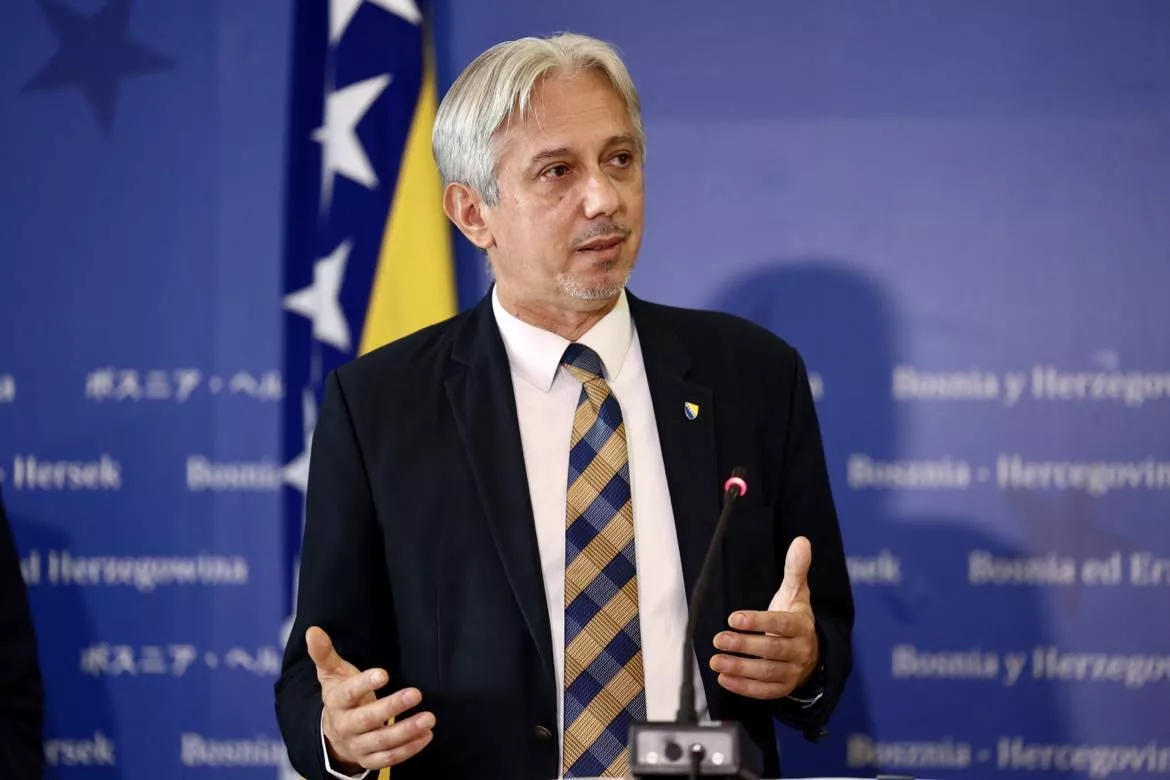
(Patria) - This week, the European Court of Human Rights published the full content of the judgment in the Kovačević case, made in June 2025, which rejected Slaven Kovačević's application. Judge of the Grand Chamber of the Court, Faris Vehabović, issued a dissenting opinion. We present the most important parts of his dissent from the majority conclusion in this text.
Speaking about whether the acting agents of Bosnia and Herzegovina had the mandate to represent the country before the Court, which the applicant disputed, and which the Court accepted as valid, Vehabović draws a parallel with the case of the revision proceedings in the case of Bosnia and Herzegovina v. Serbia and Montenegro, which was heard before the International Court of Justice (ICJ).
“A controversy arose when, in May 2016, Mr. S. Softić, the initial representative of Bosnia and Herzegovina in that case, requested clarification as to whether his appointment remained valid for initiating the revision proceedings of the judgment rendered on February 26, 2007. The Registrar of the ICJ informed him that a new appointment was necessary to initiate the revision proceedings. Despite the absence of a document by which all three members of the Presidency appointed Mr. Softić as representative in the proceedings for the revision of the 2007 judgment, a request for revision was filed on February 23, 2017 – signed by Mr. Softić as the representative of Bosnia and Herzegovina – before the ICJ. At the Court's request for clarification, two members of the Presidency, including the Chairperson, stated that the Presidency nor any other competent body had made a decision to initiate revision proceedings.
The third member, however, considered that the initial appointment decision of Mr. Softić remained valid and that the request for revision was within his mandate. The ICJ concluded, based on the submitted correspondence, that the competent authorities of Bosnia and Herzegovina as a state had not made a decision to submit a request for revision of the judgment of February 26, 2007, and that therefore the Court was not properly competent to decide on that matter. In the case now before us, which was procedurally very similar, the Court accepted that representatives do not need the approval of the Government they represent, which is an absurd and impossible situation in any country (especially in cases like this, where the constitutional structure of the state is called into question). Communication between the Court and the Government was limited exclusively to the Office of the Representative, and the Court never received the appropriate approval from the Government to refer the case to the Grand Chamber,” Vehabović wrote in his dissenting opinion.
Conflict of Interest of the OHR
Regarding the activities of the OHR, which participated in the proceedings as a 'third party', Vehabović believes that the judgment does not clarify the conflict of interest of the Office of the High Representative.
“The OHR has an obvious interest in the outcome of this case, given that the consideration of other cases initiated against decisions imposed by the OHR – which concerned amendments to the Constitution of Bosnia and Herzegovina and the Election Law, adopted fifteen minutes after the polls closed on October 2, 2022 – has been postponed by the Fourth Chamber (and the parties have been informed) until this case is concluded,” Vehabović points out.
Vehabović calls the OHR a 'state on steroids' with enormous powers to enact and amend laws, and therefore believes it can hardly be considered an objective party in the proceedings, but rather a surrogate of state authorities.
“This fact alone would be sufficient to exclude the OHR from participating in this case, not to mention the obvious conflict of interest regarding other cases currently pending before the Court. This represents another serious procedural error in this case,” Vehabović believes.
Selective Approach of the Court
Furthermore, Vehabović states that the Grand Chamber's judgment intentionally limits its consideration of the applicant's complaints, which were based on a combination of ethnic and geographic criteria, and deals exclusively with the territorial aspect of his complaints, completely ignoring the 'ethnic aspect'.
“Why? Overall, in this case, the Grand Chamber selectively chose arguments that lead in a certain direction, setting aside those arguments that were relevant for the correct outcome of the proceedings. Thus, the applicant claimed that his right not to be discriminated against as an ordinary citizen/voter was violated because his choice was limited to ethnically predetermined candidates. Furthermore, he emphasized that he could not choose candidates who best represent his political views. All his arguments were 'translated' into the context of a discriminatory electoral system (which the Court has confirmed in several judgments) and exclusive attention was paid to his ethnic affiliation, with the result that his entire complaint of discrimination was assessed from the wrong perspective,” it is stated.
Victim Status
Speaking about the victim status that the Court refused to apply to Kovačević, Judge Vehabović said that the judgment is filled with incorrect assumptions and refers to case law that is irrelevant to complaints of discrimination.
“The judgment limits the scope of the applicant's complaint primarily by treating the discriminatory structure rooted in the Constitution itself as legitimate. The applicant based his complaints on the refusal to declare his ethnicity, classifying himself in the category of 'Others' (who are not represented in any way in the Presidency or the House of Peoples). However, this was completely ignored in the judgment, which focuses exclusively on territorial aspects (ignoring the complaint as stated in the application form). The nature of the electoral rules is such that they limit even the choice of persons belonging to constituent peoples (if they wish to vote along ethnic lines and constitute more than just a small part of the population) and who live in the 'wrong' territory (for this situation, see the case of Pudarić, which deals exclusively with this (territorial) aspect; in that case, the applicant, a Serb from the Federation, could not be a candidate for the Presidency on behalf of the territory of Republika Srpska). This aspect was also completely ignored,” Vehabović points out.
He adds that it is a dangerous practice to try to justify a system that artificially divides the electorate along exclusively imaginary and unrealistic ethnic lines if it is accepted that the House of Peoples as a body exists solely to protect ethnic interests.
“If we accept that the House of Peoples as a body exists solely to protect ethnic interests, the minimum requirement would be for that House to represent a large majority of the specific ethnic group, which is not the case in Bosnia and Herzegovina, as the electorate is administratively divided into two multi-ethnic entities (a situation that could have enormous consequences in certain parts of Europe in a possible process of legitimizing the claims of secessionist movements),” Vehabović points out.
Artificial Distinction Between Active and Passive Electoral Rights
Vehabović believes that the Court's conclusion that only passive electoral rights have so far justified victim status in cases of discrimination in BiH artificially narrows the scope of protection provided by the Convention.
“In the cases of Sejdić and Finci, Pilav, and Pudarić (all cited earlier), the Court recognized the applicants as victims even though they were not denied the right to vote, but the right to run for office. The discriminatory structure that prevents individuals from either running for office or meaningfully voting for representatives of their own choice stems from the same source: ethnic and territorial exclusion established by the Dayton Constitution. If the right to run for office (passive right) is protected from ethnic discrimination under Protocol No. 12, then the right to vote (active right) should also be protected,” Vehabović points out.
He notes that encouraging active electoral rights represents unjustified hair-splitting and leaves individuals without legal remedy against structural electoral discrimination that limits voters' meaningful choices.
“Let's replace Serbs, Croats, and Bosniaks with women and imagine a female voter from the Federation or Republika Srpska who cannot vote for a female candidate in either the Federation or Republika Srpska. Theoretically, following the logic of the judgment, her complaint would lack precision and a comparative group, and therefore would be deprived of victim status… My logic is very simple: if all women were discriminatorily banned from running for office (passive electoral right), then the choice of female voters (as well as any man who would want to vote for a female candidate) would be limited on discriminatory grounds – therefore, all women who want to vote for a female candidate would be automatically discriminated against as voters with active electoral rights,” Vehabović points out.
He adds that using the current constitutional arrangement in BiH, if candidates from minority groups are excluded from running for office on a discriminatory basis (which has been confirmed in the group of cases Sejdić and Finci), then not only are all Jews and Roma discriminated against, but also all other registered voters who wish to vote for these candidates (which is reflected in the cases of Zornić, Pilav, and Pudarić) are automatically discriminated against because they are in a situation of limited choice based on discriminatory criteria.
“No one can discriminate against a certain ethnic, political, religious, or racial group by excluding its members from running for office, without simultaneously discriminating against voters who wish to vote for a particular candidate or candidates from that group. In such circumstances, as in BiH, when such exclusion arises from the Constitution itself, it automatically infringes upon the active electoral rights of those who wish to vote for a particular candidate or candidates belonging to the discriminated group,” it is stated.
Vehabović believes that Kovačević, as the Court concluded, does not dispute the system in an abstract way, but points to a concrete, personal deprivation of rights: the limitation of his right to free voting due to ethnic and territorial criteria.
“The Grand Chamber ignored the fact that this exclusion functions through a legal prohibition, not as mere subjective political frustration,” states Judge Vehabović.
He believes that the Grand Chamber in this case, unlike in the cases of 'Sejdić and Finci' or 'Baralija', imposes a higher threshold on Kovačević in terms of obtaining victim status, requiring personal exclusion with the existence of a comparative group, a position he considers inconsistent with previous judgments.
“The Court's reasoning introduces double standards: it accepted potential candidacy as sufficient for victim status in 'Sejdić and Finci', but dismisses the actual deprivation of the right to vote in 'Kovačević' as too abstract. This undermines legal predictability and coherence,” claims Vehabović.
He adds that the Grand Chamber is clearly hesitant to acknowledge Kovačević's complaint because, theoretically, it would open the door to objections from 'all voters'.
“But that is precisely the point, structural discrimination affects all voters, and the broad scope of consequences does not negate individual victimhood. The Convention does not exclude 'mass victimization'. For example, in cases relating to environmental protection or detention conditions, the Court has consistently allowed numerous individuals to challenge common causes of violations,” the dissenting opinion states.
It is noted that the judgment gives weight to the fact that Kovačević could vote, implying that his electoral rights were not denied; however, Vehabović believes, the Convention requires not only a formal approach but also the effective enjoyment of rights.
“Mr. Kovačević's inability to vote for all members of the Presidency represents unequal treatment, and the Court's emphasis on formal participation neglects the substance and dignity of political equality guaranteed by Article 1 of Protocol No. 12,” wrote Vehabović, adding that the Court thereby narrows the scope of Protocol No. 12, making it ineffective against entrenched systems of electoral exclusion.
“The Court's judgment risks sending a message that only the most blatant and individualized forms of exclusion deserve protection – an approach that undermines the progressive goals of the Convention in the field of human rights,” it is stated, reports Istraga.ba.
Komentari (0)
Prijavite se za komentiranje
PrijavaJos nema komentara. Budite prvi!
Minuta
Sve →Iz drugih kategorija

High Representative Not Elected: Germans, French and British Against Americans, New Attempt at End of June

ČOVIĆ WITHOUT MERCY: How Those Who Brought Ademović to Office Created a Political Hell for Him



Sunny Saturday, quite warm



Tragedy in Albanian resort: Two minors drown












