
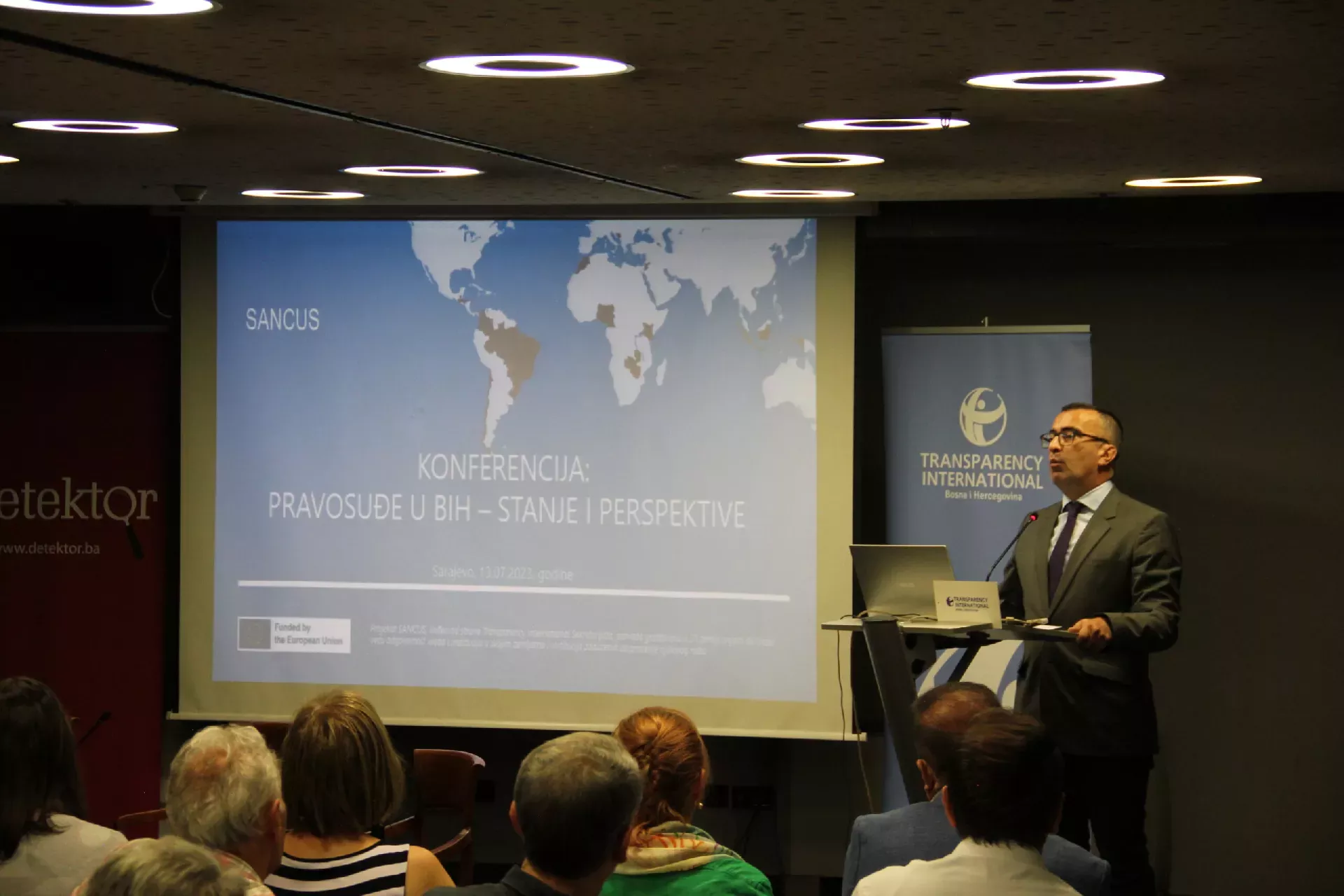
(Patria) - Most courts do not publish information on verdicts, information on prosecution cases is largely kept from the public, while half of judicial institutions ignore media and citizen inquiries, are the results of a judiciary transparency research published during the conference „Judiciary in BiH – Situation and Perspectives“ which was held today in Sarajevo.
Participants of the conference, organized by Transparency International in BiH (TIBiH) in cooperation with the Balkan Investigative Reporting Network BiH (BIRN BiH) with the support of the EU, addressed the amendments to the Law on the High Judicial and Prosecutorial Council (HJPC) through which the authorities are trying to weaken the mechanisms for ensuring accountability of judicial office holders.
The amendments, which the Council of Ministers included in the Law on Amendments to the Law on the HJPC at the last minute, aim to weaken the initially proposed mechanisms for ensuring accountability and call into question the possibility of verifying the assets of judicial office holders.
From the very beginning of the law amendment process, not all recommendations of the Venice Commission and the EU were respected, especially regarding the provisions on members of the HJPC and other judicial office holders, while TI BIH warned from the beginning that a large room is left for non-declaration of assets and abuse of the asset control system.
Therefore, one of the conclusions of the conference, which all participants agreed on, is to use the further procedure to amend and improve the draft law.
If this opportunity is missed now, it is questionable how much time will be needed to adopt a new law that adequately addresses these identified problems, and a message was sent from the conference that it is necessary to act urgently so as not to reach a situation where, due to inadequate formulation, the mechanisms intended to strengthen accountability are used precisely to avoid it.
The conference also presented an online platform containing data on the transparency of 74 courts and 20 prosecutor's offices, which shows the worrying level of public access to the work of the BiH judiciary.
Thus, 55% of courts do not publish any information about the first-instance verdicts they issue, and 90% of them do not publish any information about criminal cases on their websites, which undoubtedly undermines the low level of public trust in the work of the judiciary.
The poor state of the judiciary regarding public access to its work is illustrated by the findings that 54% of courts and prosecutor's offices in Bosnia and Herzegovina violated the legal deadline for responding to requests, while as many as half of the judicial institutions ignored media inquiries about the status of cases they are handling.
The worst transparency results are recorded by the Cantonal Prosecutor's Offices in Sarajevo and Herzegovina-Neretva Canton with a transparency index of 35, and the Municipal Courts in Žepče (28), Mostar (24) and Čitluk (23) and the Basic Court in Srebrenica with a score of 26. On the other hand, the Basic Court in Teslić records the highest level of transparency with an index of 82, while among the most transparent institutions are the Court of BiH with an index of 81 and the Prosecutor's Office of Brčko District of BiH, which, like the Cantonal Prosecutor's Offices of Central Bosnia Canton and Posavina Canton, record a score of 75.
The "Judiciary Index" platform was created as part of the project “Strengthening Civil Society Organization Networks to Improve Accountability – SANCUS” with the financial support of the European Union, and it assesses the availability of information on the websites of institutions as well as openness towards citizens, media, and civil society organizations regarding information availability.
The platform also offers information on corruption and organized crime, disciplinary proceedings, and other matters in BiH, and also allows citizens to submit their own inquiries to any judicial institution in BiH.
Komentari (0)
Prijavite se za komentiranje
PrijavaJos nema komentara. Budite prvi!
Minuta
Sve →Iz drugih kategorija

High Representative Not Elected: Germans, French and British Against Americans, New Attempt at End of June

ČOVIĆ WITHOUT MERCY: How Those Who Brought Ademović to Office Created a Political Hell for Him



Sunny Saturday, quite warm



Tragedy in Albanian resort: Two minors drown












