
By Armin Aljović
Sister Ljubica from the community of Franciscan School Sisters, whom I asked to help me understand the photograph that sent social networks into a frenzy on Friday in Bosnia and Herzegovina and the region, immediately recognized the mischief: "I don't think this is one of the sisters. I know every face, every sister in Sarajevo, and almost every sister in Bosnia and Herzegovina, but not this one. After all, the uniform worn by the girl in the photograph has nothing to do with the uniform worn by the sisters in Sarajevo or anywhere in Bosnia and Herzegovina."
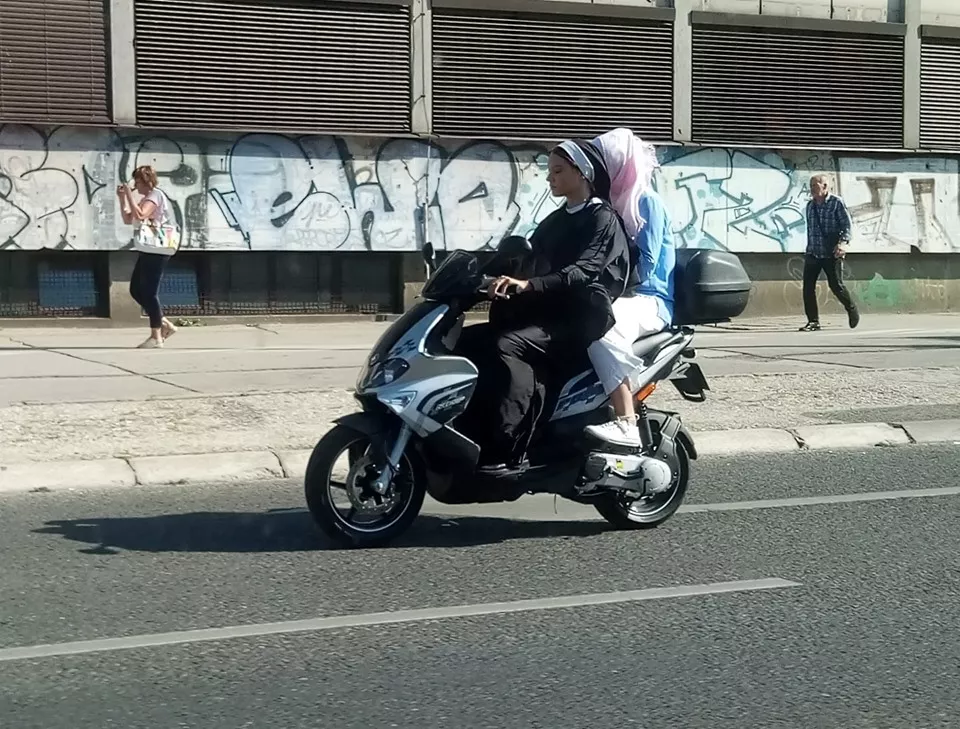
The photograph of two young women – one a nun, the other a Muslim woman in a hijab, riding together on a motorcycle down the main Sarajevo street, taken for the needs of the new film 'Greetings from Sarajevo', although this was not known at the time of the photograph's publication – quickly flooded social networks and media in Bosnia and Herzegovina, and with a plastic example, laid bare the mental and spiritual state of the Bosnian-Herzegovinian, primarily Sarajevo public: for some, the scene is an example that the multicultural spirit in Sarajevo still lives, while for others, glorifying this photograph is agreeing with the thesis of ethno-nationalist policies that Sarajevo's cosmopolitanism has indeed died and only twitches from time to time.
Sarajevo has always been open to everyone. And not only that, diversity in that place was not only respected but also mutually supported – to this day, the columns of world media are filled with the photograph of the Muslim woman Zejneb, who in 1941, in the middle of a Sarajevo street, hid the Star of David on her Jewish neighbor's arm with her clothing, thus protecting her from ending up in some Ustaše camp. During the war in Bosnia and Herzegovina in the nineties, Sarajevo was defended together by Bosniaks, Serbs, Croats, Bosnians and Herzegovinians, Yugoslavs, Roma, and those who were all of the above. Bosnian Franciscans remain an insurmountable bulwark in the defense of multinational Bosnia to this day.
The goal of the war against Bosnia and Herzegovina in the nineties was to destroy the fabric of Bosnia and Herzegovina and to divide the centuries-old multi-ethnic country into three ethno-national units, each of them reserved exclusively for members of one ethnic group. During the four years of horrors, people were killed, imprisoned in camps, forcibly relocated to other parts of the country solely because of their name and religious beliefs, although this was never emphasized in Bosnia and Herzegovina. Such fascist intentions were largely carried out by the most brutal violent methods, while the policy of dividing citizens in BiH into pure ethnic groups, this time by other means, mainly political pressure and blackmail, continued even after the signing of the Dayton Peace Agreement, which stopped the war in BiH in 1995. The concept of ethnization and confederation of Bosnia and Herzegovina is perhaps the strongest from the war to the present day.
The policy of the current leader of the Croats in BiH and the leader of the Bosnian Serbs, Dragan Čović and Milorad Dodik, consists, among other things, precisely in attempts to secure the capital of Bosnia and Herzegovina exclusively as the property of Bosniaks, after which they would have an alibi for Banja Luka to be the exclusive capital of Bosnian Serbs, and Mostar the capital city of Croats to which others have no right. Bosniak policy, led by Bakir Izetbegović, has so far had no adequate response to such a situation, often showing signs of its own radicalization – which is the goal of the other two nationalisms in BiH – while civil policies in the country, divided and burdened by inter-party conflicts, still do not have a quality response.
In any case, the photograph of the nun and the Muslim woman on the motorcycle turned out to be a litmus test – it showed that in Sarajevo there are those who have never agreed to any other city than the one in which the nun and the woman in the hijab ride together on a scooter, and those who have surrendered and believe that such a Sarajevo is lost, but their longing for a multi-ethnic city was completely unintentionally exposed and thrown onto social networks by an ordinary scene from a film, even before the film was shot.
To use the thesis of the Progressive Džematlija for the title of the text: 'The picture is not accurate, but it is true'.
Komentari (0)
Prijavite se za komentiranje
PrijavaJos nema komentara. Budite prvi!
Minuta
Sve →Iz drugih kategorija

High Representative Not Elected: Germans, French and British Against Americans, New Attempt at End of June

ČOVIĆ WITHOUT MERCY: How Those Who Brought Ademović to Office Created a Political Hell for Him



Sunny Saturday, quite warm



Tragedy in Albanian resort: Two minors drown












