
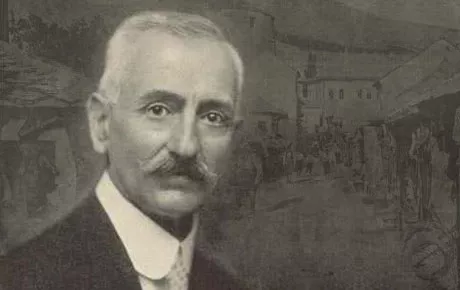
On this day, 2 February 1924, Bosnian-Herzegovinian writer Aleksa Šantić died, author of the anthology poems "Ostajte ovde", "Emina", "Veče na školju". He belonged to the Mostar circle around the literary magazine "Zora", which he launched with Jovan Dučić and Svetozar Ćorović, reports the Patria news agency.
He reached his greatest poetic maturity between 1905 and 1910, when his most beautiful poems were also written. This was a time of turbulent social changes in Bosnia and Herzegovina, in which Šantić actively participated.
Šantić's poetry is full of strong emotions and love sorrows. His beautiful love poetry developed under the strong influence of Bosniak love songs, sevdalinke; his love poems are set in Bosnian gardens full of behar and fountains. The female figures appearing in Šantić's poems are adorned with necklaces and are provocative, yet of hidden beauty. Such is the poem "Emina", which entered the folk tradition and is sung as a sevdalinka. In love poems, the most common motif is longing.
Šantić fell in love very young with Anka Tomlinović, a Slavonian woman, the daughter of a poor photographer and newcomer, whom he eventually left under pressure from his Orthodox family. Somewhat later, somewhat resigned, he met Zorka Šola, a young and wealthy woman from Mostar, who, due to the interests of her pragmatic family, left the poet, leaving him with another wound on his heart.
Another poetic theme that marked Šantić's work had a patriotic character. The poem "Ostajte ovdje", published in 1896 on the front page of the first issue of Zora, was addressed to those Bosnian Muslims who, after the annexation of Bosnia by Austria-Hungary in 1878, left the country and emigrated en masse to Turkey. There is another poignant poem, "Hljeb", in which Šantić sings about the suffering of those who forever leave their homeland and go abroad. In other poems, Šantić emphasises suffering as an important historical moment ("Mi znamo sudbu").
He was a deputy in the Bosnian Parliament. His verses are musical and his poems emotional, full of love, with a strong revolt against tyranny. He translated from German and Czech. He wrote the drama "Hasanaginica", "U magli", and translated from the German poet Heinrich Heine. A monument to Šantić was re-erected in Mostar. Bosniaks mostly respect and preserve him as part of their great tradition. Šantić remains popular and beloved in Bosnia and Herzegovina as a value, because in every way he was and remains a Bosnian writer.
Komentari (0)
Prijavite se za komentiranje
PrijavaJos nema komentara. Budite prvi!
Minuta
Sve →Iz drugih kategorija

High Representative Not Elected: Germans, French and British Against Americans, New Attempt at End of June

ČOVIĆ WITHOUT MERCY: How Those Who Brought Ademović to Office Created a Political Hell for Him



Sunny Saturday, quite warm



Tragedy in Albanian resort: Two minors drown












