By: Amina Čorbo-Zećo
How much of a news item is it in Bosnia and Herzegovina that a dealer has been arrested who is distributing drugs across Bosnia and Herzegovina for much larger cartel figures. However, the news that there is an opiate center in our country that operates within the state system, and at the same time runs a suspicious medical institution where it satisfies the needs of clients with methadone, is much bigger than what a reasonable person can comprehend. And very few in the state system even know what we are talking about when we ask them.
And this is one of those stories. The Center for Prevention and Outpatient Treatment of Addiction Mostar was officially opened on September 13, 2018. And for the most part, it is unknown to the healthcare system in the Federation of BiH.
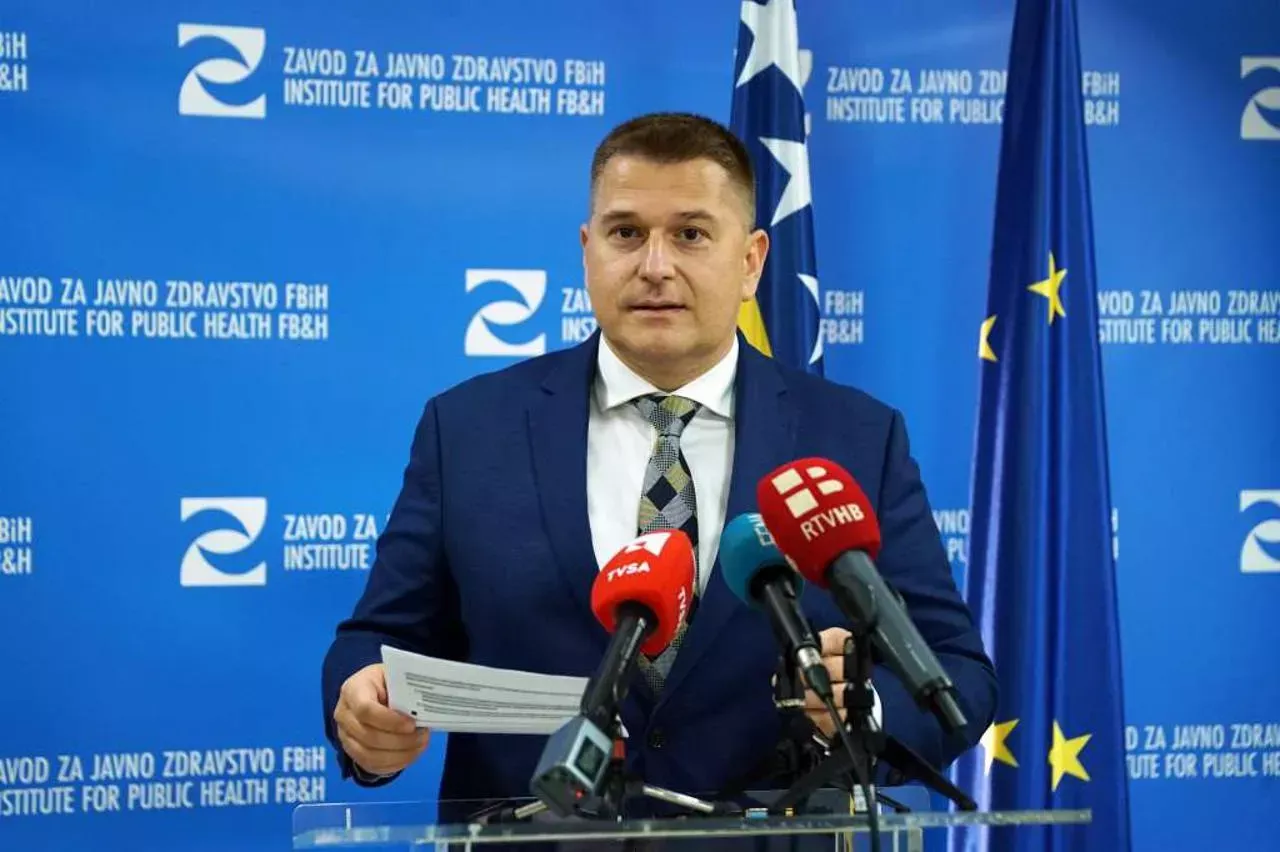
The head of the Center is Dragan Čović's cadre Siniša Skočibušić, who also holds the position of Director of the Public Health Institute of the Federation of BiH. Skočibušić, we remind you, was appointed Director of the Public Health Institute of the Federation of BiH in November 2021 for a four-year term.
At that time, he was already the director of the Center, so the question remains how it is possible for Skočibušić to hold two director positions simultaneously. In the FBiH Government, as Patria unofficially learns, it is absolutely unknown that Skočibušić holds two director positions simultaneously!?
However, a much bigger story could be hidden behind all of this, as the way the Center for Prevention and Outpatient Treatment of Addiction Mostar operates raises suspicions of illegal activities. Through our research, we tried to shed light on the case of the only remaining addiction treatment center, given that centers have been abolished and replaced by addiction treatment institutes. This means that the institution must operate at the cantonal or a higher level. Law on Health Protection of FBiH - Article 123
Patria's findings clearly indicate that the Mostar Center operates outside the institutional framework, without adequate supervision and controls, and all that the competent Ministry of Health, Labor, and Social Welfare of HNK knows are findings from their annual reports.
For a long time, the thesis has been uncritically promoted in the public eye in Bosnia and Herzegovina that the south of the country is a system unto itself, meaning that different laws apply there. It is not uncommon for institutions and companies controlled by HDZ and Dragan Čović to behave like a state within a state.
Nevertheless, the problem with the Center run by Skočibušić is a matter of societal and state security, as procedural shortcomings and questionable legality of the operations of both the Center and its director raise suspicions of illegal activities.
The Center for Prevention and Outpatient Treatment of Addiction Mostar uses methadone in solution form with a concentration of 10 mg/mL (5 mg = 0.5 mL) as therapy. Therefore, judging by what they offer as therapy to their clients, it is undeniable that the Center must be under supervision. However, the Center does not have a hospital pharmacy, and the Agency for Medicines of BiH does not certify the drug logbook that the Center is supposed to submit, as it is a legal obligation.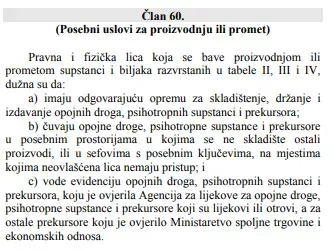 Law on Prevention and Suppression of Narcotic Drug Abuse - Article 60
We asked the Agency for Medicines of BiH, and in their response to Patria, they stated: “According to the records kept by the Agency for Medicines and Medical Devices of BiH, it has been determined that the Center for Prevention and Outpatient Treatment of Addiction Mostar has not submitted a request for certification of the Narcotic Drug Logbook. Pursuant to Art. 90 of the Law on Medicines and Medical Devices of BiH, medicines are dispensed in healthcare institutions through a pharmacy/hospital pharmacy.
"A pharmacy/hospital pharmacy is obliged to have a certified Narcotic Drug Logbook certified by the Agency.“
Therefore, the Agency, as the supervisory and regulatory body, has no record of who, how, where, and to whom methadone therapy is dispensed within the Center.
The issue of the Center's methadone supply and how it functions at all remains a mystery even after the response from the Agency for Medicines of BiH.
„We have no information about the supply method of the Center for Prevention and Outpatient Treatment of Addiction Mostar, nor which wholesale pharmacy supplies them. Given that the Center for Prevention and Outpatient Treatment of Addiction Mostar was established with the consent of the Ministry of Health, Labor, and Social Welfare of HNK and is under its jurisdiction, for information related to the Center's supply, you need to contact the aforementioned Ministry“, they add from the Agency for Medicines of BiH.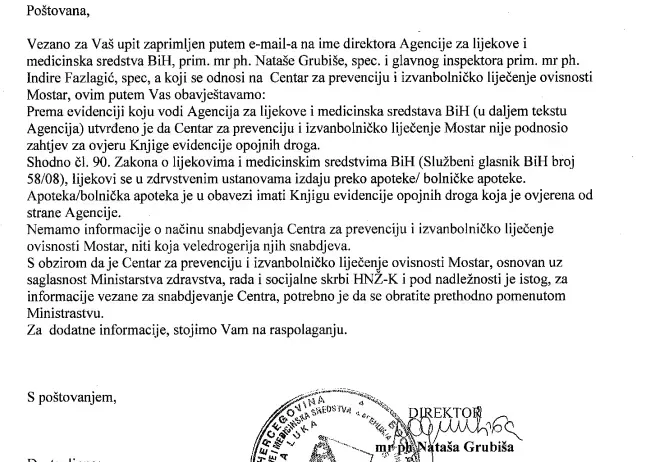 Response from the Agency for Medicines of BiH to Patria's inquiry
The competent ministry in HNK did not respond to us whether and when supervision of the work of the Center for Prevention and Outpatient Treatment of Addiction Mostar was carried out, nor how many patients it has. We were also denied answers to questions about how much medication was dispensed and similar. We only received a brief confirmation that the Center does not have a hospital pharmacy, but without details about which pharmacy they might have a contract with.
„The Ministry of Health, Labor, and Social Welfare of HNK has not issued approval for the operation of a hospital pharmacy within the Center for Prevention and Outpatient Treatment of Addiction Mostar. The said institution submits an annual report on its work to this ministry, which contains information on the number of patients, number of examinations, quantity of dispensed medicines, etc.“, state the Ministry of Health and Social Welfare of HNK and anxiously ask when we will publish the text. They did not want to tell us why they are interested.
It is clear, therefore, that patients come to the Center because there is methadone therapy there that someone delivers to them, but who the patients are, where and how they come, and who supervises the entire process remains a question awaiting an answer.
The Center for Prevention and Outpatient Treatment of Addiction Mostar ignored Patria's inquiries about how they are supplied with medication, i.e., whether they have a hospital pharmacy and with which wholesale company they have a contract. They also did not answer who certifies their Narcotic Drug Logbook, as the Agency for Medicines of BiH has no information on how the Center is supplied with medication. We were also denied an answer to the question of how it is possible that the director of the Center, Siniša Skočibušić, is also the director of the Public Health Institute of FBiH.
A center employee was surprised by our question because “Skočibušić has been the director for a long time”.
The questionable legality of the Center's functioning becomes even more apparent when looking at their website. The website states that a referral is not required for admission to treatment (I?) but only a health insurance card and an ID card. Persons without health insurance can also be treated, as they will obtain insurance for treatment purposes through the Center. Treatment is available to patients from the Herzegovina-Neretva Canton but also from the West Herzegovina Canton. It is also interesting that they state that they also provide treatment for patients from parts of eastern Republika Srpska, for which they must have a contract with the competent ministry from the smaller BiH entity due to jurisdiction in the field of healthcare.
How an addiction treatment institute should function according to the Law on Health Protection of FBiH can be easily determined by simply looking at the websites of institutes that operate within the system and according to the law. For example, the Institute for Addiction Treatment KS states that for services in this institute, the following are required: a referral for treatment from a family doctor, a certified health insurance card, the patient's ID card, and HIV and hepatitis marker test results.
So, if you need methadone therapy in Sarajevo, you must collect referrals, have a health insurance card, test results, and an ID card. On the other hand, you can go to Mostar and get therapy by showing your ID card and health insurance card. I don't know how many patients from Sarajevo report to the Center, but according to their statistics, business is going well. Because, according to the Center's report for 2023, they had 988 registered users.
In 2023, they had an average of 115 patients per month, and a total of 1,381 annually. “A total of 35,732 doses of methadone were consumed, or 214,674.5 mL / 2,146,745 mg (~ 429 bottles of methadone hydrochloride solution 10mg/mL)”, the Report states.
Komentari (0)
Prijavite se za komentiranje
PrijavaJos nema komentara. Budite prvi!
Minuta
Sve →Iz drugih kategorija

High Representative Not Elected: Germans, French and British Against Americans, New Attempt at End of June

ČOVIĆ WITHOUT MERCY: How Those Who Brought Ademović to Office Created a Political Hell for Him



Sunny Saturday, quite warm



Tragedy in Albanian resort: Two minors drown












