
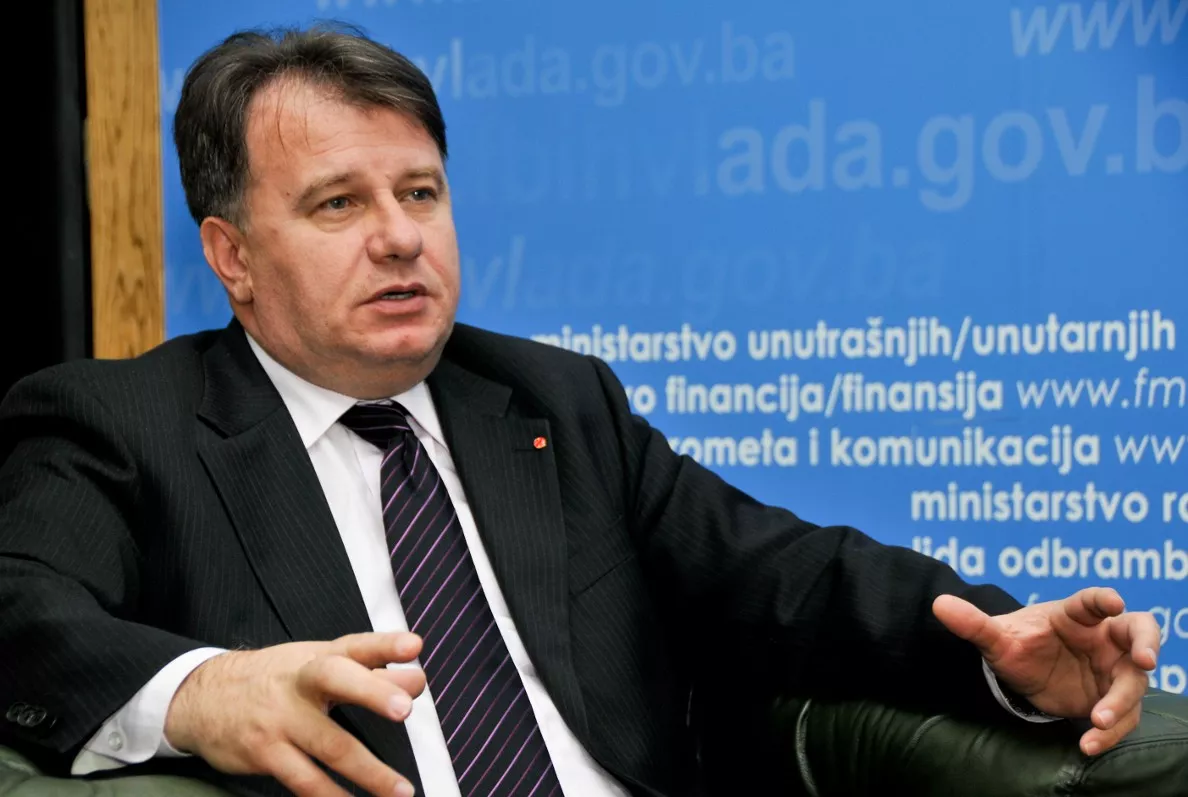
There are no innocents here, SDP takes its part of the responsibility, but we expect the same from other parties and the international community, said the Prime Minister of the Federation of Bosnia and Herzegovina, Nermin Nikšić, in an interview with the BH news agency Patria (NAP). He is aware that his government's mandate passed without a stable parliamentary majority, but he reminds that the Government he led did its part, and that problems arose in the FBiH Parliament, where many acted as the opposition.
- We tried to find new political partners with whom we could realize the same projects, but it was blocked through a series of institutional abuses. However, that is something that has passed and dealing with it brings no one any benefit – says Nikšić.
NAP: Your mandate was marked by unstable parliamentary majorities, and it seems you never had the full support of the FBiH Parliament. You were even voted out of confidence. Many in your position, in such a situation, would have given up long ago. Why didn't you?
Nikšić: Responsibility towards the citizens of the Federation of Bosnia and Herzegovina has always been my top priority, so giving up was never an option for me. Giving up is the easiest, but also the most irresponsible thing to do. Unfortunately, the situation in the FBiH Parliament has been such for a long time that there is no chance that another Government could be elected, and that would mean entering a kind of spiral of institutional dysfunction that would lead us who knows where. Together with my colleagues in the Government of the Federation of Bosnia and Herzegovina, I am taking all measures within my power to ensure its regular functioning in the interest of the citizens. I have repeated this several times in recent days, but I will repeat it again. The entire Government of the FBiH is ready to step down when someone appears who, in accordance with the Constitution and laws, will take over the mandate and ensure the continued unimpeded functioning of the Government of the FBiH. It would be very irresponsible and cowardly of me to falter now, knowing that according to existing legal solutions, pension payments, disability benefits, and social assistance to the most vulnerable categories of the population are not possible without a prime minister. The departure of the Government, without a clear plan of when and how another will come, would lead to collapse and endanger the functioning of the entire country.
NAP: You promised the IMF a continuation of privatization, what do you intend to sell besides the minority stakes of the FBiH Government in some companies?
Nikšić: The Government of the Federation of Bosnia and Herzegovina informed the IMF representatives of its clear position that the sale of companies majority-owned by the state is out of the question. This also applies to the two power utilities and the telecommunication companies. We have committed, and it was certainly our plan even without the IMF, to try to privatize state capital in companies where we do not have a majority stake this year, and we will not do that until our people, in accordance with the law, enter these companies and prepare a detailed report on what is happening there and in what condition the companies are. Here, I am primarily thinking of Fabrika duhana Sarajevo and "Bosnalijek", because, as you know, the FBiH Government has not had its representatives in the Supervisory Boards of these companies for a long time.
Also, the IMF requested a clear long-term plan of activities regarding the continuation of the privatization process in the FBiH, and this plan needs to be approved by the FBiH Parliament. Therefore, there will be no sale of public companies such as telecommunications, power utilities, or mines, and I expect the Parliament to confirm this position of the FBiH Government.
NAP: This government, at least it seemed so from the beginning, functioned best when it was necessary to fill certain personnel positions. Laws were very difficult to pass...
Nikšić: I would not agree with this statement. This Government was divided only when adopting two laws, while more than a hundred others were adopted unanimously. The same applies to all other decisions. Problems, when it comes to laws, arose in the Parliament, because unfortunately, the relationship between the coalition partners forming the Government was not entirely honest. That is, they were the government in the Government, and the opposition in the Parliament. That was one of the key reasons for the breakdown of the Platform and the formation of a new parliamentary majority, and we know how that ended. Your statement that laws were difficult to pass is therefore valid only for the FBiH Parliament, but not for the Government. Look at the situation with the set of anti-corruption laws that the Government unanimously adopted, but they did not receive the necessary majority in the FBiH Parliament. The reasons for the rejections should be stated by the parties whose representatives refused to support this set of anti-corruption laws. I believe that very soon, after the final harmonization with the Delegation of the European Commission in BiH and the representatives of judicial institutions and the HJPC, we will resubmit the set of anti-corruption laws to the parliamentary procedure, and those who constantly talk about the fight against corruption and organized crime will prove that they stand behind those words by supporting this set of laws.
If we had adopted these laws a year ago, I believe that by now we would have certainly concluded the processes for at least some cases of predatory privatization, which is one of the basic and justified demands of the disenfranchised workers in these protests.
The amendment to the FBiH Constitution, which abolishes the statute of limitations for criminal offenses related to privatization, corruption, and economic crime, was also unanimously adopted by the Government, and we will soon have an opportunity to see how the parties in the FBiH Parliament will position themselves regarding it. I hope that we have all learned lessons from the recent events and that there will be much more responsibility and much less politicking and demagoguery.
NAP: Your SDP first chose SDA as a partner, and then SBB, but now you have stated that this was also wrong. However, many believe that SDP is most responsible for the current situation. How do you comment on that?
Nikšić: SDP takes its part of the responsibility, both for the good and bad moves made by the government in which SDP participates. But we also expect other parties, as well as representatives of the international community, to take their part of the responsibility, because there are no innocents here. The political system in BiH is complex. SDP does not have an absolute majority at any level of government, so it is not able to make decisions independently, but had to form coalitions with other parties, which is common practice in most countries.
As a serious political party that received a significant percentage of citizens' trust in the previous elections, we did not, nor can we afford, the luxury of allowing the institutions of this country, at any level, to be blocked. We must talk, cooperate, and seek solutions for a better future for this country. The Platform was the first time that parties gathered around what they would do, not around which positions they would divide. Unfortunately, there was no sincerity there, and that became apparent very quickly. We tried to find new political partners with whom we would realize the same projects, but it was blocked through a series of institutional abuses.
However, that is something that has passed and dealing with it brings no one any benefit. While all those who are responsible for possible wrong assessments must bear political responsibility. I am sure that SDP is not responsible for not decisively moving forward in dealing with crime, I am sure that SDP is not to blame for the stalled reform of the police or public administration in the FBiH, I am sure that SDP has not stopped any investments in the FBiH. We often found ourselves alone on these issues and paid a high price for it, but I believe that the time has come for reform laws to start being adopted and, more importantly, implemented.
NAP: What do you consider your biggest mistake and biggest success during your mandate?
Nikšić: The biggest mistake is that in the first year of the mandate, we did not have the strength and sufficient determination to adopt the laws on public service, the law on internal affairs, and anti-corruption laws. If that had been done then, many problems that have surfaced today would certainly have been resolved. Certainly, we would have had more time and money then to more effectively resolve accumulated social problems. As for success, I have some doubts... Is it the fact that, despite constant blockades, the Government of the Federation of Bosnia and Herzegovina managed to repay about 230 million KM of debt inherited from previous governments in the past two years? Or that we managed to increase pensions in the FBiH by five percent on two occasions? Or that by the end of 2014, we will have 102 kilometers of highways built in the Federation of Bosnia and Herzegovina? Or that the defense industry has experienced a threefold increase during the three-year mandate of this Government. Of course, I consider this not only my success but also the success of the entire Government of the FBiH, while being aware that one can and should always do better.
Komentari (0)
Prijavite se za komentiranje
PrijavaJos nema komentara. Budite prvi!
Minuta
Sve →Iz drugih kategorija

High Representative Not Elected: Germans, French and British Against Americans, New Attempt at End of June

ČOVIĆ WITHOUT MERCY: How Those Who Brought Ademović to Office Created a Political Hell for Him



Sunny Saturday, quite warm



Tragedy in Albanian resort: Two minors drown












