
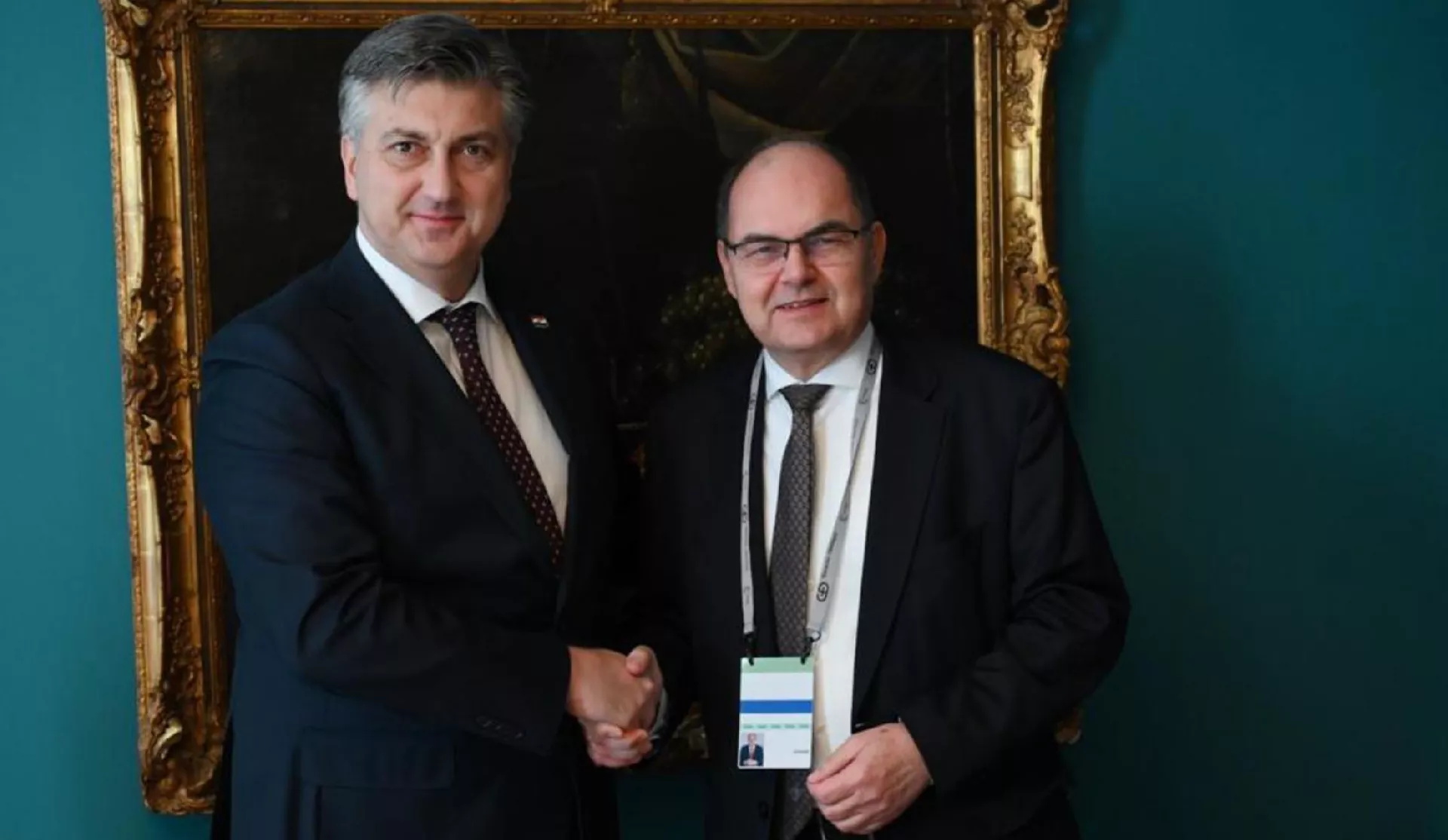
(Patria) - High Representative Christian Schmidt is traveling to London this week where he is expected to discuss details with lawyers from the Blackstone office regarding the overturning of the 'Kovačević' ruling before the European Court of Human Rights in Strasbourg, Istraga.ba has learned.
To cover his tracks, Schmidt is traveling to London via Zagreb. After that, the High Representative should meet with HDZ BiH personnel upon his return to Bosnia and Herzegovina. The meetings are expected to be held in Čapljina.
Istraga.ba is in possession of a document from the European Court of Human Rights in Strasbourg, sent on September 16 to the law firm Blackstone in London. The document clearly states that Schmidt requested the OHR to be included in the case 'Slaven Kovačević vs. Bosnia and Herzegovina'.
"I acknowledge receipt of your letter of 13 September 2024, in which you seek permission on behalf of the High Representative for Bosnia and Herzegovina to intervene as a third party in the proceedings before the Court in the above-mentioned case (Rule 44, paragraph 3 (a) of the Rules of Court).
I inform you that the President of the Grand Chamber has authorised you, in accordance with Rule 44, paragraph 3 of the Rules of Court, to submit written and oral submissions to the Court on behalf of the High Representative.
The submissions must be filed in one of the official languages of the Court, English or French," it is stated in the document signed by the Deputy Registrar of the Grand Chamber, Johan Calleweart.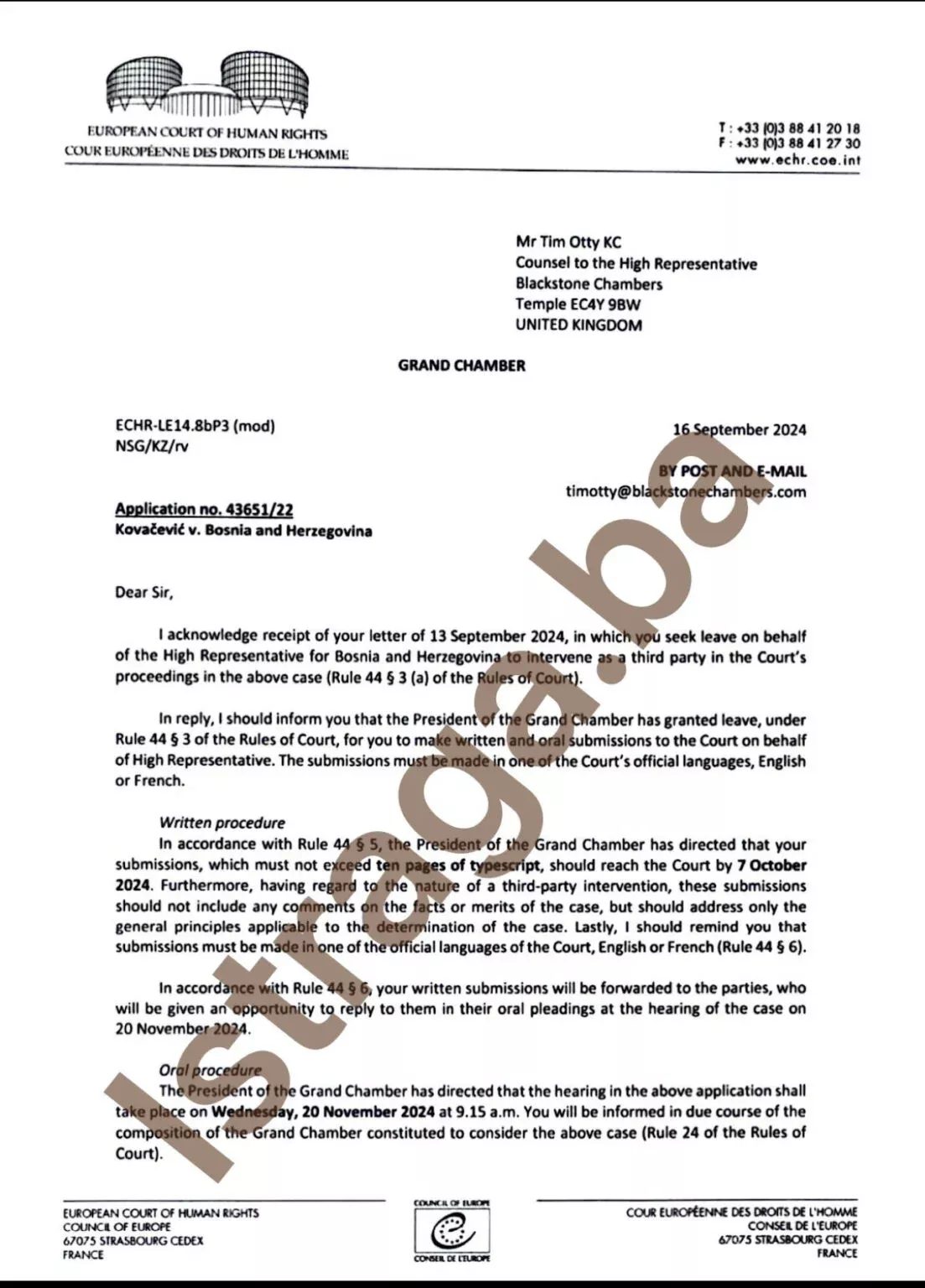
This document from the European Court of Human Rights in Strasbourg confirms that the OHR misled the public when it announced that the Court had invited Schmidt to address it as a 'friend of the Court'.
"The High Representative will agree to provide the European Court of Human Rights with independent information in the capacity of 'friend of the court' (Amicus Curiae), as High Representatives have done before in many other cases. This is standard practice.
The High Representative does not take sides but contributes as the ultimate authority in the country regarding the interpretation of the civilian aspects of the Dayton Peace Agreement in order to provide information on the Dayton framework," the OHR stated.
Thus, the Court in its letter to the law firm in London writes that Schmidt requested to be included in this case, while the OHR states that Schmidt 'agreed'.
"In accordance with Rule 44, paragraph 5, the President of the Grand Chamber has ordered that your submissions, which must not exceed ten typed pages, should reach the Court no later than 7 October 2024.
Given the nature of the third-party intervention, these submissions should not include any comments on the facts or merits of the case, but should only address the general principles applicable to deciding the case," it is stated in the document of the European Court of Human Rights.
As the deadline for submitting the response is October 7, High Representative Christian Schmidt decided to travel to London where he should finalise details with British lawyers. To cover his tracks, Schmidt first traveled to Zagreb by car, and then will fly to London.
Just before Schmidt's trip to London, a session of the Peace Implementation Council (PIC) was held in Sarajevo. According to information from Istraga, there was a major division at the PIC session between the ambassadors of EU member states on one side, and the US Embassy on the other.
The Americans, as Istraga learns, did not oppose Schmidt 'testifying' before the ECtHR in the 'Kovačević' case, while EU and PIC member states were against it. After the session, Schmidt decided to continue his engagement in the 'Kovačević' case.
The hearing before the Grand Chamber of the ECtHR is scheduled for November 20 this year.
Let us recall, the European Court of Human Rights ruled that Slaven Kovačević, as a voter and citizen of Sarajevo, was denied the right to vote for a candidate for the BiH Presidency member from the Republika Srpska.
The Court found that the BiH Presidency is a state institution and that all citizens should have the right to elect all members of the BiH Presidency. Thus, the Court effectively established that, in addition to ethnic discrimination, territorial discrimination is also in force in BiH.
To eliminate this discrimination, it is necessary to have a single electoral unit when electing members of the BiH Presidency and delegates to the House of Peoples of the Parliamentary Assembly of BiH.
The ruling was made on August 29 last year, and six judges voted for it, while Austrian judge Gabriele Kucsko-Stadlmayer dissented.
It was precisely on the dissenting opinion of the Austrian judge that HDZ BiH cadres in the Council of Ministers, led by Borjana Krišto and Monika Mijić, based their request for a review of the 'Kovačević' ruling.
The 'appeal' was submitted on September 19, 2023, i.e., the last working day of Jelena Cvijetić in the position of BiH agent before the Court in Strasbourg. Twelve days before she submitted the appeal, the current composition of the BiH Council of Ministers appointed Cvijetić as the Ombudsman of BiH.
This is the first time that Bosnia and Herzegovina has requested a review of any decision of the European Court of Human Rights related to electoral legislation – i.e., the constitutional order.
After the appeal, a five-judge panel of the European Court of Human Rights accepted the request of the BiH agents and the Chairwoman of the BiH Council of Ministers, Borjana Krišto, and forwarded the case 'Slaven Kovačević' vs. BiH to the Grand Chamber for consideration.
The small chamber that decided to refer the 'Kovačević' case for review to the Grand Chamber consisted of judges from Ireland, Slovenia, Andorra, Spain, and Moldova.
After this, Slovenian judge Marko Bošnjak, who was crucial in making the decision on the 'revision' of the case, becomes the President of the European Court of Human Rights in Strasbourg. He will be the President of the Grand Chamber.
Komentari (0)
Prijavite se za komentiranje
PrijavaJos nema komentara. Budite prvi!
Minuta
Sve →Iz drugih kategorija

High Representative Not Elected: Germans, French and British Against Americans, New Attempt at End of June

ČOVIĆ WITHOUT MERCY: How Those Who Brought Ademović to Office Created a Political Hell for Him



Sunny Saturday, quite warm



Tragedy in Albanian resort: Two minors drown












