
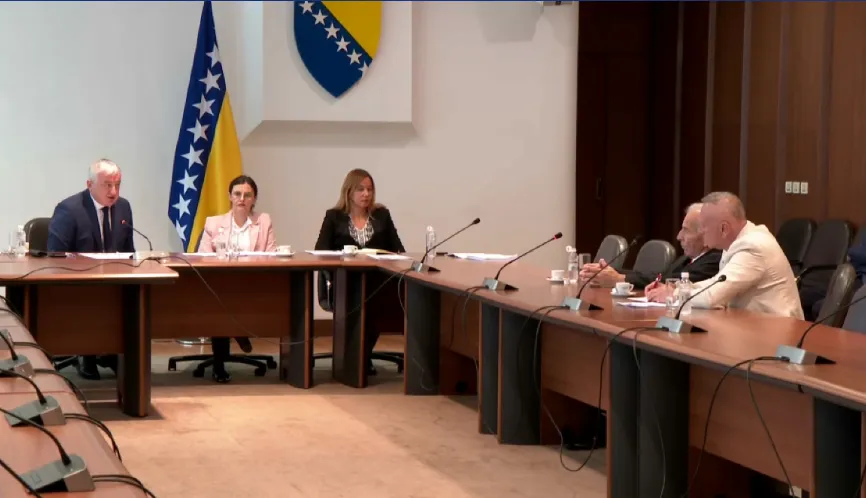
A public hearing before the Commission for Combating Corruption of the House of Representatives of the Parliamentary Assembly of BiH opened a series of questions about the accreditation of higher education institutions, the role of the Agency for Development of Higher Education and Quality Assurance of BiH, and the way private universities obtain licenses and accreditations. The focus of the discussion was the European University Kallos in Tuzla, and during the multi-hour session, issues of jurisdiction, control, conflict of interest, and the quality of higher education in Bosnia and Herzegovina were raised.
Commission Chairman Branislav Borenović initially asked the Agency Director Enes Hašić to explain how the accreditation system works. Hašić stated that the system is extremely complex and that there are 12 competent educational authorities in Bosnia and Herzegovina, and that the Agency is not an institution that establishes higher education institutions or issues them operating licenses.
“The Agency does not issue operating licenses. The Agency does not register entities. The Agency does not even issue accreditations,” said Hašić, explaining that accreditation comes later as confirmation of the institution's quality of work.
He added that the competent educational authorities issue licenses and control the work of institutions, while the Agency participates in the accreditation process by appointing a commission and entering decisions into the register.
“The Agency participates in accreditation procedures,” Hašić stated.
During the hearing, Commission member Nenad Grković asked Hašić about the status of the Kallos University and whether the Agency had given a positive recommendation for its accreditation. Hašić said that the institution had passed previous accreditation cycles, but that the current procedure, according to him, was not completed because the Agency had not received all the necessary confirmations from the competent authority.
“We have not yet received all the positions of the competent authority for this phase,” said Hašić, adding that there is correspondence with the competent bodies of the Tuzla Canton and that it is a complex procedure.
When asked how it was possible that a positive recommendation was given earlier, Hašić stated that the Agency does not provide an opinion outside of the commission's report.
“We did not give a positive opinion, but the report of the commission that gave a positive opinion,” he said.
During the discussion, Borenović repeatedly insisted on the question of who is actually responsible for controlling universities. After a series of answers that the Agency has no jurisdiction over licenses, inspection supervision, number of teachers, premises, and teaching delivery, the Commission Chairman stated that such a model makes no sense to him.
“From what I have heard from you, if I had a say, I would abolish the agency,” Borenović told Hašić.
Hašić responded that he understood such an assessment and that the current system is indeed problematic.
“The way it is defined in the law sometimes calls into question the need for it in this way, but it can be redefined and should be,” he said.
A special part of the discussion concerned medical studies at private universities. Borenović asked if it was justified for private universities to train medical doctors, and Hašić said that in his opinion, this should be regulated much more strictly.
“In my opinion, it should not be like that, or rather, it is not reasonable,” said Hašić, speaking about medical studies at private higher education institutions, adding that there are different models in Europe, but that much stricter control is needed for BiH.
Later, in response to MP Jasmin Emrić, he further emphasized that the key question is whether education must be strictly defined as a non-profit activity.
“The question is whether education must be strictly defined as a non-profit activity and endeavor,” said Hašić, warning that profit and market logic in higher education are a serious problem.
The owner of the European University Kallos and member of the Agency's Management Board, Nedeljko Stanković, answered questions about the operating conditions of this institution, the number of teachers, and medical studies. He rejected claims that the university did not meet the conditions for operation.
“First, it is not true that there were twenty teachers,” said Stanković, stating that afterwards an institute was engaged that conducted an assessment and expert examination and gave a positive opinion.
Speaking about medical studies, he said:
“I invested one million and seven hundred and fifty thousand euros of my money in medicine, and my medical school, my premises, my laboratories are better equipped than the medical faculty in Tuzla and Sarajevo, and in the entire region and Bosnia and Herzegovina.”
He also added that he has more professors than five higher education institutions in Tuzla combined, and invited Commission members and journalists to come and see the situation at the university for themselves.
During the hearing, Jasmin Emrić problematized the way professors are engaged at the Faculty of Medicine, stating that according to the information he has, only one out of 46 engaged professors has an employment contract.
Stanković responded that this is not unusual for medical faculties.
“There is not a single surgeon employed at the university; they are all employed at the University Clinical Center and come to the Faculty of Medicine,” he said, stating that it is the same in Sarajevo, Banja Luka, and Belgrade.
Emrić then stated that he was defeated by the fact that the Commission had to open such hearings and warned that the whole situation seemed like a system where profit is more important than knowledge.
“To me, it seems closer to being about profit than knowledge,” said Emrić.
During the hearing, Stanković emphasized that a group of people from Tuzla is working against him and that, as he says, they are trying to remove him from the higher education system. At one point, he also said that, in his opinion, this is related to his ethnic background.
Jasmin Emrić reacted to this by saying that it is “inappropriate” to highlight religious affiliation as the reason for the hearing and the entire case, and invited Stanković to act in accordance with the law if he has evidence of discrimination.
Borenović also stated that no one should suffer discrimination on national or religious grounds, but announced that the Commission will also invite representatives of the inspection from the Tuzla Canton to determine what is true in this case, N1 reports.
Otherwise, the acting rector of Kallos, Anka Bulatović, did not appear before the Commission today; instead, her lawyer Mirnes Ajanović appeared. The Commission reiterated its invitation to Bulatović for June 2nd, refusing to allow Ajanović to speak on her behalf.
Komentari (0)
Prijavite se za komentiranje
PrijavaJos nema komentara. Budite prvi!
Minuta
Sve →Iz drugih kategorija

High Representative Not Elected: Germans, French and British Against Americans, New Attempt at End of June

ČOVIĆ WITHOUT MERCY: How Those Who Brought Ademović to Office Created a Political Hell for Him



Sunny Saturday, quite warm



Tragedy in Albanian resort: Two minors drown












