
By Armin Sijamić
Eight months have passed since the beginning of the Russian aggression against Ukraine, and the war has entered a phase where strategic calculations for Russia are diminishing with every victory of the Ukrainian army. Moscow's visible nervousness since the beginning of this month has manifested in a new strategy – the destruction of Ukraine's power grid and other infrastructure necessary for the country to function. The beginning of October 2022 will be remembered in Ukraine's history as a time when Russian aggression took on another dimension. In addition to annexing four Ukrainian regions (Donetsk, Luhansk, Zaporizhzhia, and Kherson) and threatening to "defend the seized territories by all means," official Moscow has decided to literally return the part of Ukraine under the control of internationally recognized authorities to the Middle Ages.
Massive strikes on Ukraine's strategic infrastructure were carried out for days, with Russia using warships, strategic bombers, ballistic missiles, drones, and artillery for this purpose. This was the beginning of an operation that continues to this day, in which cities hundreds of kilometers away from the front lines were not spared, leaving entire regions without electricity and industrial capacity. The targets of the Russian army included thermal power plants, substations, hydroelectric power plants, transformers, and pipelines, followed by railway infrastructure, fuel depots, industrial complexes, and other static targets that are difficult to defend, especially given that Russia possesses hypersonic missiles against which even highly developed countries have no defense compared to Ukraine.
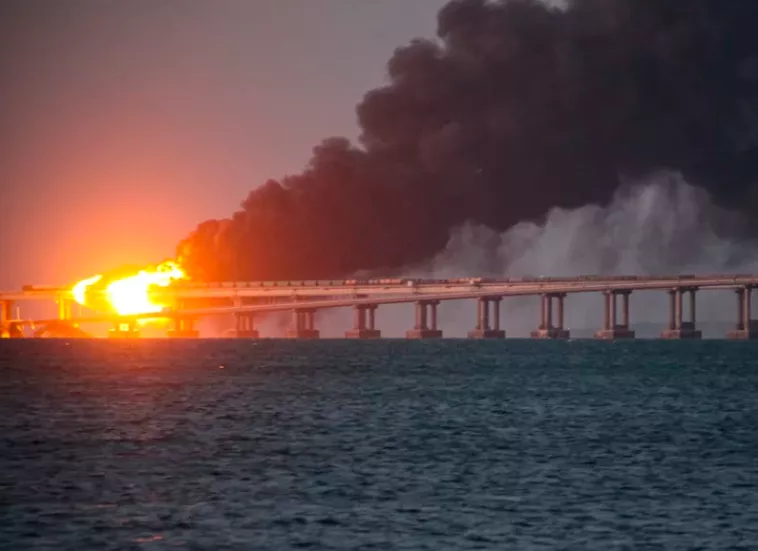
The mentioned targets are not Ukrainian propaganda, as the Russian army and Russian media have reported on them. Moscow has stated that it will destroy everything that helps the enemy army and government, and has also threatened to attack the buildings of the Ukrainian government and parliament. The massive attacks on Ukrainian infrastructure correspond with the explosion on the Kerch Bridge connecting Crimea and Russia, which remains unexplained to this day. There are various theories about how the explosion occurred, and Moscow blames Kyiv for this "terrorist act," as well as for the assassination of Darya Dugina. Kyiv has not officially confirmed its involvement in the explosion. Some Ukrainian officials celebrated the destruction of part of the bridge on social media. Some analysts are inclined to the theory that the attack was staged by Russia to justify what would follow in the coming days. Be that as it may, it remains a mystery how, according to the Russian version, Ukrainians could have loaded a truck with explosives, driven it through Russia, passed through security checks on the bridge itself, and then detonated it, destroying the part of the bridge the vehicle was on.
Destroying the country
Massive Russian attacks on Ukrainian infrastructure have been attributed by some analysts and media to a comprehensive Russian war plan – the Gerasimov Doctrine. The Gerasimov Doctrine, named after the current Chief of the General Staff of the Russian Armed Forces, Valery Gerasimov, published in 2013 under the title "The Value of Science in Prediction," is essentially a set of ideas and instructions on how the Russian army should wage war, using "non-military" means as well, which has been described in the West as hybrid warfare. Simply put, Gerasimov, based on the old Soviet doctrine, developed ideas on how to defeat an opponent even before the two armies faced each other on the battlefield. This includes, among other things, information warfare (propaganda), demoralizing the opponent (a combination of fake news and false narratives), creating rifts between citizens, the government, and allies, and creating conditions where the use of military force is not even necessary. Therefore, some analysts have attributed the massive strikes on Ukrainian infrastructure to the Gerasimov Doctrine, although this approach to breaking resistance is not new and is not exclusively Russian. In this specific case, the destruction of Ukrainian infrastructure is intended to discourage the population and the army from defending themselves.
Such brutal methods have been applied throughout world history in different eras, from the sieges of fortified cities to the present day. The obvious goal of destroying Ukraine's power infrastructure is to make life difficult for civilians, as the local population uses district heating, hot water is also supplied to citizens, communication with the authorities and among citizens is to be disrupted, and ultimately, industrial and military capacities deep within Ukrainian territory are to be halted. President Volodymyr Zelenskyy stated that about 30 percent of the country's power plants were destroyed in one wave of attacks, which has hampered industrial operations. The government has called on citizens to save electricity, and on October 11, it announced that it was ceasing exports to the European Union, despite an agreement in early July that Kyiv would supply its surplus electricity to the rest of the continent, thereby facilitating Brussels' decision to reduce energy imports from Russia.
A country without energy and food
From Moscow's perspective, such Russian moves bring multiple benefits. In addition to billions of dollars in direct damage to Kyiv (damage to facilities, disruption of electricity production, halting of industry, and worsening living conditions for civilians and the army), the EU's dependence on Russian energy is prolonged. It appears that such a move was carefully planned, which is partly illustrated by a series of articles in the Russian media about "what Russia gains" from the annexation of the aforementioned four Ukrainian regions. RT cited some data that sheds new light on Russia's intentions. Namely, with the annexation on October 4, Russia has grown by about 110,000 square kilometers (slightly more than the area of Croatia and Bosnia and Herzegovina combined), and Ukraine has shrunk by about 15 percent. The annexed territory is home to about eight million people with impressive industrial and agricultural potential.
Donbas contains Europe's fourth-largest coal field with estimated reserves of 10 billion tons, and until February 24, 115 mines operated there, producing 70 million tons of coal annually. Then, there are eight power plants. About 5.6 million hectares of high-quality arable land are located in all four regions, and Luhansk has a developed metallurgy, machine-building industry, and mines. Zaporizhzhia is the heart of Ukrainian electricity production, and it is home to Europe's largest nuclear power plant, the hydroelectric power plant on the Dnieper River, and the Botievo wind farm. In 2019/20, it produced a quarter of Ukraine's electricity, or 40 billion kilowatt-hours.
The ZAZ car factory is located in this region, and not all of the Dnieper's potential has been utilized. Furthermore, in the Kherson region, shipbuilding, tourism, and agriculture (grains, sunflowers, and vegetables) are developed, with two or even three harvests per year. It should also be mentioned that there are large deposits of oil and natural gas in the annexed territories. The existing ports are connected to Russian river routes, and from there, goods can be shipped to Africa and Asia.
From this abbreviated list of targets and capacities that Russia intends to appropriate, it is clear that Putin's "special military operation" aimed at "denazification" and overthrowing the "drug addicts" in power in Kyiv has been abandoned, if that was ever the real plan. The war that Russia is waging against Ukraine is literally the destruction of this country's potential to survive and to have its own resources sufficient for development.
The seizure and destruction of power generation capacities, especially at a time when energy prices are rising, is nothing less than bringing a country to its knees. The intention to deprive Ukraine of fertile land suggests that in the future, crops and fertile fields in the rest of the country could also become targets, which would lead to a chain reaction due to food shortages in Ukraine and in some African and Asian countries. This could be the card that Moscow will play in the future. In that case, in addition to Ukrainian refugees, millions of new people from Asia and Africa could arrive at the European borders.
Komentari (0)
Prijavite se za komentiranje
PrijavaJos nema komentara. Budite prvi!
Minuta
Sve →Iz drugih kategorija

High Representative Not Elected: Germans, French and British Sabotaged Americans, New Attempt at End of June

ČOVIĆ WITHOUT MERCY: How Those Who Brought Ademović to Office Created a Political Hell for Him



Sunny Saturday, quite warm



Tragedy in Albanian resort: Two minors drown












