
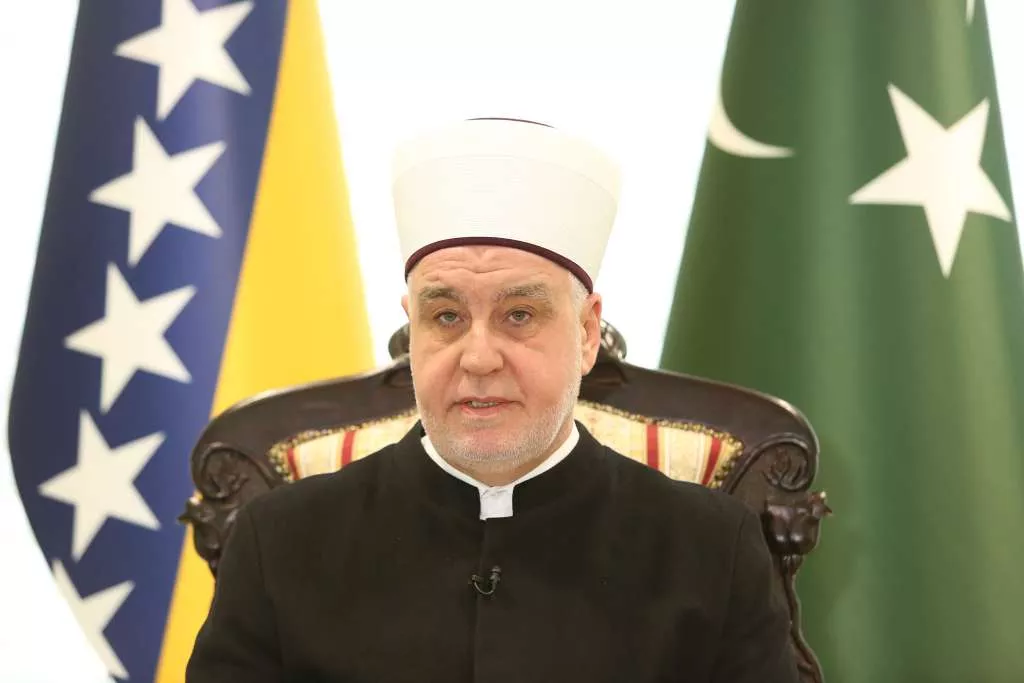
(Patria) - Reisu-l-ulema of the Islamic Community in Bosnia and Herzegovina, Husein-ef. Kavazović, pointed to the importance of facing challenges and actively strengthening the community's potential, while recalling the lessons of the past and the values of freedom that obligate us.
The fourth regular session of the Assembly of the Islamic Community in Bosnia and Herzegovina is being held in Sarajevo, and on this occasion, Reisu-l-ulema Kavazović addressed the assembly members. He assessed that the Assembly session is an opportunity to review projections and plans for the coming year, and to determine the main guidelines and directions of action.
"In a time of deep crises and alienation of modern man, when we witness virtual communications dominating our lives, in a time of great wars and threats, every meeting brings us closer to each other and restores mutual trust," said the Reisu-l-ulema.
Despite the numerous difficulties and challenges that constantly accumulate before our homeland and our people, there are also many blessings, denied to many in the world, which the Merciful Lord bestows upon us, emphasized the Reisu-l-ulema.
"According to data from relevant world agencies for measuring quality of life, if you have a place to live, enough food, drink clean water, have a mobile phone and internet access, have the opportunity to attend secondary school and conditions to study, you are in a privileged group of 7% out of a total of 7.8 billion people on planet Earth. To our joy and pride, today we are one of the few Muslim communities in the world that can boast of the blessings of freedom, thought, speech, and organization. To be free and on one's own is a supreme worldly value, which should be carefully preserved, like a little water on a dry palm," emphasized the Reisu-l-ulema.
Among other things, he reminded that "we paid dearly for our freedom, and defended our dignity," and that therefore "today we must be responsible and engaged guardians of it."
"We have no right to play with what we have acquired in the difficult times of our recent past. Especially we in the Islamic Community are called to be the best example of responsibility and dedication to the obligations we have undertaken and the trust we carry. We are obliged to work day and night on strengthening our Community, on its compactness and normative order," stated the Reisu-l-ulema.
The Reisu-l-ulema assessed that the situation in our homeland, the region, and the world vividly illustrates the fragility of international relations, and that "we must rely on our own strengths and potentials."
"The world around us is changing rapidly. A new balancing of powers is taking place. The world is in turmoil, and we must not watch this disinterestedly. After the genocide in Srebrenica and everything that happened to us in the past, we cannot afford the luxury of security, lack of perspective, and being closed in on ourselves. The wars in Gaza, Ukraine, Sudan, and around the world unfortunately confirm a dangerous trend: the rule of force and disrespect for international norms and principles. In such a world, we must be open, strengthen alliances with friends that our community, state, and people have, but, above all, strengthen our own potentials of our people and community in all spheres of life," believes the Reisu-l-ulema.
He once again pointed out the exceptional importance of the congregation (džemat) and imams for the overall mission of the Community.
"I have hinted that this year I will dedicate my work to raising the level of order in our congregations and strengthening the status of imams in them, who are the main protagonists of our Islamic activity. We are focused on preserving and improving two extremely important elements in the work of imams. These are the khutbah and social inclusion – as a permanent and irreplaceable pattern of live, direct communication between the imam and the congregation; and the mekteb, as a traditional and irreplaceable method of religious upbringing and education. Our children do not go to mekteb and the mosque for dry learning about their religion. There, symbols of identification with faith, culture, and tradition are adopted, such as the adhan, qibla, prayer, mevlud, congregation, ummah, etc. Our imams in congregations are not only religious authorities, but very often the main organizers of social actions in the congregation, especially in crisis situations. This was very clearly seen in the process of the return of muhajirs and in the natural disasters that befell us," he stated.
He added that, in an effort to improve conditions in congregations, important activities have been undertaken and important processes initiated, which should yield results in the coming years.
"The Rulebook on Membership Fees in the Islamic Community in BiH was already in application this year. Although we encounter misunderstandings and difficulties in some places, we are satisfied with its application. At today's session of the Assembly, before you is the Rulebook on Service in the Islamic Community, another extremely important document that comprehensively regulates the rights and obligations of employees and officials at all levels in the Community. Three more important documents are in the process of being drafted: the rulebook on standards of occupations and qualifications, the rulebook on categorization of congregations, and the rulebook on property in the Islamic Community. Working groups are working on drafts of these documents. Some of them should be before you at the spring session of the Assembly, with God's help," announced the Reisu-l-ulema in his address to the assembly members.
Another important process being implemented is the reform of higher education in the Islamic Community. As the Reisu-l-ulema explained, the first phase of consultations and research was concluded with a recent advisory meeting, which resulted in a series of recommendations on which direction to take.
"In the next phase, the competent bodies of the Community will open the process of changes and corrections to curricula, internal organization, and mutual cooperation of our higher education institutions in the Islamic Community. At the beginning of next year, the Museum of the Islamic Community will start operating, which will, in symbiosis with the Institute for the Islamic Tradition of Bosniaks, be our great step forward in collecting, studying, and presenting our religious and cultural heritage. We are working on further development of the infrastructure of the Islamic Community. It is significant to mention here that the reconstruction of the building next to the Gazi Husrev-beg Library is underway, which should become the seat of the archive of the Islamic Community, another important institute for preserving material heritage and testimony of our centuries-old rootedness in these areas," he stated.
He stated that at the last session of the Council of Muftis, a document called the Platform of the Islamic Community for Dialogue was adopted.
"In it, we once again confirmed our commitment to the affirmation of dialogue, as a fundamental principle of our action, which is deeply rooted in Islamic teaching and in the Muslim spirit of openness and understanding. At the same time, we clearly set the principles from which we approach dialogue with others, in interreligious and inter-Muslim dialogue, and our attitude towards the last war in our country. Our dialogue with both East and West, with communities from our neighborhood, should ensure that our voice is heard, that we clearly speak to others about ourselves, our beliefs, and our hopes. We must ensure that we are at the table when decisions are made about us. We must not have a new Berlin Congress, a new Saint-Germain Treaty repeated. We paid too high a price not to decide freely about ourselves today," emphasized the Reisu-l-ulema at the Assembly session.
He particularly emphasized that the past year was marked by a great diplomatic victory at the United Nations. As he said, the Resolution adopted by the UN General Assembly, declaring July 11 as the International Day of Remembrance of the Genocide in Srebrenica, is a victory of truth and a pledge for a future in which there will be no room for repeating these horrors.
"It is up to all of us to contribute, so that the provisions of the Resolution come to life not only in our homeland but also around the world. Ahead of us is the 30th anniversary and another funeral for the victims of the genocide in Srebrenica, and we must ensure that it passes with dignity and at a level that the innocent victims deserve. Srebrenica must be taken care of even on days not related to the anniversary and funeral. A clear plan and vision are needed to reverse the results of the genocide and preserve life in Srebrenica. The international community also has this obligation, if for no other reason than for the role they played in the fall of the UN safe zone," emphasized the Reisu-l-ulema.
He added that the genocide in Srebrenica is a great stain on the conscience not only of those who inspired and committed it, but also of those who deny it, as well as part of the international community and part of the international public.
"The Islamic Community in Bosnia and Herzegovina bases its attitude towards individuals, religious communities, and states on the basis of their attitude towards the genocide in Srebrenica. We call for the establishment of trust, which will be based on the truth about what happened, justice and condemnation, and distancing from those in whose name the crimes were committed," said the Reisu-l-ulema, among other things.
He stated that "the reaction of our state to the recent floods in our homeland once again showed all the weakness of that state and its system."
"At the same time, we saw the solidarity and dedication of our citizens, which inspired and encouraged us all. The Islamic Community collected five and a half million marks through contributions from our members. We urgently helped the victims, and now we plan to implement several projects: from building houses to repairing water supply systems. We were also encouraged by the material support delivered to the Islamic Community in Bosnia and Herzegovina from brotherly communities in the region, from our Albanian brothers, to our Turkish brothers living and working in Austria. It is good to know that we are not alone and that we have friends around the world," concluded Reisu-l-ulema Husein-ef. Kavazović in his address.
Komentari (0)
Prijavite se za komentiranje
PrijavaJos nema komentara. Budite prvi!
Minuta
Sve →Iz drugih kategorija

High Representative Not Elected: Germans, French and British Against Americans, New Attempt at End of June

ČOVIĆ WITHOUT MERCY: How Those Who Brought Ademović to Office Created a Political Hell for Him



Sunny Saturday, quite warm



Tragedy in Albanian resort: Two minors drown












