
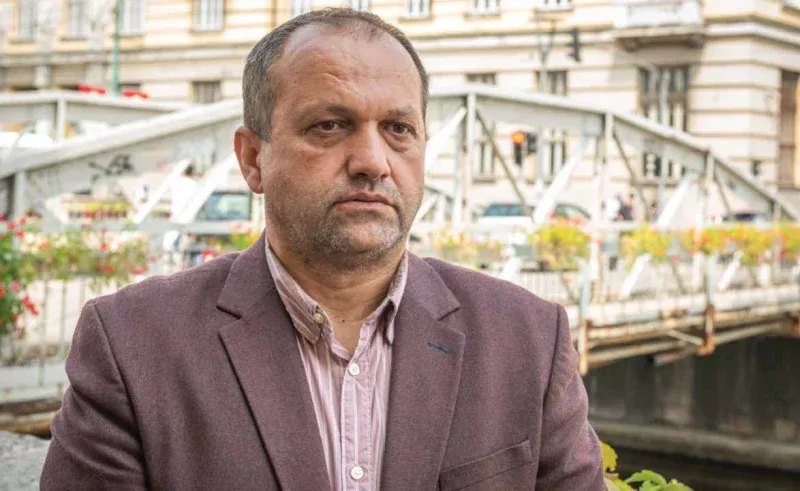
By: Dr. sci. Amir Kliko, Institute for Research of Crimes Against Humanity and International Law UNSA
On the occasion of remembering the victims of the war crime against captured members of the HVO and men of Croatian nationality on June 8, 1993, in the village of Maline (Bikoši), yesterday the Public Broadcasting Service BHRT presented two serious and unfounded claims. It misinformed the public that this war crime was committed by members of the ARBiH and that no one was held accountable for it.
The crime in Maline - in addition to others for which they were accused under command responsibility - was one of the most significant points in the indictments against the commander of the Main Staff of the ARBiH, Rasim Delić, the commander of the 3rd Corps, Enver Hadžihasanović, and the commander of the 7th Muslim Knightly Liberation Brigade (7th MVObr), Amir Kubura, before the Hague Tribunal. Therefore, this war crime was prosecuted before the International Court. For Delić, the indictment related to him as the commander of the ARBiH, for Hadžihasanović as the commander of the 3rd Corps in whose zone of responsibility it was committed, and for Kubura as the commander of the aforementioned brigade.
Even during the war, foreigners working in various international organizations in central Bosnia often equated members of the 7th MVObr with foreign fighters, volunteers from Afro-Asian countries, the so-called "mujahideen" in their reports, which is why the war crime in Maline on June 8, as well as the war crime in nearby Miletići on April 24, was attributed to that brigade. Documentation created by various military and civilian bodies of the HZ HB, which also did not distinguish between members of the 7th MVObr and foreign "mujahideen," was also used as evidence in the Hague Tribunal.
Due to this equation of the 7th MVObr and foreign "mujahideen," its commander Amir Kubura was indicted for the crime in Maline, and Hadžihasanović as his superior, while Delić was indicted as his superior. The trial against the three of them before the Hague Tribunal was long and thorough. The situation was clarified. The war crime was committed by foreign "mujahideen," not by members of the 7th MVObr, i.e., members of the ARBiH.
The Tribunal established without any doubt that the foreign "mujahideen" were not under the control of the ARBiH at the time of the crime. They acted completely independently and ignored the command of the 3rd Corps. Often in cooperation with locals who joined them, but even they did not recognize the command of the ARBiH units in whose zones of responsibility they operated. Therefore, this heinous war crime against captured members of the HVO, who surrendered after the fighting, and against men of Croatian nationality, was not committed by the ARBiH, and it is not true that no one was held accountable. The three mentioned commanders of the ARBiH were held accountable and acquitted of the charges for the war crime in Maline on June 8 and Miletići on April 24. It was precisely in the proceedings against the three of them before the Hague Tribunal that it was proven how it was not committed by the ARBiH. That is why they were acquitted of command responsibility on those counts. The public service BHRT must respect these facts and inform the public accordingly.
No one has been held accountable for these two war crimes before the Bosnian-Herzegovinian Court for War Crimes. Why, I don't know. I can assume that the problem is the identification of the perpetrators and their apprehension because they are probably no longer in Bosnia and Herzegovina. Therefore, the Herceg-Bosnia propaganda, in this case even through the public service BHRT, continues to accuse the ARBiH of the war crimes in Maline and Miletići and claims that no one has been prosecuted because it does not accept the verdict against Delić, Hadžihasanović, and Kubura on that count. Propaganda considers it more important to accuse the ARBiH in order to influence the change in the "nature" of the war than to identify and prosecute the perpetrators of these war crimes. I believe that this is not impossible, despite the problem of identification. There were Bosnian-Herzegovinian civilian and military security and intelligence services that monitored the activities and behavior of foreign "mujahideen." I am convinced that their documentation can identify the perpetrators and local Bosniaks who collaborated with them, thus initiating legal proceedings for their punishment.
I wrote more extensively about the war crimes against Croatian civilians and captured members of the HVO in central Bosnia in 1993 in my book "The War in Central Bosnia 1992-1994." There were war crimes that were undoubtedly committed by members of the ARBiH (for example, the murder of Franciscan friars in Fojnica, the murder of 23 captured members of the Bugojno HVO, crimes in Grabovica, Trusina, Počulice, Šušanj...). However, the war crimes in Miletići on April 24 and Maline on June 8 were not committed by members of the ARBiH. I emphasize that this was determined by the Hague Tribunal after an extensive and very systematic investigation. I advocate that every war crime should be spoken and written about publicly, regardless of who committed it and against whom. I personally do this as much as the available documentation allows. No one's victims should be forgotten, especially not devalued. But criminals should not be left to live freely. So far, the trials of war criminals before the Hague Tribunal and domestic courts have been largely presented as an important contribution to the reconciliation of the population of Bosnia and Herzegovina. Practice has shown that this has not had a significant impact.
Trials must be conducted to punish criminals and their commanders, and whether this will affect the reconciliation of the population is of lesser importance. Politics divides and reconciles people and nations, not courts. Misinformation by the public service BHRT regarding the war crime in Maline does not contribute to reconciliation. On the contrary, it acts even more harmfully against it.
I wrote in more detail in my aforementioned book about how the ARBiH reacted to the war crimes of foreign "mujahideen" in Miletići and Maline. For this occasion, I can only mention a few examples related to Maline (Bikoše) on June 8.
On October 15, Tadeusz Mazowiecki sent a letter to Alija Izetbegović asking for an investigation into the crimes of ARBiH members against Croatian civilians and captured HVO fighters in Grabovica and Uzdol. He also drew his attention to the crime in Maline. He had information that foreign "mujahideen" participated in it. He requested information on what was done to bring them under the control of the Bosnian-Herzegovinian government, which means they were not.
Two days later, Delić ordered Hadžihasanović to gather data. According to the report of the 306th Brigade of the ARBiH, combat operations in Maline and its surroundings were carried out at the end of May and the beginning of June. It was not aware of how many Croats lived in the area of the village at that time, but it claimed that no members of the ARBiH and local Bosniaks forced them to leave. After their defeat, the HVO members began to withdraw and evacuate Croatian civilians, even using force against them.
Incidentally, until the general attack by the HVO on the ARBiH in the Travnik municipality at the beginning of June, its unit in Maline had killed ten Bosniak residents of the village with sniper fire (three fighters and seven civilians). This unit was defeated by June 8, after several days of fighting. There was no massacre of the Croatian population or execution of captured HVO fighters during the combat operations. After the fighting, the usual clearing of the area took place. All those killed during the fighting (by bullets and shrapnel) were gathered in one place. There were 25 persons, civilians and HVO soldiers. They were not identified because they had no documents with them. They were buried in two graves between Bikoše and Maline, at Pješčara, about which the ARBiH immediately informed the HVO. Representatives of UNPROFOR, the Peace Implementation Council, the ICRC, and Fra Stipan Radić from Zenica came to the scene and said that the bodies should remain buried in the same place.
The fighters of the 306th Brigade acted honorably towards the captured HVO members and Croatian civilians from Maline. Military policeman of the 306th Brigade, Adnan Gunić, testified before the Hague Tribunal on December 27, 2004, about the crime in Maline:
"…We entered the village of Maline around 10 or 11 in the morning. Fighting was going on around. Sporadic gunfire could be heard in the village itself. In the middle of the village, there was a large group of villagers. Among them were men of military age. Some were in uniform, but all had already surrendered their weapons. However, the majority of the group were civilians, women, children, and elderly people without uniforms. The commander told a group of us, 3-4 policemen, to search the village and see if there were any remaining soldiers or discarded weapons. He stayed with the villagers and discussed with them. We searched the village and returned to the center. The number of villagers in the center had increased. I know the commander found a vehicle and sent some elderly people to Mehurić. The discussion about whether the villagers would stay in the village or go with us to Mehurić continued. People expressed fear that mujahideen might come to the village. Finally, around 2 PM, the commander decided that a group of 4 policemen would stay in the village, and the rest of us, I think there were 5 of us, would escort these residents towards Mehurić until the combat situation stabilized. There were slightly more than 200 men, women, and children in the column. I cannot say exactly how many men of military age there were. Some of the HVO members who were with us were carrying boxes of mines that we found during the search of the village. The column was not in any particular order. In some places, there were two or three in a row, and in some parts of the column, there were 4-5 people.
We talked to the people in the column... As we approached Poljanice, I noticed that the column had stopped. I paid attention to the front of the column and saw an Arab and a man with a mask on his face pointing their rifles at my brother... Suddenly, about 10 armed men emerged from the side, from a thicket, some were Arabs, and some had masks, so I cannot say if they were Arabs or our people. All of them cocked their rifles and pointed them at the column, and one put a pistol to my head. They entered the column and took out about 20 or slightly more young men with them and led them away. We then almost ran with the column to Mehurić. We took these people and accommodated them in the gymnasium. We were very scared... I saw that my brother's mouth was bleeding from the rifle that was put in his mouth... We tried to find out something for some time. The overall information we had clearly indicated that there was no one from our brigade among those people, but that they were mujahideen from the camp and some Bosniaks who were also with them in the camp... We did not find out what really happened to those people. Only later did my brother tell me that one of the HVO members who escaped from the execution told him that the mujahideen had killed the people they took from us, and that two or three of them managed to escape..."
This was confirmed by a member of the 306th Brigade, Hasan Zukanović, to the Hague Tribunal:
"…Gunić Mirsad informed me that while escorting the residents of the village of Maline and the surrendered HVO members, the mujahideen took about twenty detained persons from them at gunpoint. I then learned that there were also over 200 villagers in the hall, who were already being taken care of by civil defense and civil police… There was already suspicion that the abducted people had been killed… Gunić also informed me that one person had survived the execution, which strengthened our belief that the abducted persons had been killed. Since the military police did not know any of the people who attacked them, we tried to set up ambushes near the camp and in the village to try to recognize some of those people by their appearance. However, these attempts yielded no results, so we gave up further investigation because it was already clear that no one from the 306th Brigade participated in it, but rather mujahideen and people associated with them whose identities we could not ascertain due to masking. No one could enter the camp in Poljanice…"
The commander of the 17th Knightly Krajina Mountain Brigade (17th Vkbbr), Fikret Ćuskić, strongly protested to the commander of the 3rd Corps, Enver Hadžihasanović, regarding the information received about the war crime in Maline. Ćuskić first learned about it from his fighter Huse Džehverović, who was on leave in Zenica at the time of the HVO attack on the ARBiH in the Travnik municipality at the beginning of June. He voluntarily interrupted his leave and headed towards Travnik to report to his unit. He managed to reach Maline. He could not go further due to the road blockade in Guča Gora. He joined the defenders of the village. When the road was unblocked, he continued towards Travnik. Immediately upon arrival at the barracks, he informed Ćuskić that foreign "mujahideen," under threat of weapons, had taken a large group of captured HVO members from the military police of the 306th Brigade. Revolted by their actions, Ćuskić sent a letter to the command of the 3rd Corps on June 17, stating that this was unacceptable, that this unit could not wear the same uniform as the ARBiH, that it was a crime, and that the ARBiH must be distinguished from Chetniks and Ustashas. He asked the corps command to allow the 17th Vkbbr to deal with the foreign "mujahideen" if other commanders and units could not or dared not do so. Hadžihasanović replied that he fully agreed with his views and that the corps command supported them. He informed him that an investigation was already underway and promised to demand that the competent authorities be rigorous - we can only win with dignified behavior and actions.
According to an HVO report, 32 Croats were executed in Maline on June 10. A report from August 8, 1993, mentions that 42 people were killed. At the beginning of July 1996, three graves were exhumed in Maline (Bikoši), in which the remains of nine bodies were found. According to information from the SIS of the HR HB from July 1996, a total of 36 people aged 17 to 84 died. What is certain is that from this number, 20 or slightly more young men were taken from the column and killed after surrender, i.e., after the cessation of combat operations. This is a classic war crime that must be seriously investigated and prosecuted against its actual perpetrators and their accomplices. Media disinformation does not contribute to this.
Komentari (0)
Prijavite se za komentiranje
PrijavaJos nema komentara. Budite prvi!
Minuta
Sve →Iz drugih kategorija

High Representative Not Elected: Germans, French and British Against Americans, New Attempt at End of June

ČOVIĆ WITHOUT MERCY: How Those Who Brought Ademović to Office Created a Political Hell for Him



Sunny Saturday, quite warm



Tragedy in Albanian resort: Two minors drown












