
By: Armin Sijamić
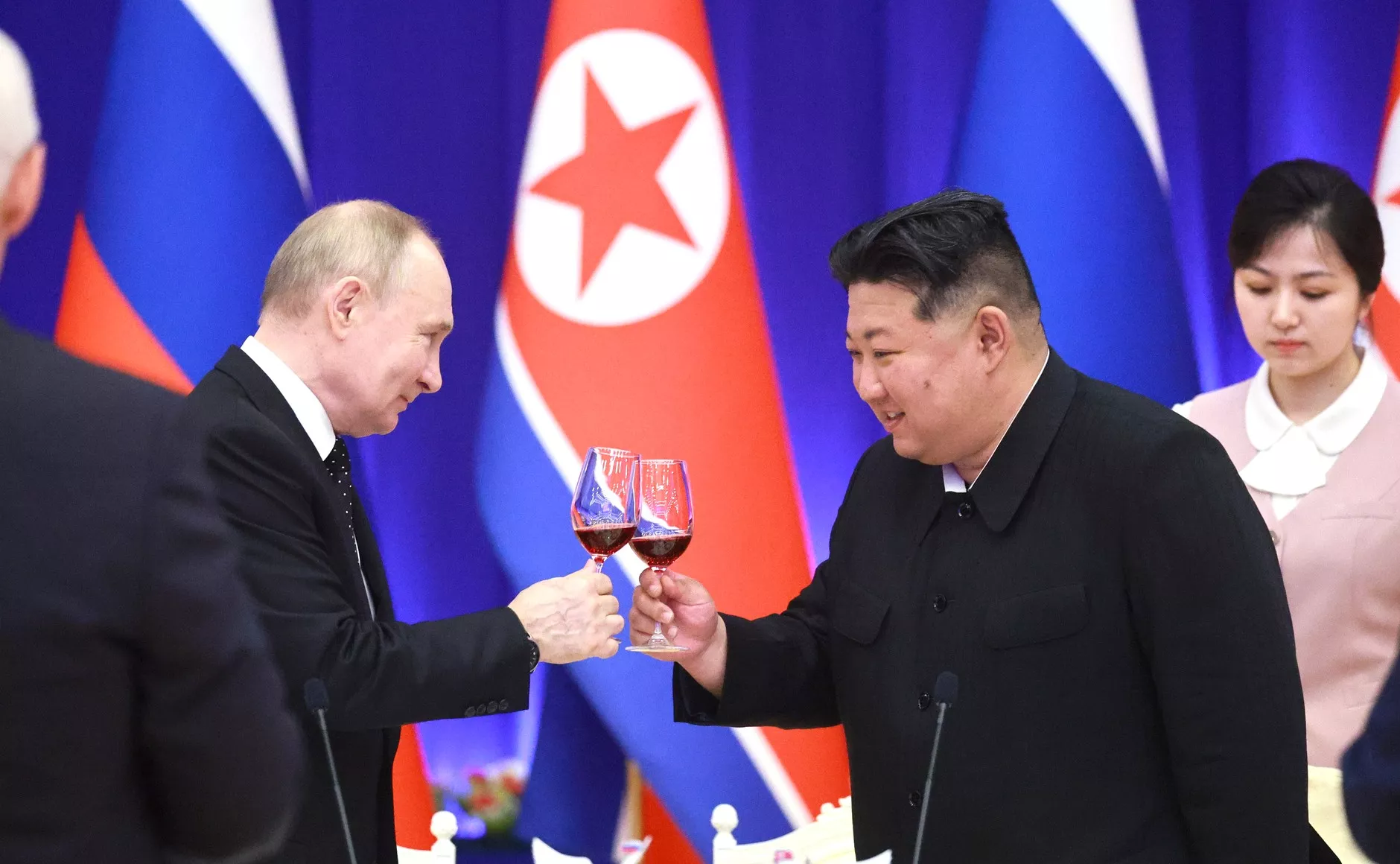
Mid-this week, Russian President Vladimir Putin visited North Korea for the first time in 24 years. Putin's trip to the isolated country, whose isolation he himself helped foster, shows the new plans of Russian policy in its confrontation with the West following the aggression against Ukraine.
When the highest state official visits a neighboring country after 24 years, it is an event of utmost importance. And if it is done by the president of a nuclear power visiting another nuclear power, then the matter is even more important, but also stranger, as Moscow and Pyongyang have no open issues.
What led Putin to visit a country under sanctions from the United Nations Security Council? Why now? What does he want from Pyongyang and what does he offer it? These are some of the questions associated with this visit. These questions have roots in the past year and are a consequence of Putin's isolation in a large part of the world, as well as the desire to strengthen the enemy of his enemy according to the recipe the West is applying in Ukraine.
Help from Pyongyang, or helping Pyongyang?
Western officials have been saying since the early months of the Russian aggression against Ukraine that Moscow wants good relations with Pyongyang to obtain weapons, and even soldiers. Moscow and Pyongyang denied that such an agreement existed, and in the meantime, everyone has forgotten about North Korean soldiers in Ukraine. However, Kyiv claims that remnants of weapons produced in North Korea have been found in Ukraine, and Western media have claimed from time to time that these weapons, shells and missiles, have a huge impact on the war, to the point that the projectiles do not explode when they hit the target.
North Korea is a poor and isolated country, and it is difficult to believe that it can help anyone, especially in Ukraine, where a war is being waged that literally depletes resources of all kinds. Therefore, aid from Pyongyang, if it existed, would only be a drop in the ocean of Russian needs.
On the other hand, Russia can help North Korea in several ways, in sectors where Moscow excels. For example, it can help Pyongyang with food, technology transfer, selling energy resources, and other things that are denied to them by sanctions. This could be seen in August last year when Moscow decided to *de facto* recognize North Korea as a nuclear power, violate the sanctions it voted for, and prepare Pyongyang to cause headaches for Washington and Seoul.
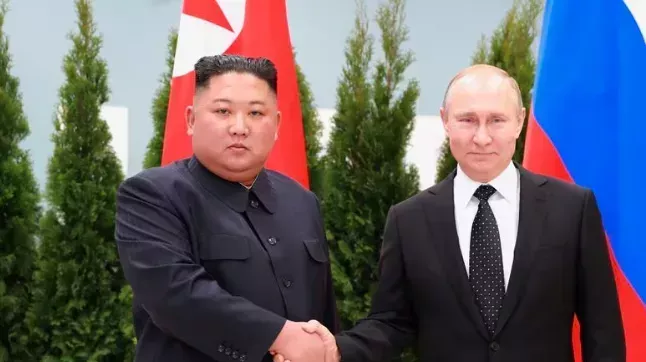
Even then, it was clear that Russia wanted to strengthen the enemies of its enemies. The Kremlin waited for South Korean weapons to appear in Ukraine and then decided to bring Pyongyang into the game.
The North Korean leader came to Russia, invited Putin for a return visit, and then his army received a spy satellite that it had been trying to launch unsuccessfully for years.
Welcome for a dear (and only) guest
Putin's return to North Korea, after meeting with the then leader Kim Jong Il in 2000, was spectacular, in line with the welcomes prepared for important guests visiting that country. It was as if time had stopped in the years of Kim Il Sung, who organized parades, rallies, and brought tens of thousands of people to stadiums and squares to participate in the program.
Putin's arrival is perhaps the most important visit for Pyongyang this century, especially during the reign of Kim Jong Un, who met him at the airport and hugged him. Then, Putin drove through streets decorated with his photos and Russian flags, after which "the leaders of the two countries spent almost the entire day at the negotiating table in various formats," reported Russian media.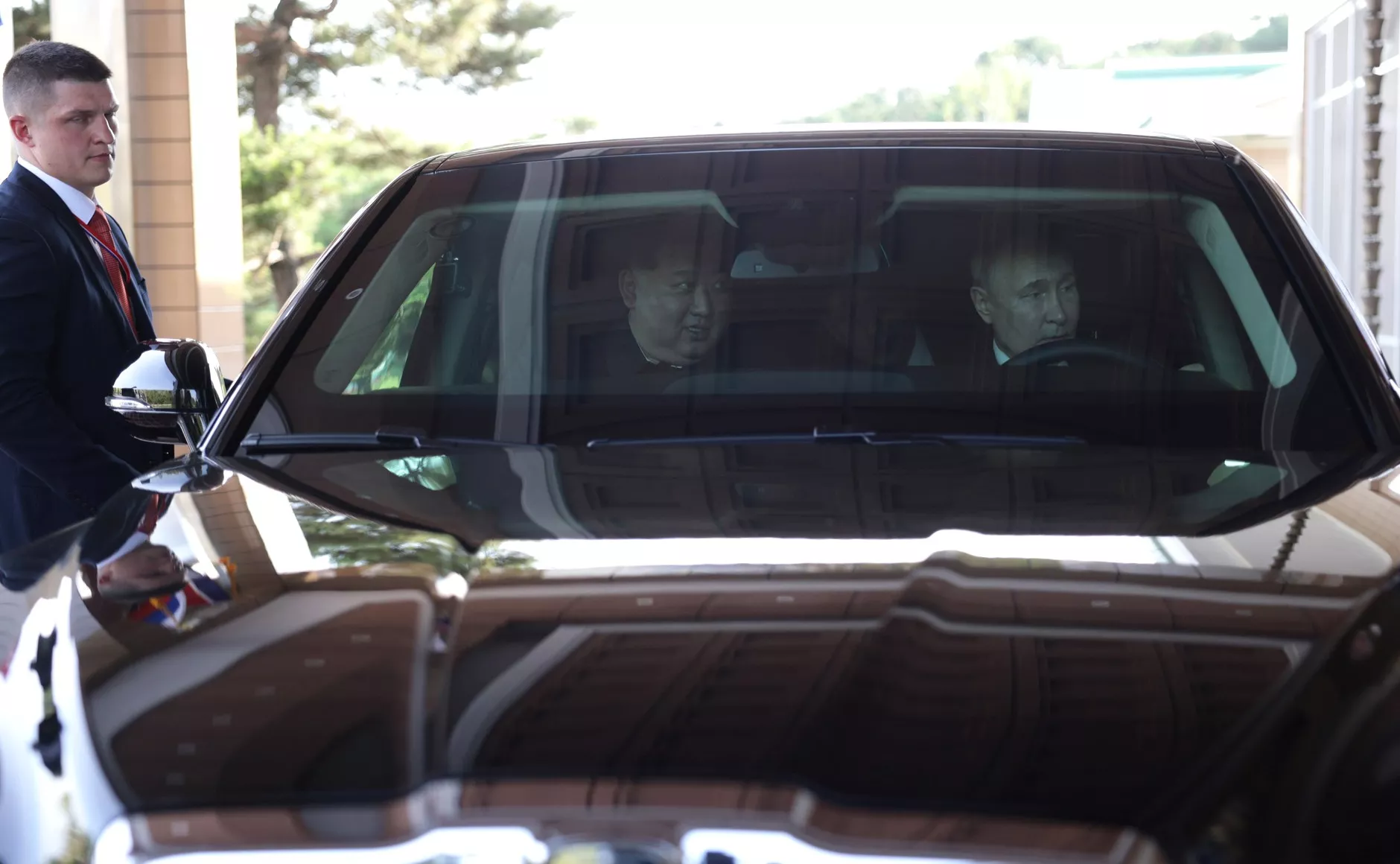
Putin brought a large delegation, including the Minister of Foreign Affairs, the First Deputy Prime Minister, the Minister of Defense and his deputy, the Minister of Health, the head of Roscosmos, and the heads of other important state companies.
Before his arrival, Putin published an opinion piece in the newspaper Rodong Sinmun, the organ of the ruling party, thanking his host for "firm support" in Ukraine and promising that Moscow would stand by Pyongyang to defend its interests despite "American pressure, blackmail, and military threats." The two countries will continue to "resolutely oppose Western ambitions to disrupt the establishment of a multipolar world order based on mutual respect for justice," Putin stated, and promised to "develop alternative trade and mutual settlement mechanisms not controlled by the West" and "build an equal and indivisible security architecture in Eurasia."
Signed, agreed, promised
Various agreements were signed, but among them, the defense agreement stands out. Kim Jong Un described the visit as a "new chapter" in the relations between the two states, which it is, considering that documents replacing those from 1961, 2000, and 2001 were signed. The state news agency KCNA assessed that this visit is a "motor for accelerating the construction of a new multipolar world."
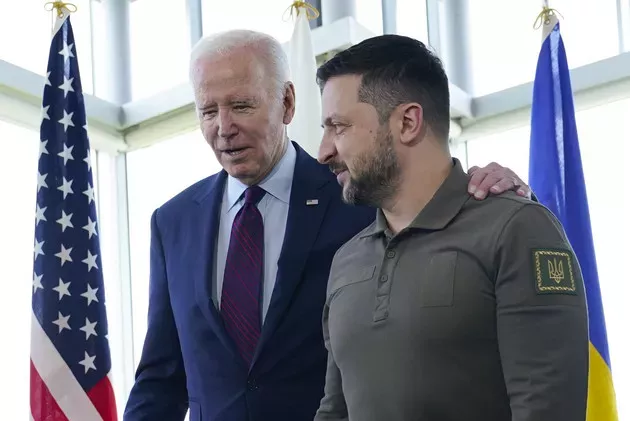
The aforementioned agreement is one of Russia's most important moves in Asia in recent years. "The comprehensive partnership agreement signed today includes, among other things, providing mutual assistance in case of aggression against one of the parties to this agreement," Putin said. The agreement covers "political, trade, investment, cultural spheres, as well as the security sphere," Putin said, calling it a "revolutionary document symbolizing unity." How the agreement will be implemented is unknown, just as the military cooperation agreement between the United States and Ukraine from last week leaves room for interpretation.
However, there is no doubt that the agreement is Moscow's response to the West because of Ukraine, as it leaves open the possibility for Pyongyang to come under the Russian security umbrella, just as Belarus did. Evidence of this is Putin's aforementioned article, which implies that North Korea can develop its economy within the bloc led by Russia. How far Pyongyang is willing to go in security arrangements with Russia remains a dilemma, partly due to the stance of neighboring China, for which North Korea is strategically important. But developing economic ties, without Western influence, is certainly a victory for Pyongyang.
In his statements, Putin left no doubt that he wants to strengthen North Korea, as it is threatened by the US, South Korea, and Japan, and he described their behavior as "hostile" and "confrontational." Therefore, his stay in Pyongyang is, in a way, building a strengthened North Korea that will become an even greater security and other risk for its rivals. Essentially, it is the realization of the warning he recently gave to the West that, by giving Ukraine the green light to use modern weapons on Russian territory, he would arm the enemies of the West.
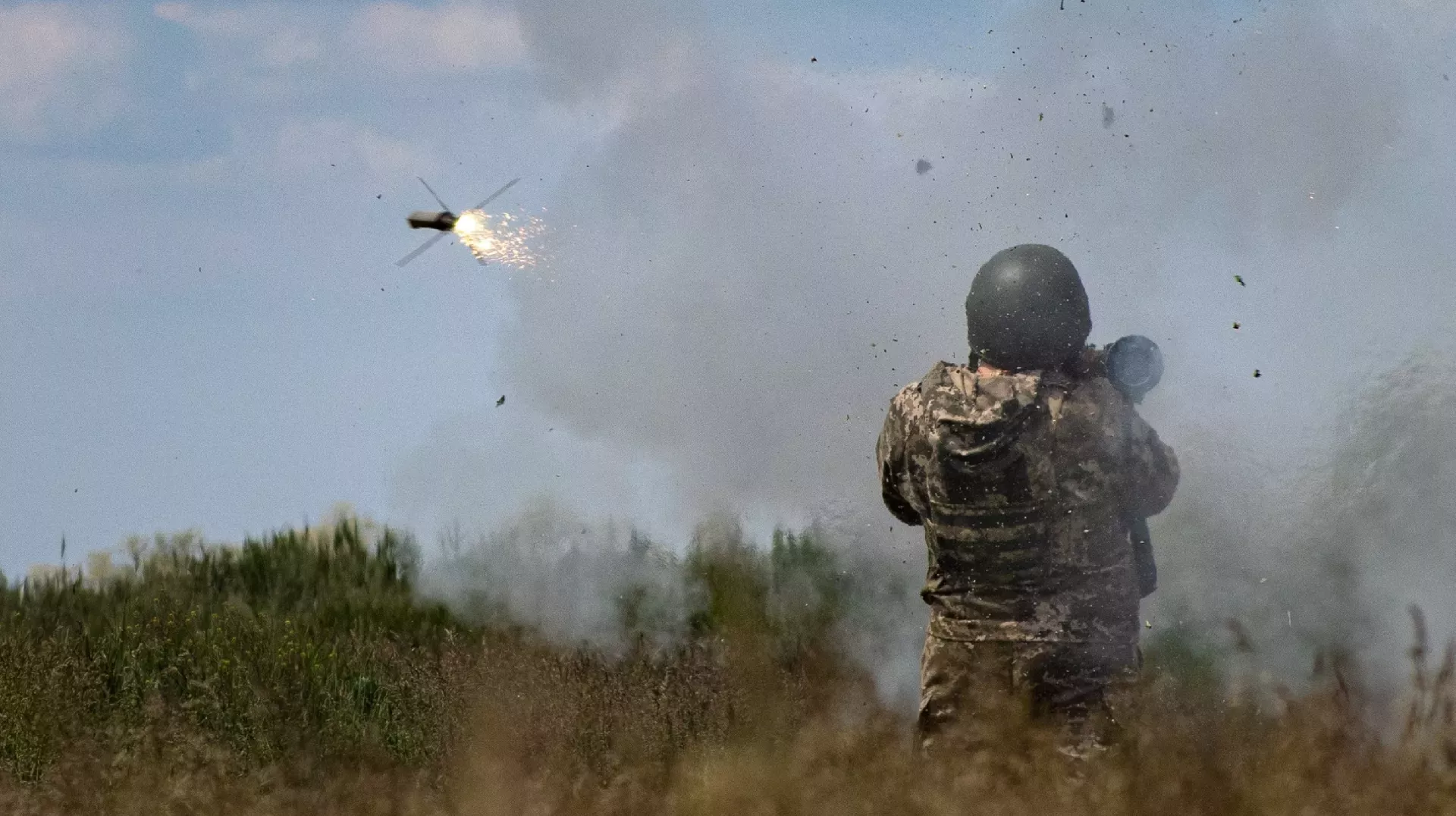
Putin said that the delivery of advanced long-range weapons to Ukraine for attacks on Russia, including F-16 aircraft, is a violation of existing agreements. "In this regard, Russia does not rule out further development of military-technical cooperation with North Korea," Putin said.
In the event of strengthening North Korea, which is a nuclear and military power, it would mean the transfer of modern weapons, systems, and technology. It is little known to the public that Pyongyang has weak air defense, as it lacks the resources to develop it. Russian assistance in this segment could disrupt the air superiority held by the US, South Korea, or Japan.
In recent months, Kim Jong Un has repeatedly told the army and the people to prepare for war with the United States and South Korea, launched ballistic missiles, practiced artillery fire within range of Seoul with its ten million inhabitants, and ordered increased production of all types of weapons.
Since the beginning of Russian aggression against Ukraine, the idea has emerged in public discourse that the war could end according to the "Korean scenario." This idea comes from the West, for example, from Josep Borrell, the head of EU diplomacy, but as we see, the Kremlin also considers it a possible solution, hoping for escalation on the Korean Peninsula, thereby putting pressure on Washington.
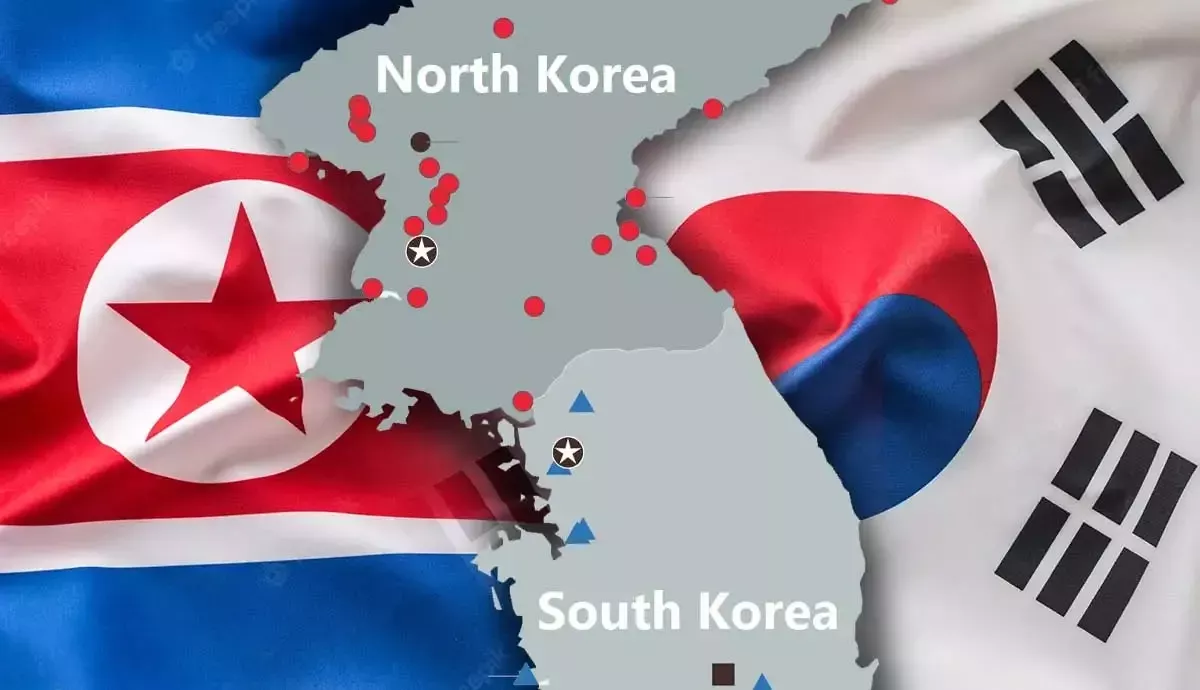
Putin's visit to Pyongyang did not answer some of these questions, but it sent a message to Washington, on which Ukraine's defense depends. The Kremlin wants to break free from the West's grip, while most countries do not want to help Russia due to fear of conflict with the West. North Korea has nothing to lose in this regard, so there is no doubt that it is ready to play this Russian game.
In other words, Kim Jong Un is ready to become part of the European geopolitical calculation in the confrontation between Washington and Moscow, which was Putin's plan last summer. And that the North Korean leader is getting closer to Europe, Putin confirmed by announcing that he will soon visit Moscow. Thus, a strengthened North Korea, at the expense of the war in Ukraine, could threaten Washington's and its allies' positions on China's borders. Although completely isolated, North Korea is a problem that Washington has not found an answer to for decades. Finding that answer, without the involvement of Moscow and Beijing, is even more difficult.
Komentari (0)
Prijavite se za komentiranje
PrijavaJos nema komentara. Budite prvi!
Minuta
Sve →Iz drugih kategorija

High Representative Not Elected: Germans, French and British Sabotaged Americans, New Attempt at End of June

ČOVIĆ WITHOUT MERCY: How Those Who Brought Ademović to Office Created a Political Hell for Him



Sunny Saturday, quite warm



Tragedy in Albanian resort: Two minors drown












