
By Armin Sijamić
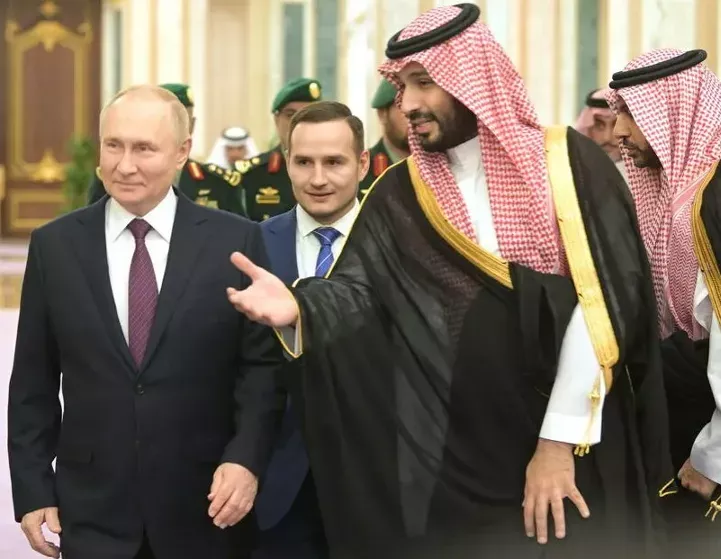
In less than 48 hours, Russian President Vladimir Putin met with three foreign leaders, two of whom hosted him for several hours. This unusual diplomatic tour reflects Putin's intentions and shows that Moscow has something to offer the Middle East.
Putin has not traveled much since the International Criminal Court issued an arrest warrant. Since Russia attacked Ukraine, Putin has been barred from the West. Elsewhere, Putin is welcome, as evidenced by his visits to the United Arab Emirates and Saudi Arabia, his first since 2019. Accompanied by four Su-35 fighter jets, the presidential Il-96 aircraft arrived in Abu Dhabi via Iran on Wednesday, where Putin was met by Sheikh Mohammed bin Zayed Al Nahyan, President of the United Arab Emirates.
In honor of the guest with an international arrest warrant, the host country's aircraft painted the colors of the Russian flag in the sky, and the streets were decorated with Russian flags. On the same day, Putin extended his trip to Riyadh, where Crown Prince Mohammed bin Salman awaited him, showing him exceptional respect. The host was invited to Russia to be the first Saudi official to do so since the visit of his father, Abdulaziz bin Salman, in 2017.
A day later, Iranian President Ebrahim Raisi arrived in Moscow, with whom Putin discussed the relations between the two friendly states, agreeing to strengthen ties in various areas, which, as a rule, hinders Western plans. The guest particularly insisted on accelerating the "North-South" corridor project, which Putin supported, and on the Caucasus issue.
Yesterday in Moscow, Putin also met with Oman's Crown Prince Theyazin bin Haitham, who is also the Minister of Culture, Sports, and Youth of a country that often plays the role of a mediator in the Middle East.
Among Western Allies
Putin's foreign policy advisor, Yuri Ushakov, described Putin's trip as a "strong blow" and a "signal to the international community," speaking about the character and importance of the visit. Bloomberg reached a similar conclusion – the trip "signals Putin's growing confidence to travel outside Russia despite efforts by the United States and Europe to isolate him on the global stage," adding that it is a blow to Washington's policy in Ukraine.
Indeed, this is a first-class diplomatic event involving close US allies and a man they have been trying to isolate and remove from the world political stage for almost two years. The trip showed that the West has failed to do so outside its borders, even in some of its interest zones where governments they have controlled for decades are located.
The series of agreements reached indicates that the two largest Arab economies are seriously counting on Russia, especially in the economic field. Putin thanked bin Zayed for allocating land for the construction of a church in the UAE, which will be used by some of the nearly one million Russian tourists who visited the country last year, and for the establishment of a Russian school in the country. These relations have "reached an unprecedented high level," Putin told his host, who called his guest his "dear friend."
It is devastating for the West that this happened at a time when Russia is under sanctions. The UAE is Russia's largest trading partner in the Arab world, with a trade volume of nine billion dollars in 2022, and this year, from January to September, it increased by 63 percent compared to last year.
Furthermore, UAE investments in Russia outside the oil sector have increased by 103 percent compared to last year, and in February of this year, at an arms fair in that Arab country, Russian companies exhibited and sold products, according to Russian media. In addition, the UAE will join BRICS next year. The achievement of an "unprecedented" level of relations was made possible by Russian companies that were expelled from the West since the beginning of the aggression against Ukraine and found their place in the UAE, developing business ties. Russian capital has entered an important global financial center and achieved success there.
However, the highlight for Putin is the oil deals, which are the primary reason for his trip. Putin's oil and energy coalition The West aimed to bring Moscow to its knees by cutting off energy imports from Russia. That moment is likely a turning point in relations between Russia and a number of Arab states. After cutting Russia off from the European market, US President Joseph Biden asked Mohammed bin Salman to increase oil production in Saudi Arabia and other OPEC+ member states to lower prices. Bin Salman refused and further reduced production, thus filling his coffers and preventing Russia from running out of money. Moreover, according to Western media, Riyadh bought oil from Russia and sold it on the world market.
The COP28 summit is underway in Dubai, where world leaders are discussing the fight against climate change, and one of the proposals is to reduce the use of fossil fuels. The Saudi representative rejected this, which is effectively a continuation of the policy that also rejected Biden. Therefore, the agreement between Saudi Arabia, Russia, and the UAE is important. The first, second, and sixth largest oil exporters in the world are now playing together. Since they clearly do not care about Western sanctions, let's add Iran, fifteenth on that list, to the equation.
Putin's delegation spoke about the importance of the business. Foreign Minister Sergey Lavrov, First Deputy Prime Minister Andrey Belousov, Deputy Prime Minister and Minister of Industry and Trade Denis Manturov, Deputy Prime Minister Alexander Novak, Head of the Bank of Russia Elvira Nabiullina, Director General of Roscosmos, CEOs of Rosatom and the Russian Direct Investment Fund were part of the delegation, reported TASS agency.
Vedomosti reported that there was also an unannounced part of the delegation, consisting of Chechen leader Ramzan Kadyrov, the Minister of Economic Development, the head of Roshydromet, the Deputy Minister of Natural Resources, the Minister of Finance... a total of 35 people.
Thus, Putin offered his Arab partners Russian capabilities in space exploration, nuclear energy, mutual investments, and the services of the Russian central bank, which, under Nabiullina's leadership, is circumventing Western sanctions. Indicatively, there were no representatives of Russian arms manufacturers, although Saudi Arabia had previously expressed interest in some Russian arsenal.
In a joint statement after the meeting in Riyadh, it was stated that the two sides agreed on the importance of expanding cooperation in the fields of oil and gas, petrochemicals, and working to expand cooperation in the civil use of nuclear energy, electricity, and renewable energy sources. They announced that OPEC+ member states must work to reduce oil production in the "interest of the world economy," although they had already agreed on a reduction on November 30.
Against Western Interests
Putin's attempt to get closer to the Arabs is multi-layered, meaning it depends on several factors. Arab ties with the West are strong, and it will take time for Russia to reach that level. However, Putin is also playing on the emotions of the population, as shown by his policy in the Israel-Hamas war.
With Mohammed bin Salman, Putin agreed that "comprehensive and lasting peace" is needed in Gaza and that "military operations in the Palestinian territories must stop," meaning that a Palestinian state needs to be formed within the 1967 borders with East Jerusalem as its capital. This almost worn-out phrase, which world powers have been repeating for decades, appeals to the emotions of Muslims who support Palestine, and thus against Washington, which strongly supports Israel.
But Putin is increasingly persistent in the Middle East, wanting to win over a number of states there, to end his diplomatic isolation, and to thwart the West where he can, even among close US allies.
The discussion with bin Salman about the "North-South" corridor confirms that Putin is offering Arab leaders further integration, without interfering in their internal affairs, so during such discussions, human rights, democracy, or elections are not on the agenda as the West insists.
This could lead to the creation of a kind of coalition of rulers who control important resources and see the world completely differently from the West.
"Nothing can prevent the development of our friendly relations," Putin said, adding that this has also happened due to the "wise policy" of the Crown Prince's father.
"In the past seven years, relations have reached a quality never seen before," he concluded.
Komentari (0)
Prijavite se za komentiranje
PrijavaJos nema komentara. Budite prvi!
Minuta
Sve →Iz drugih kategorija

High Representative Not Elected: Germans, French and British Against Americans, New Attempt at End of June

ČOVIĆ WITHOUT MERCY: How Those Who Brought Ademović to Office Created a Political Hell for Him



Sunny Saturday, quite warm



Tragedy in Albanian resort: Two minors drown












